Owners raise this on detailing forums. One said the roof rails went blotchy after a touchless wash, and a detailer then called the whole car acid-etched. Another had eggs mark a metallic panel and was offered wet sanding plus a touch-up blend, and asked whether a respray was the honest answer.
What etching is, and what it isn’t
Etching is damage inside the clear coat, not dirt sitting on it. A detailing retailer’s FAQ says bird droppings are often acidic and can etch the clear coat within minutes. A Midwest detailer’s guide says hard-water spots left too long start to etch. At that point the damage is below the surface, not a deposit on top, and in severe cases it may need a repaint to fully repair.
Discolored trim is a different problem. One carmaker’s support page says cleaners with a pH below 3.5 or above 11.5 can discolor anodized aluminum parts such as the roof rails and the trim around the side windows. It also says never to use metal polish on them, because that can destroy the surface treatment. That’s a trim finish, not paint. Ask the dealer what a replacement part costs, and ask the wash which products it used.
Checks to do before you agree
- Wash it first. The same detailing FAQ suggests a water spot remover for light etchings that are hard to see or feel. One maker’s 16 oz water spot remover gel is $19.99 and is labeled for use on paint and glass after washing.
- Feel it. A San Jose mobile detailer says to run a fingernail across a spot. A dip or crater means it’s etched into the clear coat. Rough or raised is usually fixable with polish or compound.
- Count the panels. The same detailer treats only the affected panels, so a hood-only problem is priced as the hood. “All over the car” should show up panel by panel when you walk around it together.
- Ask for a depth reading. A paint-care educator calls a paint thickness gauge a go or no-go tool. He uses it to decide whether to sand, only polish, or leave thin paint alone. Our guide to a paint-depth reading explains the numbers.
Damage, fix and price
| What you find | Realistic fix | Typical price |
|---|---|---|
| Marks that come off after a wash or a spot remover | Deposits, not etching; a spot remover gel | $19.99 for a 16 oz gel (Chemical Guys) |
| Etching you can feel on a few panels | Machine compounding and polishing, affected panels only | $125 to $315 (Norbay Mobile Detailing, San Jose) |
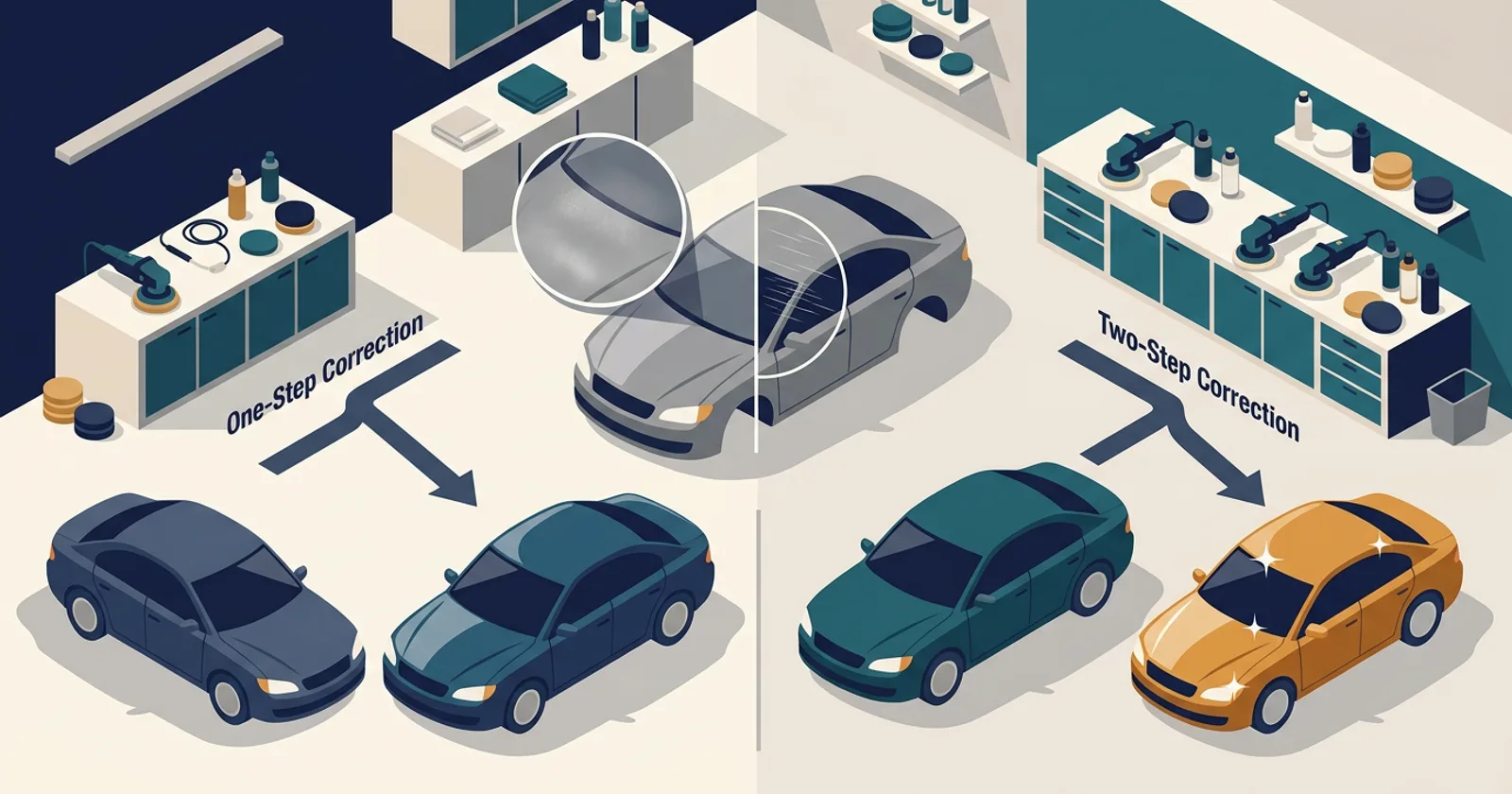
| Light etching across most of the car | A full one-step machine correction | From $325 for a sedan (Norbay) |
| Deep craters from months of exposure | Wet sanding, then multi-step polishing, if the depth reading allows | Quoted after photos (Norbay) |
| Etched through the clear, or paint too thin to sand | Repaint the panel | $400 to $800 per panel in Phoenix (Brad’s Deer Valley Collision) |
| Blotchy anodized roof rails or window trim | Not a paint fix; a dealer parts quote | Ask the dealer |
The middle column is our reading of the sources below. How we research: methodology.
When a repaint is the honest answer
The paint-care educator says a stain on top can often be buffed off. When the paint itself is altered, the only way to make it disappear is to level it, often by wet or dry sanding. That only works if there’s clear coat to spare. When the depth reading says the paint is too thin, a panel repaint is the honest quote. A Phoenix body shop puts one repainted door or fender at $400 to $800, with blending into the panels next to it.
For a few small spots, rock chip repair costs compares touch-up and repaint options. If the car is coated, see water spots on a ceramic-coated car. If a paid fix leaves marks behind, see holograms after a paid polish and getting a bad detail fixed.
Sources
Based on 7 sources · How we price
- Detailed Image, FAQ: removing spots or etchings caused by bird droppings: detailedimage.com/FAQ/Detailing/What-do-you-recommend-to-remove-spots-or-etchings-caused-by-bird-droppings
- Revive Auto Detailing, Water spots: reviveautodetailing.com/water-spots
- Volvo Cars US Support, V90 cleaning exterior plastic, rubber and trim components: volvocars.com/us/support/car/v90/article/6ddcf2aa8e24fe91c0a8015170bdb24b
- Chemical Guys, Heavy Duty Water Spot Remover: chemicalguys.com/products/heavy-duty-water-spot-remover
- Norbay Mobile Detailing, Water spot removal San Jose: norbaymobile.com/exterior-car-detailing-san-jose/water-spot-removal
- Dr. Beasley’s (Mike Phillips), How to remove bird dropping etching from car paint: drbeasleys.com/blog/2024/09/03/how-to-remove-bird-dropping-etching-from-car-paint
- Brad’s Deer Valley Collision, Car paint job cost in Phoenix, AZ: bradsdeervalleycollision.com/blog/car-paint-job-cost-in-phoenix-az-budget-guide-for-auto-body-repairs