What detailers charge
Golf cart detailing is usually priced flat per cart. The spread below is wide because packages differ: $45 buys a wash and wheel clean, while $100-plus adds wax, seat conditioning and the roof.
| Detailer (location) | Price | What’s included or noted |
|---|---|---|
| Pinehurst Mobile Detailing (Moore County, NC) | $45 basic; $75 supreme | Basic: wash, dry, compartments, tires and rims. Supreme adds tire shine, battery compartment cleaning, premium wax and dressing |
| Revive Auto Detailing (Washington, MO) | $50 to $100 | Regular-size cart; the shop does not detail the engine or battery compartment |
| Shine On Site (Buffalo, MN) | $75 regular size; $85 to $120 by size | Wash, roof degreasing, seats, wheels and wax |
| Platinum Finish Detailing (Fort Myers, FL) | $100 | Final price varies with size, condition and location |
| Average Joe’s Mobile Details (Spring Hill, FL) | $100 | About 3 hours at the customer’s place |
| Carolina Mobile Car Wash (Summerville, SC) | From $125 | Add-on charge for extra dirty carts or mold |
| Detail.com (national network) | $159 | Exterior wash, hand wax, leather and vinyl conditioning, wheels and tires |
| Best Mobile Car Wash (Tampa Bay, FL) | From $199.99 | Golf courses and neighborhoods |
For comparison, see detailing cost by vehicle size for car prices. Outside a detailer’s usual area, a travel fee can add to any of these numbers.
What moves the price:
- Size. One Minnesota detailer lists $75 for a regular cart and $85 to $120 depending on size. One Florida detailer says its $100 price varies with size, condition and location.
- Condition. One South Carolina provider lists an add-on for extra-dirty carts, mold or build-up.
- The battery compartment. Shops split on this. One North Carolina detailer includes it in its $75 package. One Missouri shop stays out of it for safety and liability reasons, noting that many carts are electric and cannot be exposed to water there.
Why manuals say no pressure washer
Read the owner’s manual before anyone brings out a wand. We read three, and they don’t all agree.
- A 2009 to 2011 manual from one maker: the bodies are hand-washable, a garden hose at normal residential pressure is adequate, and the maker does not recommend any pressure washing or steam cleaning. Its reason: moisture entering electrical components can cause water damage and component failure.
- A lithium and lead-acid cart manual: it says not to use any pressure washing or steam cleaning equipment, to avoid exposing electrical components to moisture.
- A third maker (three electric series): the one that allows it, with a cap. Don’t exceed 700 psi on the exterior, and don’t use abrasive or reactive solvents on plastic parts.
That cap is low. One popular consumer electric pressure washer is sold as a 2030 PSI model, nearly three times the limit. It’s the same idea as washing a motorcycle without soaking the electrics.
Rules that follow from the manuals:
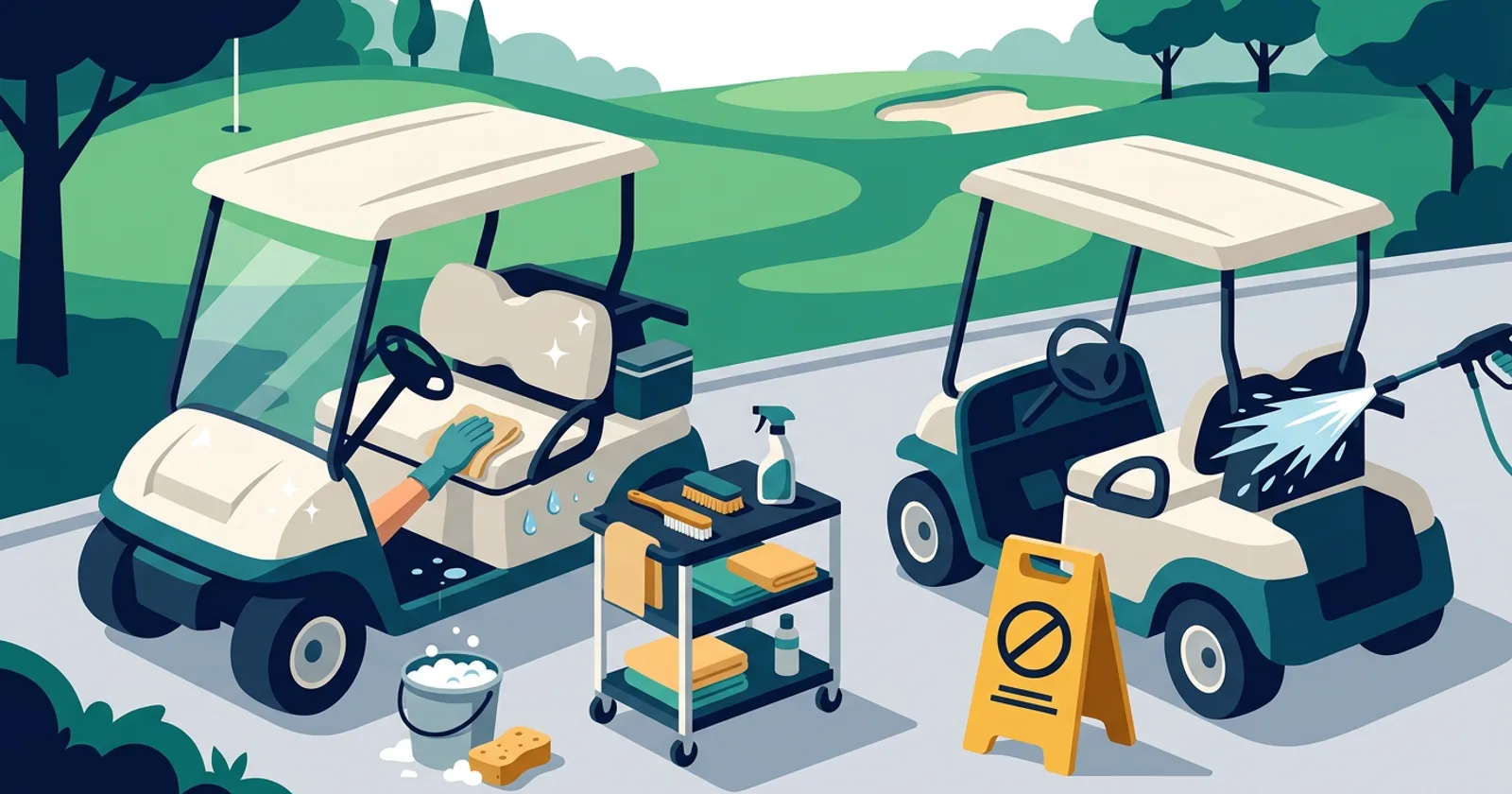
- Hose, sponge and soft cloth on the body, with automotive cleaners.
- Keep spray away from electrical components.
- Rinse the underbody with clear water every wash. One manual says some fertilizers and dust-control agents contain corrosive materials that collect there.
If a detailer plans to pressure wash the whole cart, ask them to hose the body instead.
Seats, roof and plastics
Cart seats are vinyl, and the makers keep it simple. One manual says a 10% liquid soap and warm water solution on a soft cloth, with a soft bristle brush for embedded dirt. Another says mild soap and water for seats, plastic parts and rubber trim, wiped down with a damp cloth, plus a vinyl and rubber cleaner for oil, tar or asphalt.
Two cautions from the first manual save paint. Leveling or rubbing compounds will permanently dull the finish. And wax discolors the black plastic underbody, the front bumper and the textured “NO STEP” area, so keep wax on the painted panels. For what the same seat and plastic steps cost on a car, see interior detail price tiers.
Lead-acid batteries
One manual says to wash lead-acid battery tops and terminals with 1 cup of baking soda per gallon of water, then rinse. That is battery maintenance, and as the table shows, some detailers stay out of the compartment, so ask who handles it. Our note on a dead battery after a detail covers the car version of that conversation.
Where carts are daily drivers
In The Villages, Florida, the district government describes a community of more than 150,000 residents, with multi-modal paths intended for bicycles, golf cars and pedestrians, and over 100 recreation centers easily accessible by golf car. On public roads, Florida law (section 316.212) allows a golf cart only on a county road or municipal street that the county or city has designated for golf carts, with signs posted.
How we research prices: methodology.
Sources
Based on 14 sources · How we price
- Pinehurst Mobile Detailing, Golf Carts (Moore County, NC): pinehurstmobiledetailing.com/services/golf-carts
- Revive Auto Detailing & Paint Correction, Golf Cart Detailing (Washington, MO): reviveautodetailing.com/golf-cart-detailing
- Shine On Site Auto Detailing, Golf Cart / ATV Detailing (Buffalo, MN): shineonsitedetailing.com/golf-cart-detailing and shineonsitedetailing.com/locations
- Platinum Finish Detailing, Golf Cart Detailing (Fort Myers, FL): platinumfinishdetailing.com/golf-cart-detailing.php
- Average Joe’s Mobile Details, Golf Cart Detailing (Spring Hill, FL): averagejoesmobiledetails.com/service-page/golf-cart-detailing
- Carolina Mobile Car Wash, Golf Cart Detailing (Summerville, SC): carolinamobilecarwash.com/book-now/golf-cart-detailing
- Detail.com, Golf Cart Detailing Package: detail.com/packages/golf-cart-detailing
- Best Mobile Car Wash, Golf Cart Detailing Tampa Bay: bestmobilecarwash.com/golf-cart-detailing
- Club Car, 2009-2011 Precedent Golf Car Owner’s Manual (PDF): jerrypate.com/wp-content/uploads/2018/01/Precedent_Owners-Manual_2009-2011.pdf
- MD Carts, Owner’s Manual for Rookie, Legend & Pro Series (PDF): golfcarts.com/wp-content/uploads/sites/4/2022/04/MD-Cart-Manual-v21072.pdf
- LION Golf Car Owner’s Manual, lithium/lead-acid (PDF): cdn.hibuwebsites.com/6b86369b5c0c461d9c656792e41f3ae2/files/uploaded/big-time-carts-lion-golf-cart-manual.pdf
- Sun Joe, SPX3000 Electric Pressure Washer product page: shopjoe.com/products/sun-joe-spx3000-14-5-amp-electric-pressure-washer
- The Villages Community Development Districts, Getting Around: districtgov.org/how-to/getting-around
- Florida Statutes, section 316.212, Operation of golf carts on certain roadways: leg.state.fl.us/statutes/index.cfm?App_mode=Display_Statute&URL=0300-0399/0316/Sections/0316.212.html