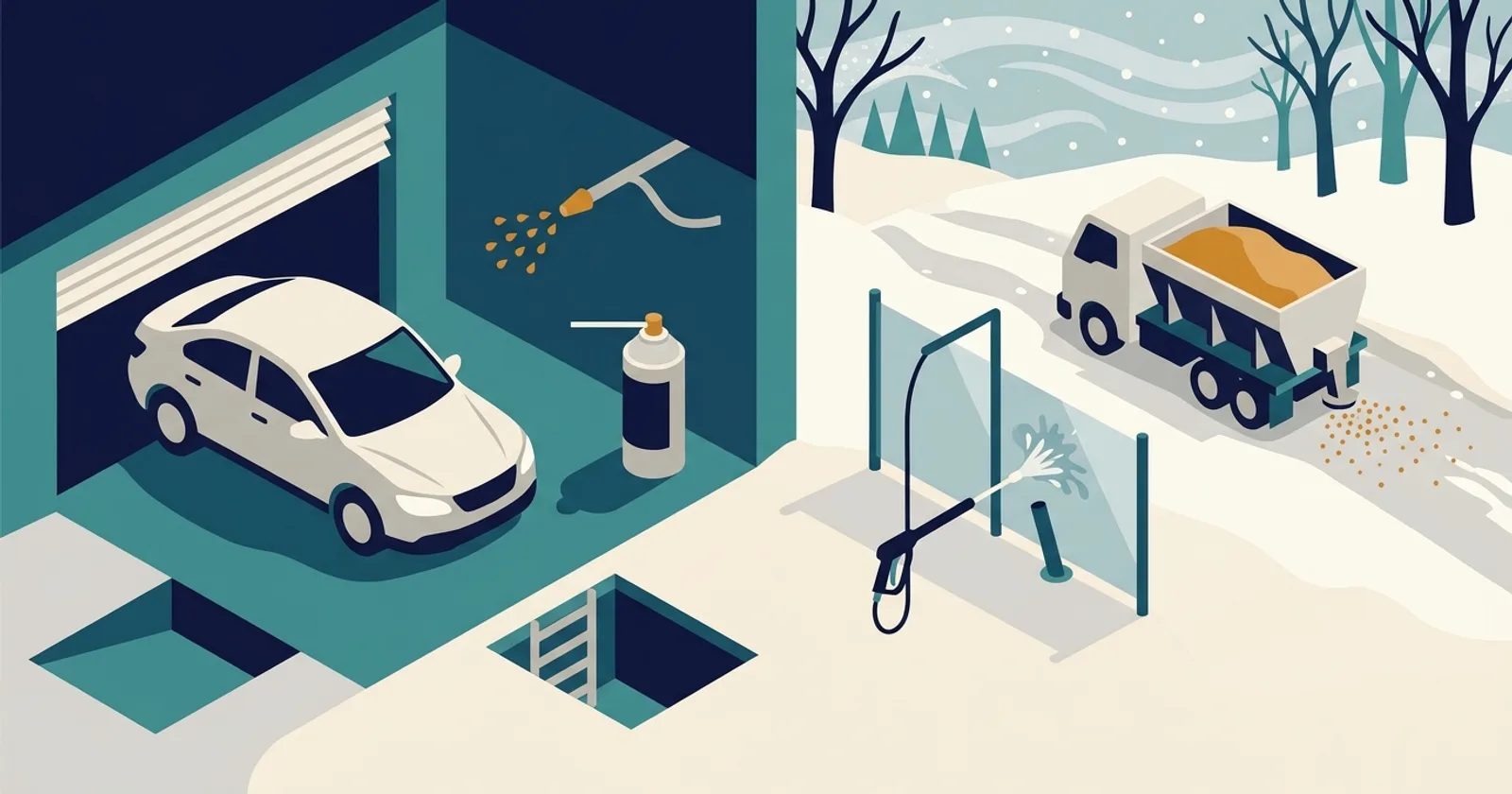
Here’s how to decide before the first storm, using what the warranty booklets say and what shops charge.
What the factory warranty covers
Every new car comes with corrosion coverage, but it’s narrower than most buyers think. It pays for rust-through, meaning a hole in a body panel caused by a factory defect. Surface rust, chips and salt damage are mostly your problem.
| Carmaker (2026 booklet) | Rust-through (perforation) | Surface rust | Salt damage |
|---|---|---|---|
| Toyota | 60 months, regardless of mileage | No separate term listed | Excluded (“salt” among environmental conditions) |
| Ford | 5 years, unlimited miles | Not covered when it comes from use or the elements | Road salt listed as use and environment damage, not covered |
| Chevrolet | 6 years or 100,000 miles | 3 years or 36,000 miles | Salt used on roads excluded |
One carmaker’s booklet goes further. It says adding rust-inhibiting materials is “neither necessary nor required.” It warns that after-manufacture rustproofing may reduce the car’s built-in corrosion resistance. Repairs for damage it causes are not covered. Your car’s booklet may differ, so read its corrosion section before you buy any add-on. This is not legal advice.
Three options, with real prices
These prices come from shops’ own published price pages. They’re examples, not quotes for your car.
| Option | Example published price | How often | Rough cost per year |
|---|---|---|---|
| Skip it: wash often, use the factory warranty | $0 extra | n/a | Your wash budget |
| Yearly oil spray (Stop & Go Oil, Brattleboro, VT) | $129.99 sedan, $209.99 full-size truck or SUV | Each season | $130 to $210 |
| Yearly oil spray (Northwoods Undercoating, Marinette, WI) | $300 small car | Yearly | $300 |
| Full first coat, then re-coats (Steel City Oil Undercoating, PA) | $695 first full package, $150 yearly re-application | Yearly | $695 the first year, then $150 |
| Lanolin wool-wax coat (UnderCover UnderCoaters, several states) | $439 car or small SUV | Every 2 to 3 years | About $146 to $220 |
| Dealer undercoating | Ask for a written price | Varies | Varies |
Over five years, a $129.99 yearly sedan spray adds up to about $650. At $300 a year it’s $1,500. Compare that with how long you’ll keep the car. A short lease gets little from it.
Ask before dealer undercoating
Undercoating offered in the finance office is an add-on. The FTC’s car-buying advice says add-ons are not free, and it’s OK to say no and to ask the price. It also says to ask about any limits or conditions, because add-ons might not cover what you expect.
Before you agree, get in writing:
- the product name and who applies it
- the price, and its cost over the life of the loan if you finance it
- whether it has its own warranty, and what that requires
- how it fits with the carmaker’s corrosion warranty
It’s the same drill as a dealer ceramic coating package. While you’re at the dealer, see how to get swirl-free paint on delivery day.
What a yearly oil spray buys
Oil sprays are meant to stay wet. One Wisconsin shop says its oil does not dry. It stays pliable and migrates into small places to lock out moisture. Its basic package fogs the frame rails, rockers and doors. That’s also the downside. One Pennsylvania shop recommends a re-coat every 12 months. A lanolin installer says thinner materials may need reapplying every 8 to 10 months.
A few things owners ask about:
- Drips and overspray. A commenter on a community thread said oil from one coated vehicle crept onto the paint for weeks. Planning a ceramic coating? Schedule the undercoat first, and have the paint cleaned before coating.
- Washing afterward. Owners on a community thread say high-pressure undercarriage washes can strip the film. One said their installer advised avoiding them. Ask yours.
- New versus older cars. One lanolin installer says it sometimes sees surface rust on new cars from the trip between factory and dealer. That’s the shop’s claim, not a study. Still, it’s a reason to look underneath before you decide.
Washing instead
If you skip the spray, washing is your rust plan. A national motor club advises washing often in winter, paying attention to the undercarriage. It lists brake lines, fuel tanks and floorboards among parts at risk. It warns that liquid de-icers can seep into cracks and crevices.
That matters in places like Syracuse, New York. The city averages 127.8 inches of snow a year. On about 47 days the high stays at or below 32°F, per NOAA’s 1991–2020 normals. New York’s Thruway Authority says it uses about 180,000 tons of rock salt in an average year, plus brine and other liquid de-icers.
No hose in winter? See four ways to wash when the spigot is off. Salt gets inside too. Here’s how to lift salt rings from carpet and mats.
The bottom line
- Keeping the car many years in a salt state? A yearly oil spray from an independent shop is a reasonable add, if the yearly cost suits you.
- Leasing or trading in soon? Skip it and wash often.
- Dealer undercoating? Ask for the product, price and terms in writing, and compare with your warranty booklet.
How we got these numbers: methodology.
Sources
Based on 14 sources · How we price
Checked 2026-10-09. How we check facts: methodology.
- Toyota, 2026 Warranty & Maintenance Guide (Tacoma): assets.sia.toyota.com/publications/en/omms-s/T-MMS-26Tacoma/pdf/T-MMS-26Tacoma.pdf
- Ford, 2026 Model Year Ford Warranty Guide (Internet Archive, Sept. 2026): web.archive.org/web/20260929212725/https://www.fordservicecontent.com/Ford_Content/Catalog/owner_information/26MY_US_Ford_WTY_V4..pdf
- Chevrolet, 2026 Limited Warranty and Owner Assistance Information: contentdelivery.ext.gm.com/content/dam/cope/en_us/public/pdf_assets/active/warranty_manuals_browse/2026/chevrolet/26_CHEV_WM_en_US_U_19680728B_2025DEC12_2P.pdf
- FTC, Financing or Leasing a Car (Internet Archive, Sept. 2026): web.archive.org/web/20260921220719/https://consumer.ftc.gov/articles/financing-or-leasing-car
- Stop & Go Oil, NH Oil Undercoating pricing: stopngooil.com/nhou
- Northwoods Undercoating LLC: northwoodsundercoatingllc.com
- Steel City Oil Undercoating, pricing: steelcityundercoating.com/pricing
- UnderCover UnderCoaters, pricing and FAQ: undercoverundercoaters.com
- AAA East Central, How to Minimize Winter Vehicle Damage: news.eastcentral.aaa.com/news/releases-20170420-6059251
- NOAA NCEI, U.S. Climate Normals 1991–2020, annual, Syracuse NY (USW00014771): ncei.noaa.gov/access/services/data/v1?dataset=normals-annualseasonal-1991-2020&stations=USW00014771&format=csv&dataTypes=ANN-SNOW-NORMAL,ANN-TMAX-AVGNDS-LSTH032&includeStationName=true
- NOAA NCEI, Normals readme (variable definitions): ncei.noaa.gov/data/normals-annualseasonal/1991-2020/doc/Readme_By-Variable_By-Station_Normals_Files.txt
- New York State Thruway Authority, Winter Maintenance Program (Internet Archive, May 2025): web.archive.org/web/20250524123653/https://www.thruway.ny.gov/travelers/safety/wintermaint.html
- Community discussion: washing the underside after an oil undercoat: reddit.com/r/AutoDetailing/comments/1poe1i4
- Community discussion: oil undercoat before or after a ceramic coating: reddit.com/r/AutoDetailing/comments/1miq958