Those come from four providers in two metros, so treat them as a sample, not a national average. To set your own prices, work out your cost floor and check what local competitors publish. Then build packages with size and condition surcharges. See how we get these numbers.
Step 1. Find your cost floor
A price below your cost floor loses money on every job, however busy you are. The floor has four parts.
- Labor. If you pay an employee, the wage is a real cost. May 2023 BLS data covers “Cleaners of Vehicles and Equipment” (53-7061). The national median wage was $16.42 an hour, and the 90th percentile was $22.33. BLS has a newer May 2025 table that we could not read, so check current figures. One Charlotte provider lists “The Reset” at 3 to 4 hours. At the 2023 median, four hours of employee labor is about $65.68 ($16.42 x 4). That’s before payroll costs, products or travel.
- Materials per job. From your own receipts, divide each product’s price by the jobs it covers. Add them up. Competitors’ menus cannot tell you this number.
- Drive time, fuel and admin. A mobile job includes the drive, setup, teardown and unpaid time on quotes and invoices. One San Diego provider says travel is “included at no extra charge” across the county. Another offers it free within 30 miles. Free travel only works if the driving cost is already inside your package prices. For the customer side of surprise fees, see the steps to the best result when booking a detail.
- Overhead and equipment wear. Add insurance, software, phone, water and power, and replacement pads and hoses. Divide by the jobs you expect per month. Fewer jobs means higher overhead per job.
Add the four lines for your cost floor. Then price above it by enough to cover slow weeks, taxes and your own pay. Ask an accountant about taxes. Our startup cost breakdown shows an equipment line. Slow winter weeks are covered in our winter detailing guide. Your business model changes the floor too, as the mobile-or-shop comparison shows.
Step 2. Check local prices
Here are published sedan prices from four providers, read from their own pages on 2026-10-08. Most say “from” or “starting at”, so condition can raise the final price.
| Provider (area) | Exterior wash | Mid-level full detail | Top full detail |
|---|---|---|---|
| Provider A (San Diego) | $159 (Wash & Wax) | $239 (Standard), $349 (Complete) | $569 (Luxury) |
| Provider B (San Diego) | $99 (Wash & Wax) | $349 (Complete) | $499 (Premium) |
| Provider C (Charlotte) | $100 (Express Wash) | from $185 (The Reset), from $250 (The Like New) | not listed |
| Provider D (Charlotte) | not listed | from $269 (Reset), from $349 (Deluxe) | not listed |
What the menus show:
- Exterior washes sit between $99 and $159.
- Entry-level full details start between $185 and $269.
- The $349 price point appears on three of the four menus.
- Top tiers run $499 to $569.
These are asking prices on a handful of menus, not what customers pay. Search your own city and keep only real mobile businesses that publish prices. Record the date. For how customers see the same price lists, see our cost by vehicle size guide. For the second visit, see maintenance wash pricing.
Step 3. Build your package menu
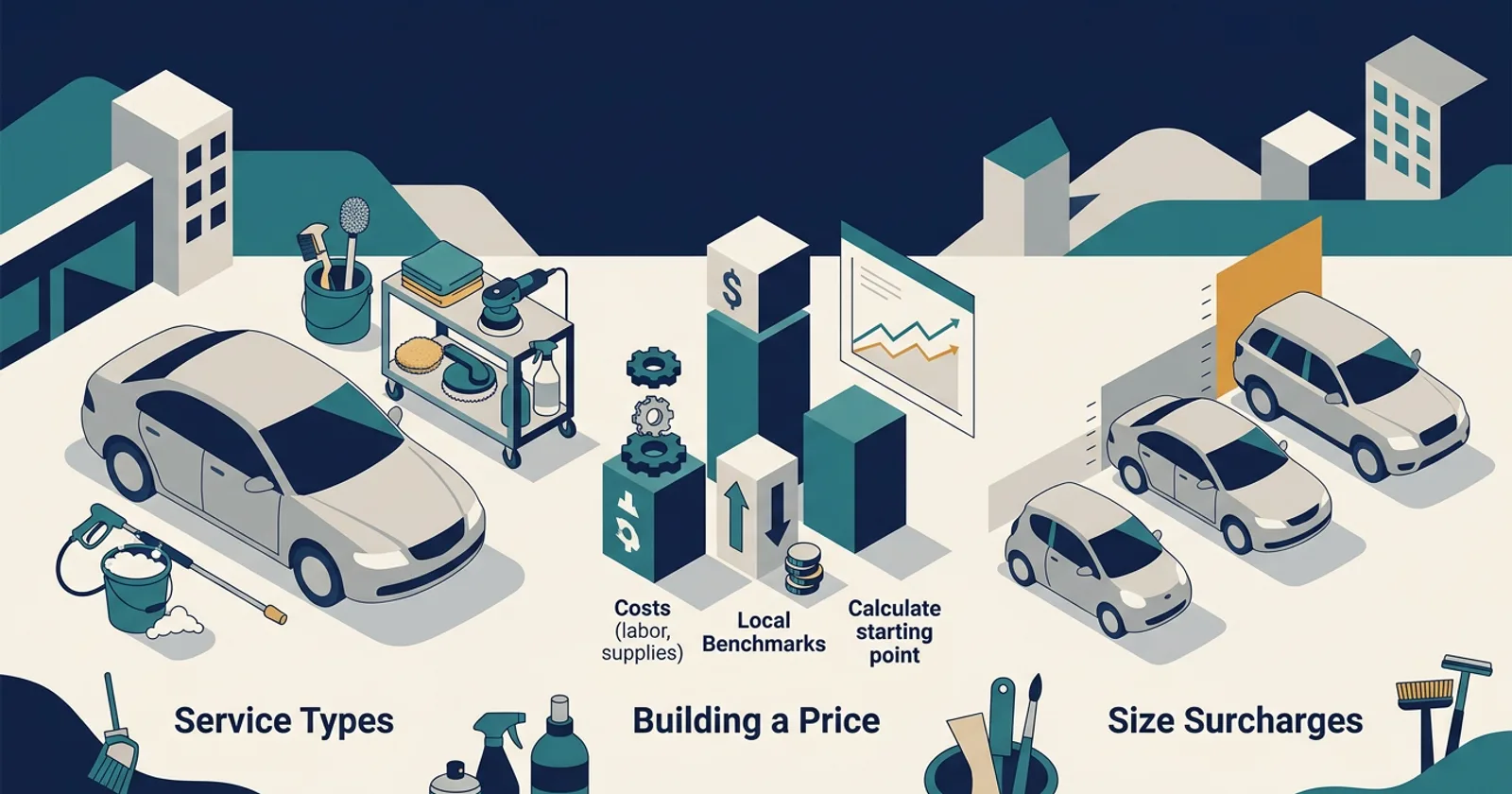
Tiers. For coating work, see what shops publish in our ceramic coating price guide. The providers above use similar ladders. There’s a wash, an interior detail tier or mid-level detail, a complete detail, and sometimes a premium tier. List what each includes so a buyer can compare without calling you.
Vehicle-size surcharges. Published ladders differ a lot. Provider A adds $10 for a 2-row SUV on its $349 Complete detail. Provider B adds $20 for an SUV or hatchback ($369) and $40 for a truck, 7-seater or minivan ($389). Provider C’s ladder:
- sedan: +$0
- small SUV: +$25
- mid-size SUV: +$50
- big SUV, van or truck: +$75
- big truck: +$95
Charge for the extra time and product a larger vehicle takes. A flat ladder is easy to quote over the phone.
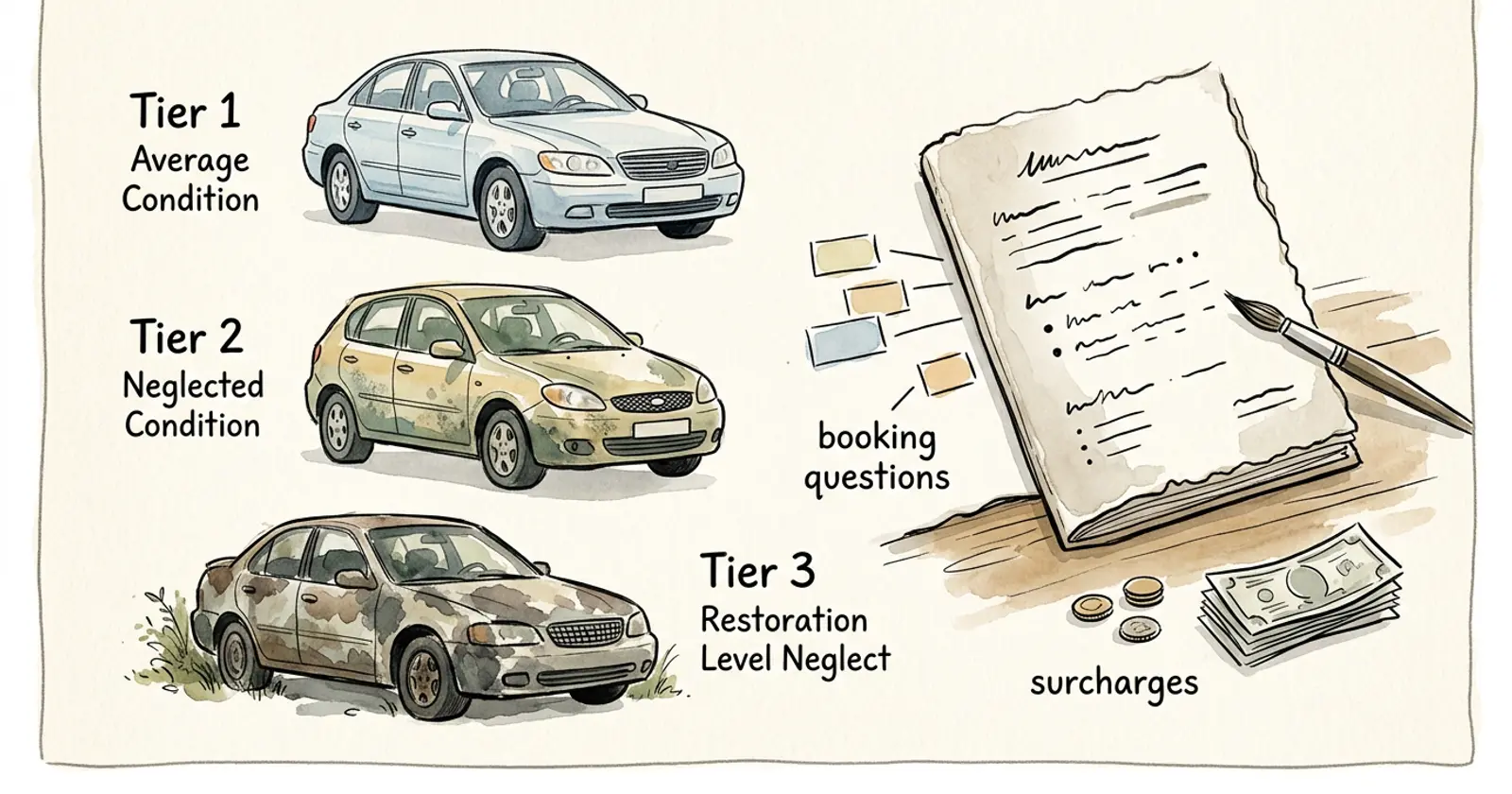
Condition surcharges. Menus start at a base price and add for hard jobs. Provider A charges $40 per 30 minutes for pet hair removal. Tying the surcharge to time makes it easy to explain. You are charging for the extra hours.
Travel. Two San Diego providers advertise free travel inside a defined area. Neither Charlotte menu we checked lists a detailing travel fee. If you include travel, define the area, such as a county or a radius of 30 miles. Price the drive time into your packages. If you charge for it, say so on the menu.
Deposits and card fees. Provider A requires a 10% non-refundable deposit and adds a 4% card fee. Provider C takes a $50 deposit that goes toward the total. It’s refundable with at least 24 hours’ notice. Decide what a no-show costs you and pick a policy that covers it. Put it in writing on your booking page. Customers vetting you, as in our reliable detailer checklist, will look for this.
A worked labor example
Take a mid-level full detail that one provider says takes 3 to 4 hours. At 4 hours and the May 2023 median wage of $16.42, the labor line is $65.68. Add your materials, drive and admin time, and per-job overhead. Then compare the total with the local menus. A floor close to or above the local range means your costs or positioning need a second look. A floor far below it means you may have room to charge more. Once your floor moves, raising prices without losing regulars covers how to tell them.
Gear that drives the floor: dual-action polisher for paint correction, portable pressure washer for mobile detailing and wet/dry shop vacuum with crevice tools.
Sources
Based on 5 sources · How we price
Prices were read from each provider’s own page on 2026-10-08. Wage data is from the U.S. Bureau of Labor Statistics.
- Provider A (San Diego): dennisautodetails.com/featured/car-detailing-prices-san-diego
- Provider B (San Diego): fresh-layer.com
- Provider C (Charlotte): sullyautocare.com
- Provider D (Charlotte): wedetailnc.com/services.html
- U.S. Bureau of Labor Statistics, OEWS, Cleaners of Vehicles and Equipment (May 2023): bls.gov/oes/2023/may/oes537061.htm