What owners and detailers keep asking
In one large detailing community, an owner described doing a coach in stages: wash, decontaminate, clay, two-step correction and a spray coating, one section whenever they had the energy. One member asked the practical question: how do you reach the high panels?
In a second thread, a first-time polisher used a rotary buffer and compound on an RV and was left with what looked like residue that a pressure wash didn’t remove. One reply noted RVs are often gel coat, not clear-coated paint, and suggested working small spots and removing residue as you go. Others thought the haze was micro-marring in the gel coat that needed more polishing.
Step 1: Know what each surface is
A typical coach has a roof membrane (EPDM rubber, TPO, or fiberglass), fiberglass or painted sidewalls, and plastic or rubber trim. Check your owner’s manual or the roof paperwork before buying any product.
- Fiberglass (gel coat) sides. One composite-panel maker says sunlight, heat and moist air oxidize gel coat over time, making it cloudy. It recommends a wash at least monthly with a mild liquid detergent. Avoid abrasive, highly alkaline or ammonia cleaners. It says caustic cleaners can cause discoloration and loss of gloss.
- Painted sides. One RV maker’s manual says to wash a new unit and wait 60 days before waxing, so the paint can cure. It also says not to wax flat-black areas, which can discolor.
Step 2: The roof, carefully
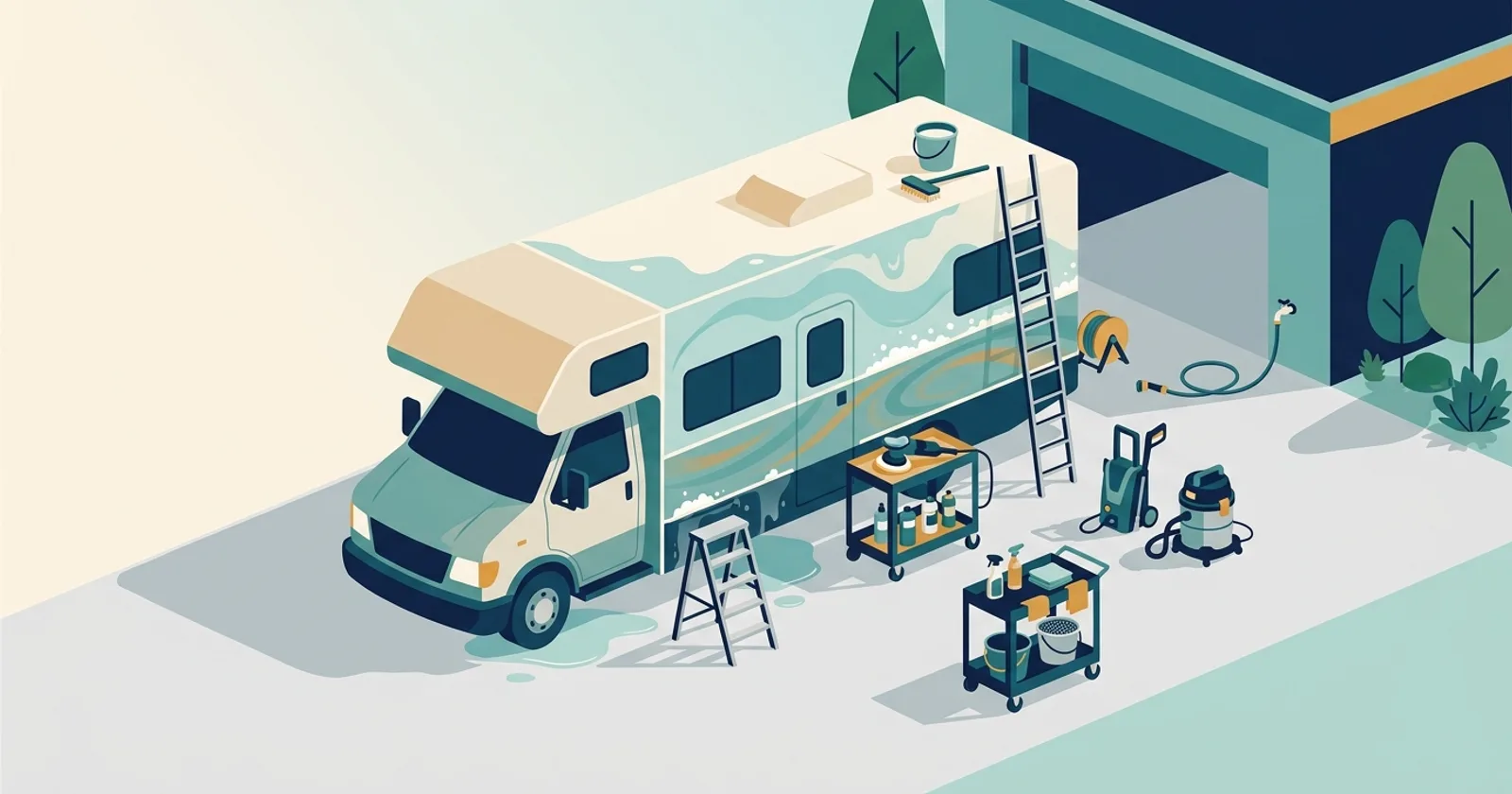
Clean the roof first. One roof-membrane maker’s guide (covering its Brite-Ply EPDM and Brite-TEK roofs) says to clean at least four times a year. Rinse loose dirt, scrub with a medium-bristle brush and the diluted cleaner, then rinse thoroughly so residue doesn’t build up on the roof or sidewalls.
The same guide warns against cleaners with petroleum solvents, harsh abrasives or citric-based ingredients. It says they may cause irreparable damage and may void the warranty. It also warns that a wet membrane may be extremely slippery. That guide covers only those two membrane lines, so follow the maker’s instructions for your roof.
Ladders matter too. The same RV maker’s manual says to set a stepladder alongside the coach and not prop a ladder against the body, which can damage the finish. Detailers with employees should know OSHA’s general-industry rule. It requires fall protection, such as guardrails or a personal fall-arrest system, for workers on surfaces with an unprotected edge 4 feet or more above a lower level. This isn’t safety or legal advice. Check OSHA’s rules for your setup.
Step 3: The sides, in panels
That manual’s washing steps translate well to a long coach:
- Wash the wheels and wheel wells first, so heavy grit doesn’t splash onto clean panels.
- Wet the whole side, then hand wash one area at a time, top down, rinsing often.
- Wash with the surface under 90°F and out of direct sun. Direct sun causes water spotting.
- Skip wash-and-wax combo soaps; the manual says they can cause buildup.
- Dry with a damp chamois or microfiber. Hard tap water can stain, and our guide to spot-free rinse options compares filters and deionizers.
Step 4: Compound without the haze
The composite-panel maker says compounding is the fix only when cleaning and waxing won’t restore a weathered surface. Its procedure is short: wash and dry the panel, apply the compound per the label, then wash the panel with water and dry it before waxing.
To keep residue under control:
- Work one panel at a time, in shade, and wipe off compound before it dries.
- Wash and dry each corrected panel before you move on, rather than at the end.
- Wax once or twice a year after that. The panel maker says not to wash or wax in direct sunlight. The RV manual says wax stains wipe off with a soft cloth and warm water.
If the finish is badly weathered, a pro may be worth pricing; the panel maker says major repairs should go to a professional. Our guide to judging a detail covers what to do if a hired job leaves haze behind.
What RV detailers charge
| Operator (location) | Service | Published price |
|---|---|---|
| Jae’Kae’ Motorsports (Mesa, AZ) | Exterior detail, per linear foot | $9 to $14 small to mid-size; $10 to $15 large or fifth wheel; up to $20 ultra high-end |
| Kern Mobile Details | Wash and wax, includes roof | $300 (25-ft travel trailer) to $700 (45 ft); fifth wheels $375 to $775 |
| Kern Mobile Details | Wash, wax and light oxidation removal | $24 per foot; extreme oxidation adds $3 to $6 |
The flat tiers work out to $12 a foot for a 25-foot trailer and about $15.56 a foot at 45 feet. Before you book, ask whether the roof is included and how the length is measured. Also ask what counts as “oxidation” and what proof of insurance covers roof work. Our checklist for finding a reliable detailer covers the paperwork, and travel fees matter if the coach sits in a remote park.
If your coach winters near Quartzsite, Arizona, the BLM’s La Posa long-term visitor areas run from September 15 to April 15, with a $180 permit for the season. For car-sized pricing, see our cost by vehicle size guide.
How we check every number: methodology.
Sources
Checked 2026-10-09. Community threads are used only for the questions people ask.
- Dicor, Brite-Ply and Brite-TEK Roof Care and Maintenance (hosted by Forest River): forestriverinc.com/brochures/0000/0000RoofDicorGuide.pdf
- Crane Composites, Recreational Vehicle Care and Maintenance (hosted by Forest River): forestriverinc.com/files/Component-Manuals/Care%20-%20Maintenance/Crane%20Composites%20-%20Fiberglass%20Care%20%26%20Maintenance%20Guide.pdf
- Jayco, 2024 Solstice Owner’s Manual, Section 13: Exterior: jayco.com/uploads/rvs/manuals/631-2024-Jayco-Solstice-OM---COLOR.pdf
- OSHA, 29 CFR 1910.28, Duty to have fall protection: osha.gov/laws-regs/regulations/standardnumber/1910/1910.28
- Bureau of Land Management, La Posa Long Term Visitor Area: blm.gov/visit/la-posa-long-term-visitor-area
- Jae’Kae’ Motorsports, Detail Services: jaekaemotorsports.yolasite.com/Detail-Services.php
- Kern Mobile Details, RV, trailer and boat detailing: pocketsuite.io/book/kernmobiledetails/items/rv%2C-trailer%2C-boats-detailing
- Community discussion, an RV detailed section by section: reddit.com/r/AutoDetailing/comments/1pkdml6