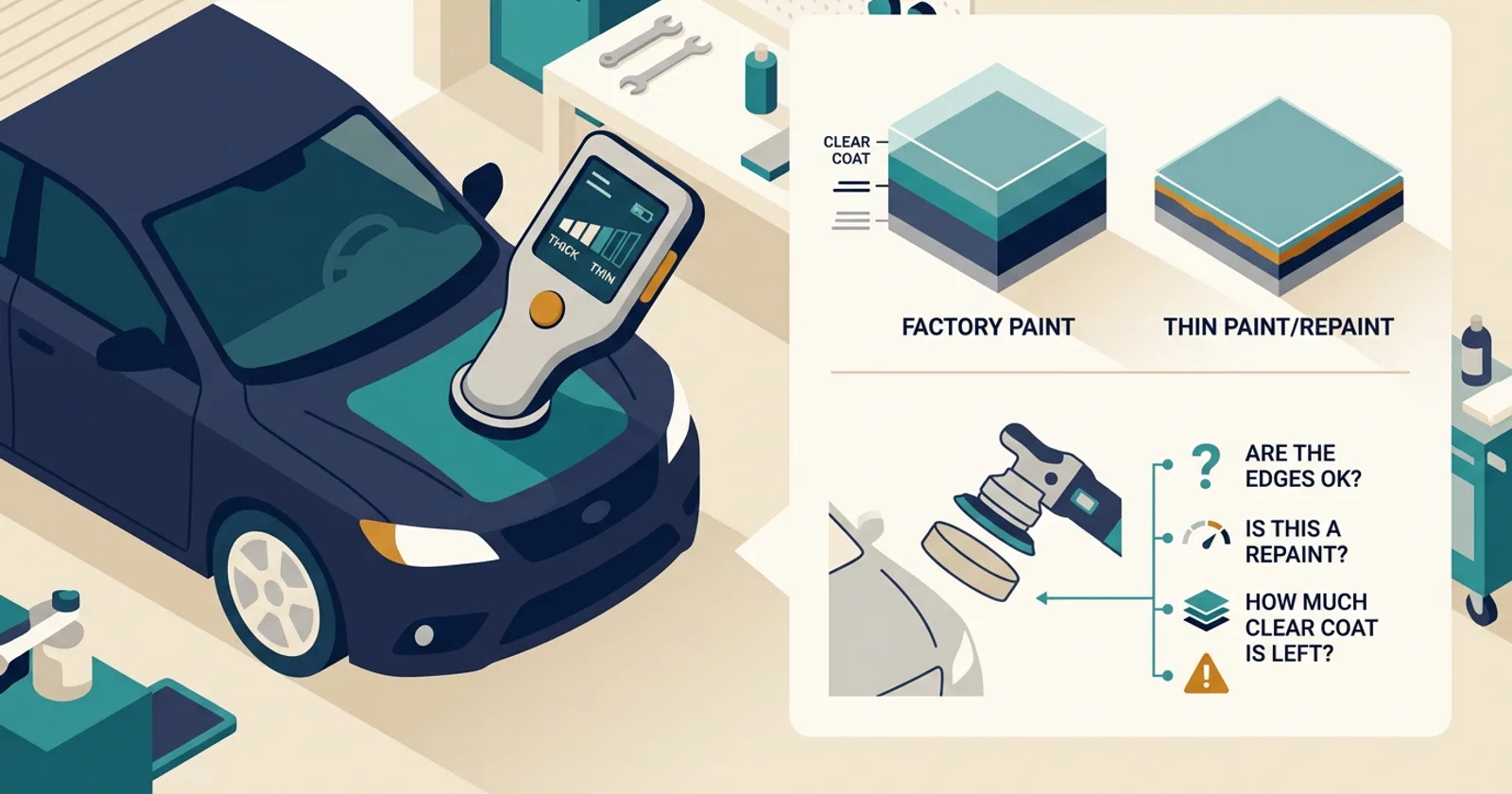
You ask about paint correction or a ceramic coating. A detailer who knows the job walks around your car with a small electronic gauge, pressing it to the hood, fenders and doors. That number isn’t a detail-nerd flex. It’s the most important reading you’ll get before a polisher touches your car.
What the gauge actually measures
A paint gauge measures the gap between its probe and the metal underneath. It can’t tell the layers apart, so primer, color and clear coat all add up to one total. Readings come in microns (one thousandth of a millimeter) or mils (one thousandth of an inch).
So when a detailer says “70,” that’s not 70 microns of clear. It’s everything on top of the metal. A careful operator takes several readings per panel, because one spot tells you very little.
Typical factory numbers
One gauge maker says a factory paint job typically runs 100 to 180 microns total, with the clear coat usually 35 to 50 microns of that. It also notes a wide spread between models. Some roofs carry only about 75 microns, and some SUV rocker panels reach 430.
The same maker says there is no single “right” thickness. Consistency is what matters. Readings should vary only a little across a panel. A thin area is a warning, and a much thicker one may be a repair.
Reading the numbers
| What the gauge shows | What it can mean | What a careful detailer does |
|---|---|---|
| Similar numbers across the car, in the 100–180 µm range | Likely original factory paint (DeFelsko) | Plans correction around the lowest reading |
| One panel much thicker than the rest | Likely repainted; the gauge can’t judge the repaint’s clear coat (DeFelsko) | Treats that panel as unknown and goes gentle |
| Very low readings | Clear coat may be almost entirely removed (DeFelsko) | Skips machine cutting there, or hand polishes only |
| No reading at all | Over the gauge’s limit; possible filler and a past repair (DeFelsko) | Flags the panel and asks you before touching it |
| Readings swing widely within one panel | Earlier repairs (Elcometer: “extremely high or low” readings) | Maps the panel before choosing pads and polish |
Why “safe to remove” is so small
Polishing levels defects by removing a thin slice of clear coat. That clear coat also carries the UV protection for the color underneath. One gauge maker says most automakers recommend removing no more than 8 microns of clear coat to protect against UV damage. That’s a small budget, and earlier polishing may have used some of it already.
Gauge quality matters here, too. One maker’s detailing gauge reads in 2-micron steps. Another maker’s automotive paint meter reads in 10-micron steps, with accuracy of ±5% or ±20 microns. That second type is fine for spotting a repainted fender. It can’t show an 8-micron change. Ask which gauge they use.
What it looks like in real life
A detailing community thread shows how confusing this gets. The owner of a 2021 sedan with just over 50,000 miles was told their paint read 50 to 70 “mm” in most places. The shop offered only a light polish. Commenters pointed out the shop must have meant microns. Then they disagreed. One said that was quite thin if it was the total. Another said they work on new cars that read 30 to 50 microns from the factory.
The lesson is to ask what was measured and where. For an owner weighing a coating on paint like this, our guide to ceramic coating on an older or high-mileage car covers the coat-without-heavy-correction option.
Red flags
- No gauge at all. A shop that quotes multi-step correction without measuring is guessing.
- One reading off one fender. Paint varies by panel. Plastic bumpers need a different, ultrasonic gauge.
- “I’ll get every scratch out” on thin paint. On low readings, the honest answer is better clarity, not perfection.
- “We’ll wet sand it” with no talk of film depth. One gauge maker says carmakers now specify measuring before and after any wet sanding or buffing.
Questions to ask before you say yes
- Will you measure in front of me and show me the lowest reading?
- Is that number total paint or your estimate of the clear coat?
- How much will your process remove, and how will you check it?
- What happens if a panel is too thin?
- Will you write the readings down for me?
That last one matters if you want correction again in a few years. Our checklist for finding a reliable mobile detailer covers the rest of the vetting. If a job already went wrong, see how to get a bad detail fixed.
The hard truth about thin clear coat
Clear coat doesn’t grow back. Once it’s gone, you need a body shop. Sun makes it worse. EPA says UV intensity rises about 6% per kilometer of elevation. A Colorado TV station notes that the state’s high elevation increases UV reaching the ground. So a car parked outside in Colorado takes more UV than the same car at sea level under the same sun. Matte and satin finishes are a separate case, covered in our guide to washing matte paint or satin PPF.
If your readings are low, a coating or sealant over lightly polished paint protects what’s left. Our ceramic coating cost guide shows what that runs. Paint and gauge figures come from the makers’ own technical pages, checked October 2026. See how we check numbers. For paint damage from vandalism, see what to do after someone spray-paints your car.
Sources
- DeFelsko, How to use paint thickness gauges for better automotive detailing: defelsko.com/resources/how-to-use-paint-thickness-gauges-for-better-automotive-detailing
- Elcometer 311 Automotive Paint Meter, specifications: elcometer.com/en/elcometer-311-automotive-paint-meter.html
- Elcometer, How to find accident damage using the Elcometer 311: elcometer.com/en/how-to-find-accident-damage-using-the-elcometer-311-automotive-paint-meter
- US EPA, Calculating the UV Index: epa.gov/sunsafety/calculating-uv-index-0
- KOAA, How Colorado’s elevation impacts the UV index: koaa.com/weather/weather-science/how-colorados-elevation-impacts-the-uv-index
- Community discussion, r/AutoDetailing, thin clear coat reading before a coating (paraphrased; not linked)