The film did its job. Now it’s an eyesore, and getting it off is a test of patience, not muscle. If new film goes on afterward and it is satin, washing matte paint or satin PPF is worth reading first.
First, make sure it’s film
An owner of an older pickup asked a detailing community how to remove “baked-on” film from the lower sides. It had turned white and came off only in tiny pieces. Commenters told the owner it wasn’t film at all: they said the owner was scraping off paint, likely a thick factory coating on the lower panels. If you can’t find an edge, ask a detailer to look before you scrape.
Why film turns yellow
The film’s top layer is a clear coat. One film maker’s technical bulletin says it protects against “environmental influences and mechanical stress,” and lists environmental conditions among the factors that affect film life. One Texas shop says quality film lasts 10 years or more, but cheaper or older film can yellow, chalk or stain after 5 to 7 years.
What can go wrong
Pulled paint. One Houston shop says the older and more worn the film, the higher the chance paint comes off with it. Any rock chip that was under the film when it went on is a weak spot. Resprayed paint is the other risk. That Texas shop says film removal can lift a respray, especially a recent one.
Glue left behind. Brittle film tears into small pieces, and the adhesive stays on the paint instead of the film. Now you’re cleaning glue panel by panel.
A metal razor blade. Plastic only. One slip means a deep scratch.
DIY or call a pro?
You can DIY if the film still lifts in strips with some heat, the paint is factory paint, and you have the patience. That Texas shop says a good removal takes 2 to 4 hours per panel, longer for the hood and roof.
Call a pro if the film flakes into confetti, the car has been repainted, or the film is badly yellowed or cracked. The Texas shop says film over 8 to 10 years old on a daily driver often turns into a many-hour job per panel. The Houston shop says it has spent up to 16 hours removing very old film from one vehicle.
How to remove it
One film maker’s install bulletin gives just two removal rules: use a steamer, and pull at 30 to 60 degrees from the paint. The shops fill in the rest.
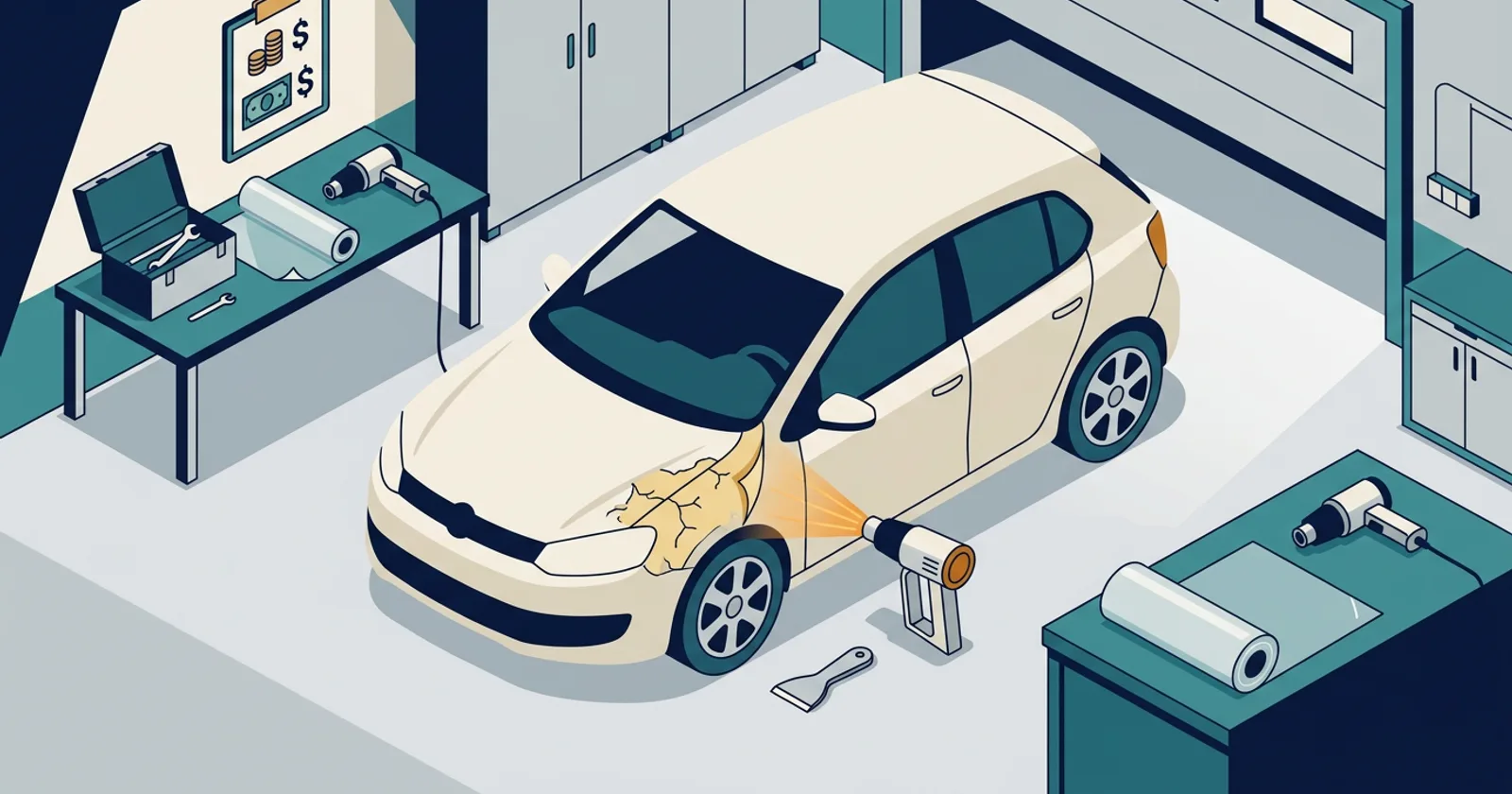
- Warm the film. A steamer is the film maker’s pick. With a heat gun, the Texas shop says to start on low, 6 to 8 inches off the panel. The film should feel warm, not hot, to the back of your hand.
- Lift a corner with a plastic blade or your fingernail. If it won’t lift, add heat. If it tears, the film is brittle. Slow down or stop.
- Peel low and slow, keeping the film close to the panel instead of pulling straight up. Keep heating just ahead of the peel. Finish a panel once you start it.
- Clear the glue. The Texas shop uses isopropyl alcohol or a citrus-based remover, left on 30 seconds, then wiped in straight lines. It warns that acetone and lacquer thinner can strip clear coat.
- Wash and inspect in good light. Paint that sat under film may look slightly darker than the paint around it. The Texas shop says that evens out over a few months in the sun.
If the film is still fairly new and you’re unhappy with the install itself, see PPF install problems instead.
What removal costs
Here’s what three shops publish.
| Shop | Area | Published removal price | Notes |
|---|---|---|---|
| R3 Detailing | Houston, TX | $500 to $3,500 | Up to 16 hours on very old film |
| Shell Shocked Wraps | Wylie, TX | Single panel $150 to $300; front kit $400 to $700; full vehicle $1,200 to $2,500 | Discounts removal paired with a new install |
| Veteran Detail | Utah County, UT | $200 to $500 | Usually 2 to 4 hours |
The spread is wide because film age and condition drive the hours. Ask for a quote after the shop sees the film, and ask what happens if paint chips. The Houston shop says some chipping on worn film is hard to avoid. Our guide to finding a reliable detailer covers checking a shop first.
Check the warranty before you pay. One film maker’s limited warranty covers yellowing for ten years on its main films. If the maker elects to replace a defective film, its installer removes and reapplies it, with parts and labor covered. You’ll need the warranty card and original receipt.
Re-film or go bare?
Go bare if the car is an older daily driver and you don’t mind touching up chips.
Re-film if the paint is original and in good shape, you plan to keep the car, or you just paid for paint correction. The Texas shop says removal plus a same-day install costs less because the panels are already prepped. Still deciding? Compare PPF and ceramic coating, and see cheap ways to protect the front end if you only need a season.
Buying a used car with yellowed film? Price the removal in. That film is a job waiting to happen.
Prices come from shops’ own published pages, checked October 2026. See how we research our articles.
Sources
- 3M, Paint Protection Film Installation Guideline, Technical Bulletin (Feb. 2022): multimedia.3m.com/mws/media/2165701O/3m-paint-protection-film-installation-guidelines-usac.pdf
- XPEL, Warranty Information (limited product warranties): xpel.com/warranty-information
- R3 Detailing (Houston, TX), PPF in Houston: r3detailing.com/ppf-houston
- Shell Shocked Wraps (Wylie, TX), How to Remove Paint Protection Film: shellshockedwraps.com/how-to-remove-paint-protection-film
- Veteran Detail (Utah County, UT), Can PPF Be Removed?: veterandetail.com/can-ppf-be-removed-safe-ppf-removal-when-to-replace-it
- Community discussion (2006 pickup, “baked-on film” that was paint): reddit.com/r/AutoDetailing/comments/1vuuy8u