The FTC and BBB guidance quoted below is written for home-improvement contractors, not detailers. We apply it by analogy, because the checks are the same when you hire someone to work on your property.
Where to look
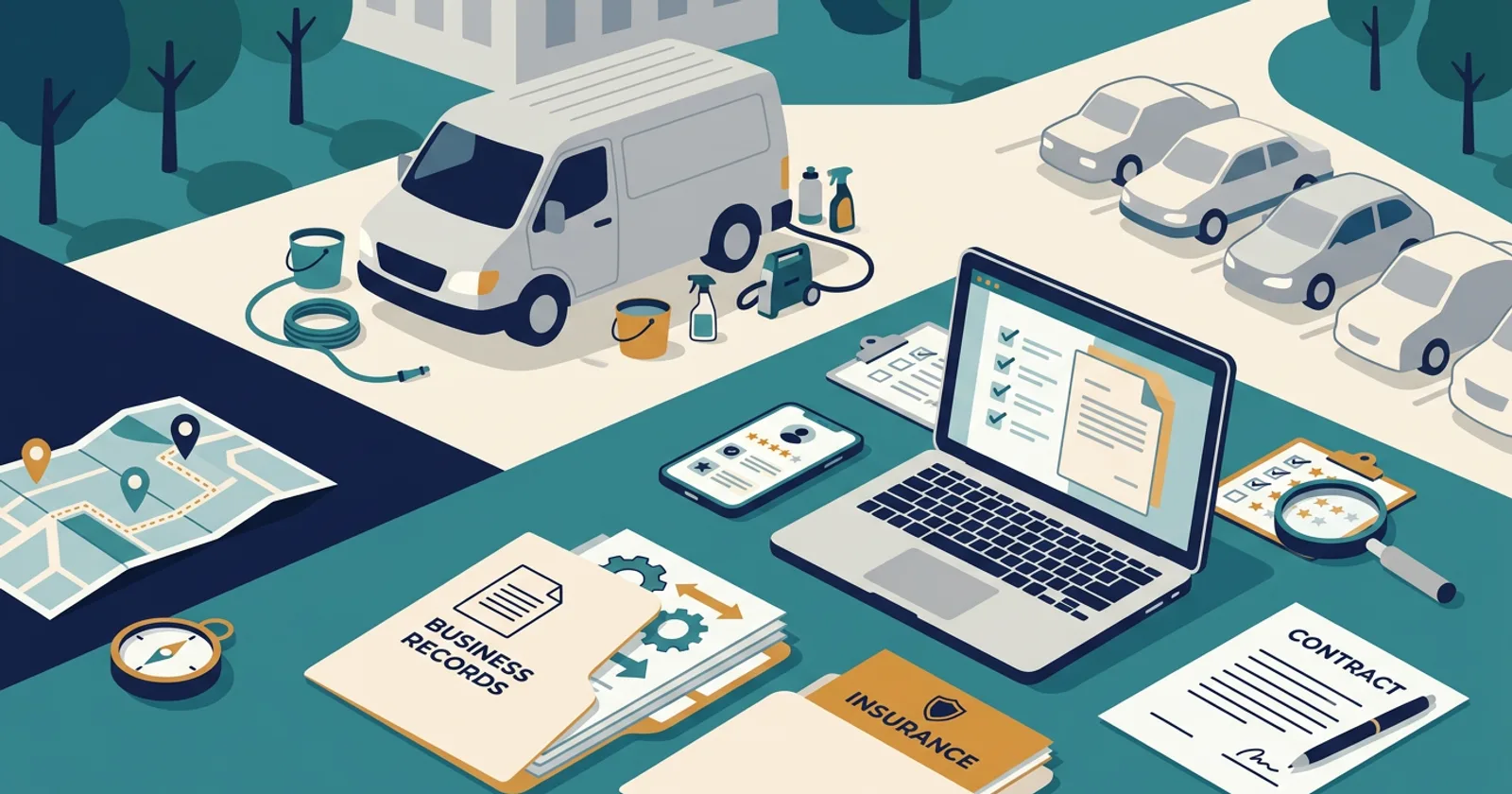
The FTC’s contractor advice is to get recommendations from people you know and trust, so ask neighbors, coworkers or a local car club. Then try local map search, the detailer’s own website (a real price page is a good sign) and social media pages. The BBB notes that social media is usually the best place to find recently completed work. Aim for two or three candidates.
What to verify before you book
| What to check | Where to check it | What a good answer looks like |
|---|---|---|
| Insurance | Ask for proof, then call the insurer | An active policy in the business’s name |
| Business record | Your state’s business search | A name that matches the quote and invoice |
| Reviews | More than one site | Steady reviews over months, with details |
| Past work | Their social pages, or ask for photos | Recent cars like yours, not stock images |
| Written quote | Email or text from the detailer | Services, price, date and add-ons listed |
Insurance
Ask for proof of insurance before the first visit. The FTC’s contractor advice says to ask for it. Then call the insurance company on the paper to confirm the coverage, as the BBB suggests. The SBA describes general liability insurance as covering bodily injury and property damage, among other things. Ask: “If you damage my paint or interior, what covers it?” Skipping this question is among the mistakes to avoid when booking a mobile detail.
Licensing and insurance rules for detailers vary by state and city (owners can read our guide to starting a mobile detailing business). Check your state and local rules rather than assuming a license is or isn’t required.
State business record
Most states let you search business filings online, and NASS links to each state’s business registration pages. In Texas, the Secretary of State’s online search charges $1.00 per search. Search the exact business name and check that it matches your invoice.
A missing record is not automatically a red flag. The SBA says you are automatically a sole proprietor if you do business without registering as another type. If you can’t find the business, ask: “What is your legal business name?”
Reviews
The FTC says it can often be nearly impossible to tell a fake review for sure. Its tips:
- Watch for a burst of reviews over a short time.
- Check the reviewer’s other reviews. An account with one review is weaker evidence.
- Look at a variety of sources.
You can also search the business name with words like “scam,” “review” or “complaint,” as the FTC suggests.
Photos and a written quote
Ask for recent photos of cars like yours. The BBB suggests asking businesses to text or email photos of recent jobs similar to what you need.
Get the price in writing before work starts. The FTC says a written estimate should include a description of the work, materials, the completion date and the price. For detailing, that means: Tipping is a separate question, covered in should you tip a car detailer.
- the package name and what it includes
- the vehicle size it is priced for
- add-ons such as pet hair, stain removal or odor treatment
- any travel fee, deposit or card fee
- the date and arrival window
Use our price guides to sanity-check a quote
Compare the quote with published prices:
A quote far below the others deserves a question, not a quick yes. The FTC says not to automatically choose the lowest bidder, and the BBB notes a much lower bid can mean the business is cutting corners. See our methodology.
Questions and red flags
Ask what the package includes and how they handle wash water (see wash water rules) and who is responsible if the car won’t start afterward. Rules vary by place. As one city’s example, a City of San Diego guide says businesses that wash vehicles commercially must contain and capture the wash water before it reaches a storm drain. Check your own city’s rules.
The FTC lists these as common contractor scam signs, and they fit detailers too:
- Pressure to decide now.
- Full payment up front, or cash only.
- No written quote, or one with blanks.
- No proof of insurance, or a name that matches no record.
Paying and protecting yourself
Pay with a method that leaves a paper trail. The FTC explains that you can dispute a credit card charge for something not delivered as agreed, and your letter must reach the card issuer within 60 days after the first bill with the error. Don’t make the final payment until the work is done and you’re satisfied. If a problem isn’t resolved, USA.gov lists each state’s consumer protection office.
Sources
Checked 2026-10-08.
- FTC, How To Avoid a Home Improvement Scam: consumer.ftc.gov/articles/how-avoid-home-improvement-scam
- FTC, How To Evaluate Online Reviews: consumer.ftc.gov/articles/how-evaluate-online-reviews
- FTC, Using Credit Cards and Disputing Charges: consumer.ftc.gov/articles/using-credit-cards-and-disputing-charges
- BBB, How to hire a reliable and trustworthy general contractor: bbb.org/all/home-improvement/how-to-hire-a-reliable-and-trustworthy-general-contractor
- SBA, Get business insurance: sba.gov/business-guide/launch-your-business/get-business-insurance
- SBA, Register your business: sba.gov/business-guide/launch-your-business/register-your-business
- NASS, Corporate Registration: nass.org/business-services/corporate-registration
- Texas Secretary of State, SOSPortal: sos.state.tx.us/corp/sosda/index.shtml
- City of San Diego car washing guide (hosted by EPA): cfpub.epa.gov/npstbx/files/tbsd_car_washing.pdf
- USA.gov, State consumer protection offices: usa.gov/state-consumer