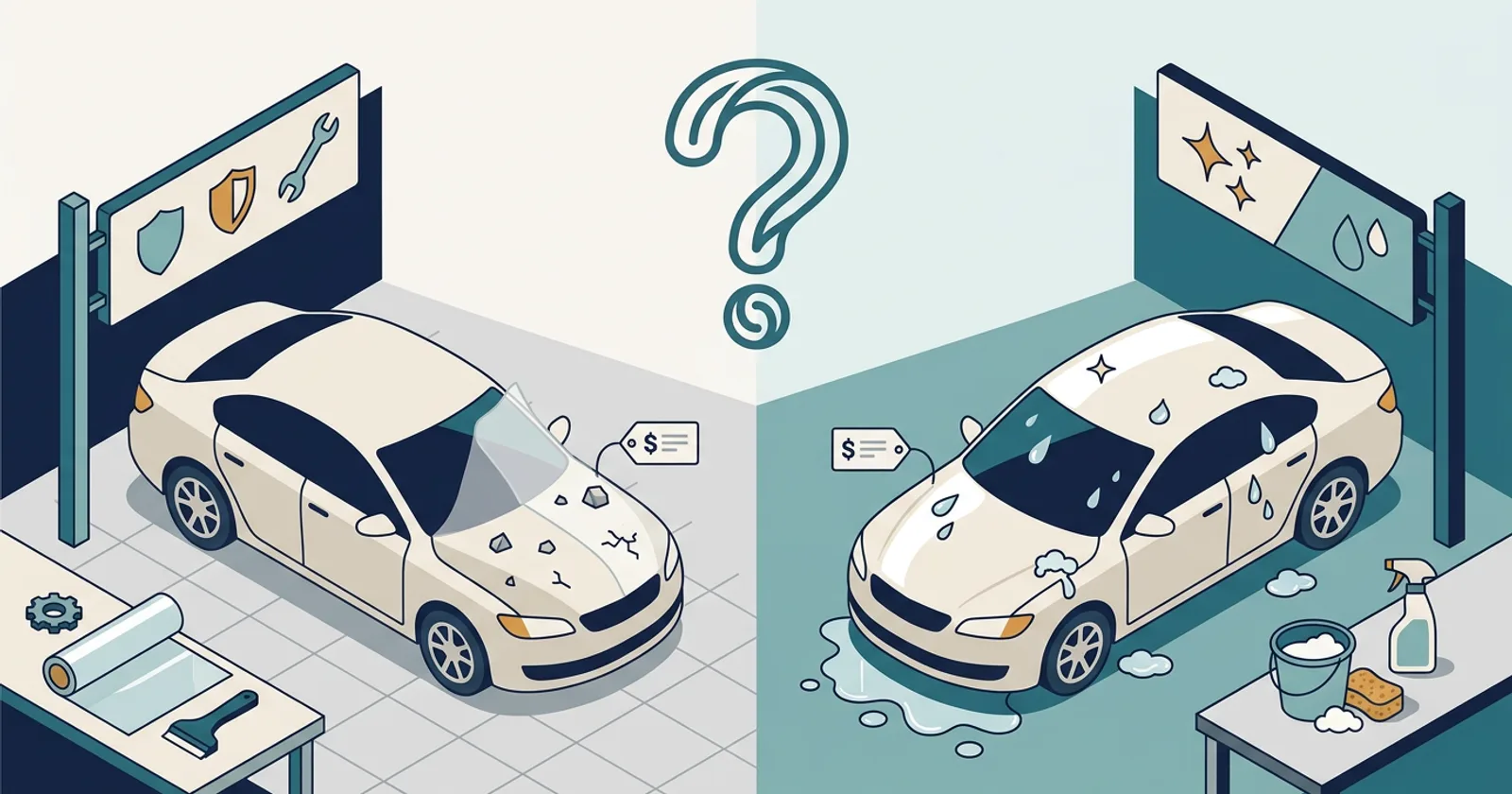
Take a new car in the Chicago suburbs. In one community discussion, an owner there with a brand-new white SUV said they plan to keep it at least 7 years and drive through snow and salt every winter. They were scheduling a ceramic coating, and the detailer recommended film too, at the very least on the headlights. That’s the real question for most new-car owners: is the coating enough, or do you need film too?
The real difference: what each one stops
Paint protection film (PPF) is a clear urethane sheet laid over the paint. It takes the hit. A film maker says PPF is generally better against physical damage like scratches and chips because it is a thicker, impact-resistant layer. The same maker says its film can self-heal minor scratches and swirls.
A ceramic coating is a thin liquid layer that cures hard on the paint. It makes water bead and dirt release, which makes washing faster. It does not stop a rock. One coating maker says its self-healing coating is built for light surface scratches, not “major impacts and rock chips.” A veteran detailer writing on a detailing retailer’s site puts it more bluntly: “No coating will prevent rock chips.” Some makers sell a “graphene” version of the same idea.
Pick your protector
Pick PPF if chips are what you dread. Highway miles, gravel trucks and winter road grit all go after the front bumper, hood leading edge and mirrors. Film is the only one of the two that physically blocks that.
Pick ceramic if washing is the chore you hate. A coated car sheds road film and water more easily, so a rinse and a gentle wash do more. It won’t stop chips, but it keeps a parked-outside car looking cleaner between washes.
Do both if you’ll keep the car a long time. Film on the high-impact areas, then a coating over the whole car, film included. One film maker says coating its film makes the surface easier to clean and adds gloss, and that its own coating won’t void the film warranty. Ask your installer which coatings the film maker approves.
PPF vs ceramic coating at a glance
| What you get | PPF | Ceramic coating |
|---|---|---|
| Stops rock chips | Yes, it absorbs the impact | No |
| Makes washing easier | Somewhat | Yes, water and dirt release |
| Light swirls | Self-heals minor ones (XPEL) | Can’t fix them; polish first |
| Published price | Partial front $1,250–$1,800; full front $2,250–$3,200; full car $4,500–$5,500 (Blackout Window Tinting, Bay Area, 2026) | Sedan $649 (1 yr), $849 (3 yr), $1,399 (5 yr), polish included (Smith Bros Mobile Detailing, San Diego) |
| How long it lasts | Typically 5–10 years; 10-year limited warranty (defects) on XPEL ULTIMATE PLUS | Sold as up-to-1-, 3- or 5-year tiers |
| Best for | Bumper, hood, fenders, mirrors | Every painted surface, film included |
Those are single shops’ list prices, not national averages. Vehicle size, film brand and paint condition move every quote. For a wider look at coating prices and cost per year, see our ceramic coating cost guide, and for how vehicle size shifts a detailer’s price, our cost by vehicle size guide.
Front-only PPF vs. full car: where you need it
Most new-car owners don’t need a full wrap. The Bay Area installer above defines its partial front as the full bumper, the first 18 to 24 inches of the hood, the fender leading edges, mirror caps and usually the headlights. Its full front adds the whole hood and fenders. That’s where gravel hits. Cloudy lenses are a separate fix; see headlight restoration, DIY vs pro. If the film looks off after install, see which PPF flaws are normal.
Full-car film starts at $4,500 on that menu, double its $2,250 full-front starting price. It makes sense if you street-park in a tight city, own something hard to repaint, or simply want every panel covered. The same shop lists rocker panels as an add-on at $200 to $350 and door edges at $80 to $120. Rockers are worth asking about in a salt-belt town, where slush and grit blast the lower doors all winter.
When the salt hits
In December 2017, Chicago’s mayor’s office said the city had built a reserve of 374,000 tons of road salt for that winter. That is the kind of salt a Chicago-area car meets every winter.
With bare paint, salty grime sits on the finish until you wash it off. With a coating, the same grime releases faster, so a quick rinse at a self-serve bay does more. With film on the front and a coating everywhere, the nose shrugs off grit and the rest of the car stays easier to keep clean. None of it makes winter washing fun. It makes it faster. For a cross-country haul, see cheap front-end protection for a road trip.
One thing nobody tells you on the sales floor
Prep matters as much as the product. New cars can arrive with light swirls from the dealer lot. A coating maker warns that once a ceramic coating is applied, it will “lock in any scratches and swirls” until the coating comes off. Film goes over whatever is underneath it, too. To head it off, see how to keep the dealer from swirling the paint.
So ask whether a polish step is in the quote. The San Diego detailer in the table includes a one-step polish in every coating tier. If yours doesn’t, ask what it costs. Our list of booking mistakes to avoid covers prep and aftercare, and our guide to finding a reliable mobile detailer covers checking insurance and getting written quotes.
Prices come from businesses’ own websites as of October 2026 and can change. See how we research our articles.
Sources
- XPEL, Product Care FAQs (PPF vs ceramic, lifespan, warranty, coating over film): xpel.com/faq
- XPEL, Warranty Information (ULTIMATE PLUS and STEALTH limited product warranty): xpel.com/warranty-information
- XPEL, ULTIMATE PLUS paint protection film: xpel.com/ultimate-plus-black-paint-protection-film
- Blackout Window Tinting, PPF Cost in California 2026: gilroyblackout.com/blog/paint-protection-film-cost-california-2026
- Smith Bros Mobile Detailing, Ceramic Coating: sbmobiledetailing.com/services/ceramic-coating
- Feynlab, ceramic coating myths: feynlab.com/?p=47263
- Detailed Image, Ask a Pro Detailer: Will a Ceramic Coating Prevent Scratches?: detailedimage.com/Ask-a-Pro/will-a-ceramic-coating-prevent-scratches/amp
- Chemical Guys, How to Prep for a Ceramic Coating: chemicalguys.com/howtoprep.html
- City of Chicago, Mayor’s Press Office, December 12, 2017 snow preparedness release: chicago.gov/city/en/depts/mayor/press_room/press_releases/2017/december/SnowPrepare.html
- Community discussion (Chicago suburbs, new car, PPF on top of ceramic): reddit.com/r/AutoDetailing/comments/1vb787o
- Community discussion (new car, dealer coating vs PPF): reddit.com/r/AutoDetailing/comments/1wklnfx
- Community discussion (is PPF plus ceramic worth it): reddit.com/r/AutoDetailing/comments/1ul25xz