Owners in community discussions often hit this right after pickup. One paid about $200 to film a carbon-fiber wing and found bubbles, white spots and miscut lines. Another, with a full-body wrap, could feel dust bumps under the film on a door. A third bought film through a dealer and found it hand-cut, with edges that didn’t wrap.
Why new film looks rough at first
Most PPF goes on wet. The installer sprays a slip solution so the film can slide into place, then squeegees most of it out. The rest has to escape through the film. One film maker says most install bubbles “typically go away within a few days to a few weeks” as the film settles.
Weather sets the pace. Another film maker’s install guide lists application temperatures of 60°F to 85°F. A Gilroy, California, installer says full cure there takes 2 to 3 weeks in summer and 4 to 6 weeks in the winter fog season. It lists cold below 50°F and high humidity as things that slow curing. So film put on in a cool, damp month may look hazy longer than a summer job.
Normal or redo: a quick check
| What you see | Usually normal when | Ask the installer when |
|---|---|---|
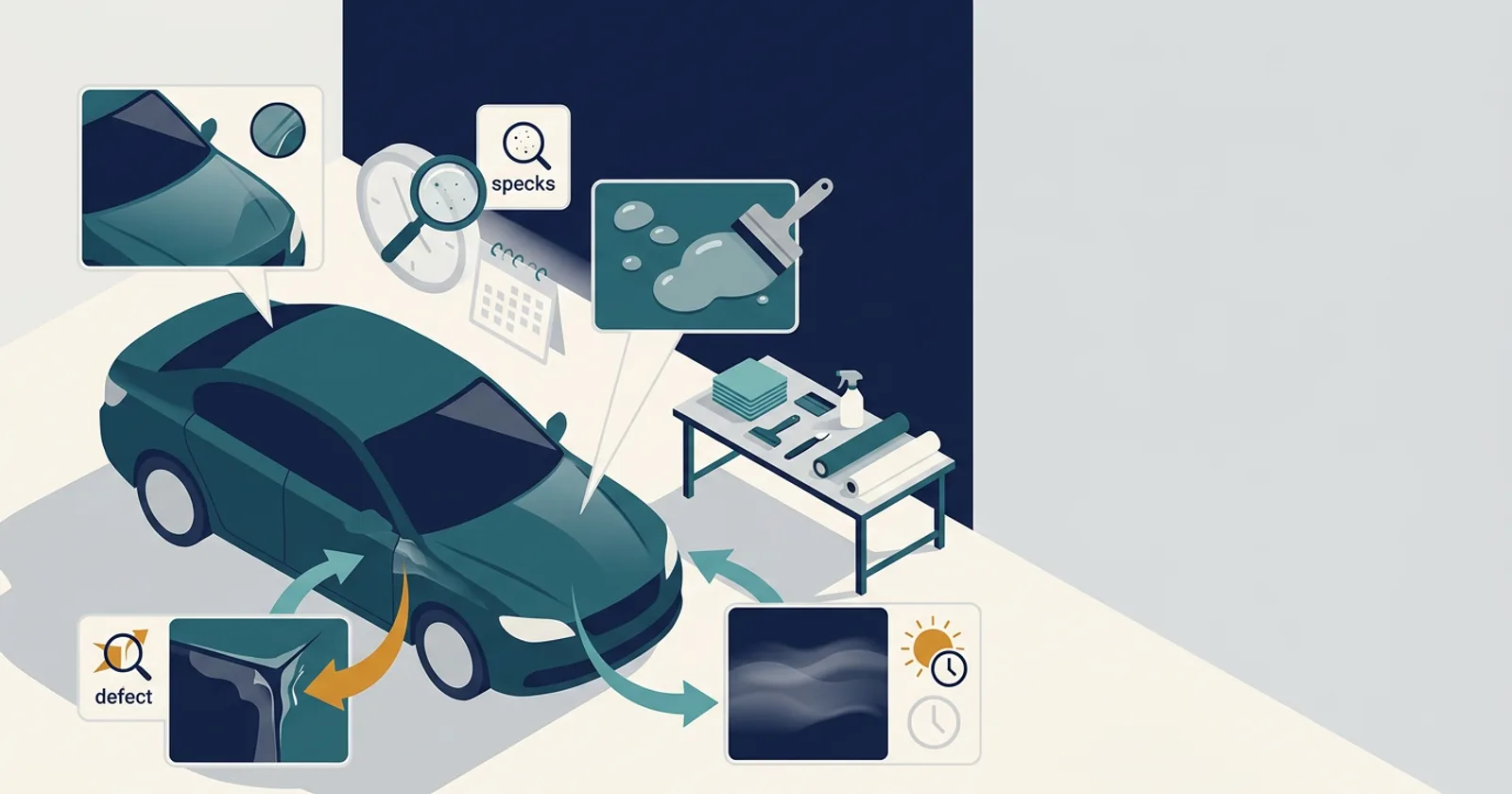
| Bubbles | Small, clear water bubbles in the first 1 to 3 weeks | Larger, milky-white air bubbles still there past 2 weeks |
| Haze or cloudy patches | Inside the 2- to 4-week cure | Still cloudy after that window |
| Visible film edge | You see it up close or at certain angles | The edge is raised, peeling or lifting |
| Dust specks | Small, isolated specks | Contamination beyond that, such as grit you can feel across a panel |
| Stretch or install lines | Faint lines at deep curves and wrapped edges | Lines that stay after the film settles |
| Seams and relief cuts | Where the panel’s shape requires them | Misaligned film that doesn’t line up with the panel |
| Dark line at the edge | Wax or grime built up along the edge | It won’t wipe clean, or dirt is under the film |
These calls come from installers’ guides and one shop’s written warranty, which lists small specks, minor stretch marks and visible relief cuts as normal. Your installer’s terms may differ.
Leave it alone while it cures
Don’t press bubbles or pick at edges. One California installer’s care guide says not to touch or press on the film, or try to fix bubbles, in the first 48 hours.
Wait before the first wash. One film maker says 48 hours, another says 72 hours, and a shop that installs in Texas and Florida asks for 7 days in its warranty. Follow the sheet your installer gives you.
Keep pressure washers off the edges. One film maker says high-pressure water near the edges can make the film lift. Another says to hold the nozzle at least 12 inches from the film with a wide 40-degree tip. That Texas and Florida shop asks for 24 inches from edges.
What counts as an install defect
Problems with the film itself and problems with the install go to different places. One film maker’s limited warranty covers defects such as yellowing, cracking, blistering and delaminating. It excludes “improper storage, installation, handling and/or use” of the film. So a bad install is the shop’s problem, not the film maker’s. Film that has already yellowed is a separate job; see removing old, yellowed PPF.
One shop’s workmanship warranty spells out what it treats as its own fault. It covers edge lifting or peeling, contamination beyond normal tolerance and misalignment, for 12 months. Another film maker’s guide tells owners to return the car to the installer if any lifting or peeling occurs.
Dust is the gray area. In one community thread, an installer told the owner that lifting the film to remove dust could do more harm than leaving it. One shop’s warranty counts small, isolated specks as normal. A panel full of grit you can feel is worth raising.
How to ask for a redo
- Let it cure, then look in daylight. Check each panel once the cure window has passed. Note which panel and where.
- Report it early. One shop asks owners to report suspected install issues within the first 30 days after installation. It also says photos alone aren’t enough and it inspects in person.
- Ask what the fix is. A California installer says minor lifting can often be re-adhered with heat, while larger lifting may need the section replaced.
- Don’t let another shop touch it first. One shop’s warranty is void on any panel trimmed, repaired or reinstalled by someone else.
Our guide to getting a detail fixed covers how to ask calmly and when to escalate.
Before you book
Ask where the film will stop on each panel, which edges get wrapped and which get trimmed. One film maker says the edge of a partial front wrap may be slightly noticeable, depending on paint color and finish. If you’re still choosing between products, see PPF vs ceramic coating on a new car. Get the shop’s written warranty first, and read its list of “normal” items. Our guide to finding a reliable detailer covers checking a shop before you pay. Picking up a new car? See keeping the dealer from swirling the paint, since film covers whatever is underneath.
Guidance comes from film makers’ and installers’ own published pages, checked October 2026. See how we research our articles.
Sources
- XPEL, Product Care FAQs (bubbles, partial-front edges): xpel.com/faq
- XPEL, Product Care (48-hour wash wait, pressure washer near edges): xpel.com/care
- XPEL, Warranty Information (limited product warranty, exclusions): xpel.com/warranty-information
- 3M, Paint Protection Film Product Care Guide (72-hour wash wait): multimedia.3m.com/mws/media/2154337O/product-care-guide-for-3m-paint-protection-film.pdf
- 3M, Paint Protection Film installation guide (temperatures, pressure washing, lifting): multimedia.3m.com/mws/media/2149722O/ppf-install-guide-rc-pdf.pdf
- Blackout Window Tinting (Gilroy, CA), PPF After Installation: gilroyblackout.com/blog/paint-protection-film-ppf-after-installation
- Huracán Nero Auto Spa, locations in Texas and Florida: huracannero.com
- Huracán Nero Auto Spa (Texas and Florida), PPF Limited Warranty (rev. 09-09-2026): irp.cdn-website.com/644fe6bd/files/uploaded/Huracan+Nero+PPF+Limited+Warranty+2026.pdf
- Community discussion (dealer-installed film, hand-cut edges): reddit.com/r/AutoDetailing/comments/1wrkqvl
- Community discussion (dust under full-body film): reddit.com/r/AutoDetailing/comments/1w6zju5
- Community discussion ($200 wing film, bubbles and miscuts): reddit.com/r/AutoDetailing/comments/1wd75cu
- Community discussion (edges look dirty after washing): reddit.com/r/AutoDetailing/comments/1vpwzf2