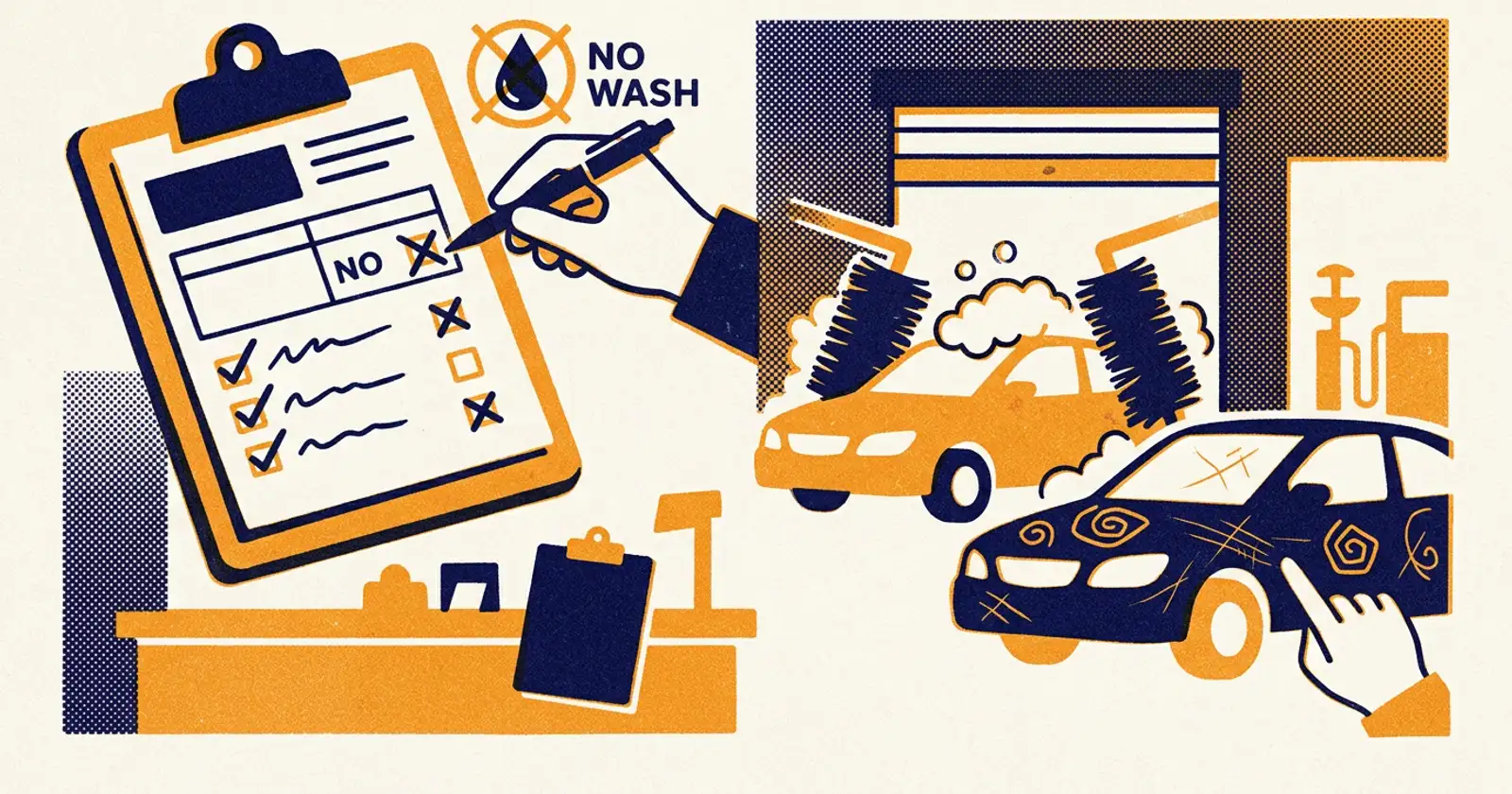
Three detailing-forum threads told the same story. An owner who had asked at every visit for no wash picked up the car on a day the service manager was out and found it covered in wash scratches; the manager apologized by email the next day and promised to make it right. Another owner called the dealer’s wash “unauthorized” and got told, fairly, that courtesy washes are standard and it’s on the owner to be proactive. A third asked whether a ceramic-coated car should ever go through the dealer wash. The replies converged on the same routine, below.
Why the dealer wash scratches paint
It usually isn’t malice; a courtesy wash is a quick add-on, not a detail. One carmaker’s own manual says automatic car wash brushes could reduce the paint lustre or hasten paint deterioration, warns against a wash that uses brushes that are dirty or too stiff, and states flatly that it is not responsible for scratches caused by automatic car washes. It also notes scratches show more on dark paint. A coating maker’s care guide says the same for coated cars: avoid automatic brush washes, because dirty brushes and friction media create scratches and marring; if an automated wash is unavoidable, use a touchless one. That’s the whole case for declining.
Make the request stick
| Step | What to do | Why |
|---|---|---|
| At drop-off | Tell the advisor “no wash, no vacuum, no dressing,” and ask to see it typed on the repair order before you sign | The repair order is the paperwork the shop works from; a verbal request depends on who is on shift |
| In your file | Ask the advisor to add a permanent “do not wash” note to your customer record | Replies in the coated-car thread said dealers who know the drill flag the file |
| In the car | Hang a “Do Not Wash” mirror hanger ($9.99, Carbon Collective via Detail Division) or tape a card to the steering wheel and dash | Forum replies say porters ignore anything they can’t miss |
| At pickup | Inspect in daylight before signing or paying; ask for the car outside, not in the bay | Damage you point out before leaving is far easier to tie to the visit |
How we research our articles: methodology.
Why all three? The owner with the scratched car had a verbal request and a cooperative manager; on the day that manager was out, the request did not carry over. One reply described another service department refunding a $120 service bill because “Do Not Wash” was in the notes and the car got washed anyway. The note helped.
If it came back scratched
- Don’t leave. Walk the car in daylight and photograph every panel, with the dealer’s building or your repair order in frame. Swirls show best with the sun low or a phone flashlight at an angle.
- Report it on the spot to the advisor, then ask for the service manager and follow up the same day by email so the acknowledgment is written. In the forum thread, the manager’s emailed apology became the owner’s leverage.
- Decline the in-house buff. The crew that scratched the paint is not the crew to polish it. Replies in the thread suggested getting an estimate from a reputable correction shop and asking the dealer to pay all or part. Our coating cost guide shows what correction tiers run, and paint-depth readings explains why you want a gauge on the car before anyone polishes a second time.
- If the car is coated or matte, call your installer first. Polishing can remove coating where it’s worked, and matte finishes need different care. See washing matte paint. Water spots, possibly from mineral-heavy water, are a different problem; see water spots on a coated car and, if the coating looks dead afterward, clogged or failed.
- Escalate in order: service manager, general manager, then the manufacturer’s customer-care line with your photos and the repair order. Replies noted that dealers dislike corporate complaints landing above them. Our guide to getting a bad detail fixed covers the same ladder for a detailer.
What the law covers, and what it doesn’t
State auto-repair laws are mostly about money, not paint. Washington’s attorney general explains that you’re entitled to a written estimate, when you deal face-to-face and the work is expected to cost over $100, that a shop can’t charge more than 10% over it without approval, and that a violation of the repair law is also a consumer-protection-act violation, with up to three times damages (capped at $10,000) in a successful court action. Connecticut’s attorney general says a shop must get your signed written authorization before work and sends repair complaints to the DMV’s Consumer Complaint Center. Neither page addresses a scratched hood. That doesn’t mean you have no claim; it means the paperwork trail, the repair order with “no wash” on it, your photos, and the manager’s email, is what any complaint or small-claims filing rests on. Small-claims limits and procedures vary by state; check your state court’s self-help page. None of this is legal advice.
One reply put the realistic limit well: with no actual damage, just an unwanted wash, there’s little recourse beyond making sure it doesn’t happen again. If a new car was swirled before you ever drove it, that’s a different fight; see swirl-free delivery.
Sources
Based on 5 sources · How we price
- Mazda owner’s manual, Appearance Care (CX-9): owners-manual.mazda.com/gen/en/cx-9/cx-9_8hu6eo19k/contents/07040101.html
- Opti-Coat, Car Care Guide: opticoat.com/pages/car-care-guide
- Detail Division, Carbon Collective “Do Not Wash” Hanger: detail-division.com/products/carbon-collective-hanger
- Washington State Office of the Attorney General, Auto Repair: atg.wa.gov/auto-repair
- Connecticut Attorney General, Quick Tips: Automobile Repair in Connecticut (PDF): portal.ct.gov/-/media/ag/consumers/quicktips/quicktipautorepairenglishpdf.pdf