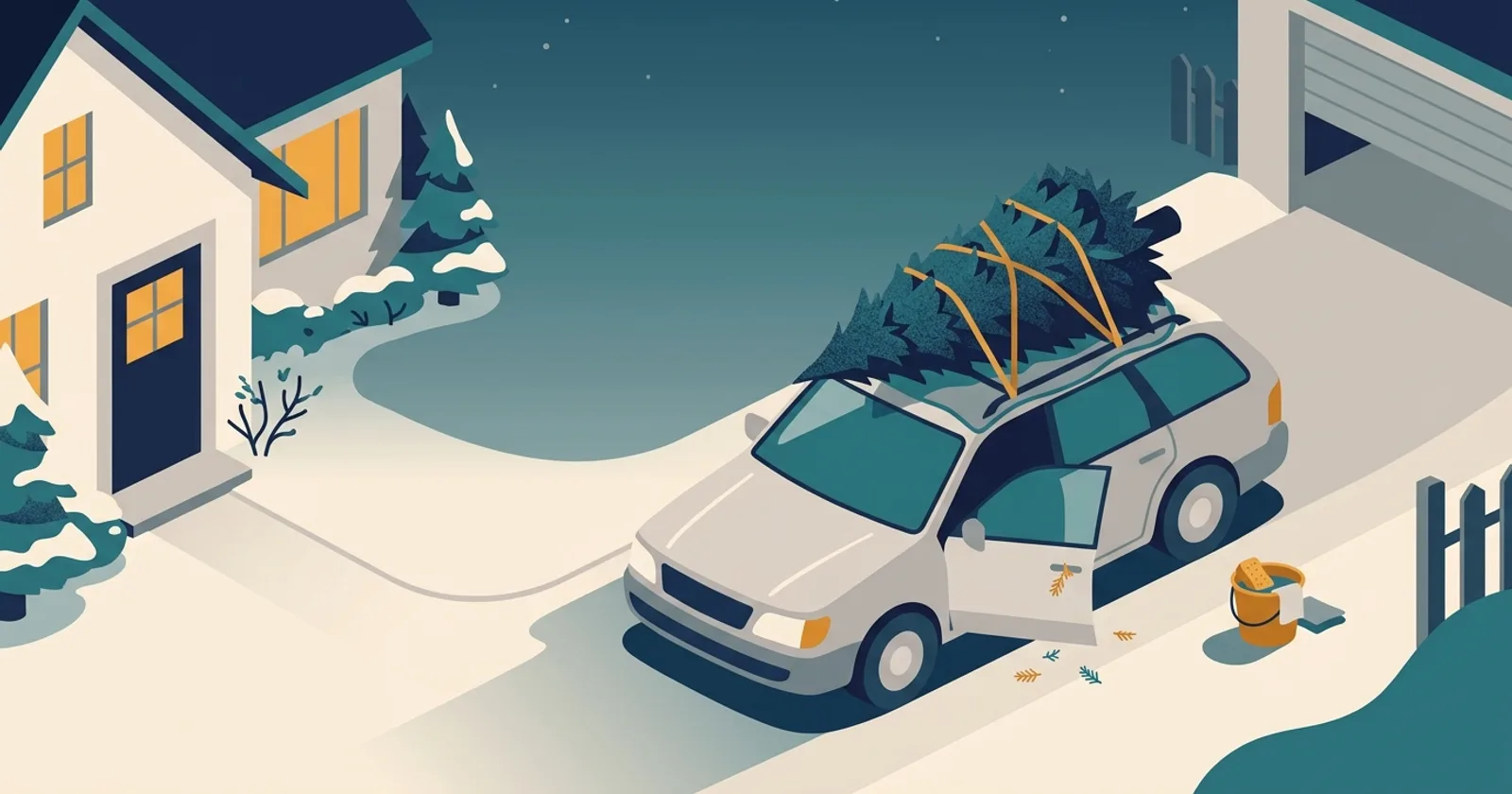
A national auto club has said a badly secured tree can cause up to $1,500 in damage. That includes scratched paint, torn door seals and bent window frames. In an earlier study, 44% of Americans admitted moving a tree in an unsafe way. That included 20% who would tie it to a roof with no rack.
Before you leave the lot
The club’s checklist is short. Each step protects either the car or the drivers behind you:
- Pick the right spot. A roof rack is best. Without one, use a pickup bed or a van or SUV that fits the tree with every door closed.
- Bring strong rope or ratchet straps, an old blanket and gloves. The club says to skip the light twine many lots hand out.
- Ask for netting. The club says to have the lot wrap the tree in netting. Tie loose branches with rope.
- Blanket down first. The club’s tip is to cover the roof before loading to prevent paint scratches.
- Trunk toward the front. Tie the tree at the bottom, center and top, using fixed tie-down points. Loop the strap around the trunk above a branch so it can’t slide.
- Tug test, then drive slowly. Pull hard from several directions. The club suggests driving slowly on back roads if possible. Higher speeds create airflow that can challenge even the best tie-down.
Don’t cinch the straps through the door openings. The club warns that straps routed that way can wear paint and tear seals. Closing a door on one can permanently distort the window frame. One carmaker’s manual also warns against pressing hard on any one area of the roof while washing or waxing. The roof can dent. Keep strap pressure on the rack or the trunk, not on bare sheet metal.
Rules on how far a load can hang past the bumper vary by state. So do rules on when it needs a flag. Check your state’s department of transportation before you buy a tall tree.
The club also ties this to road safety. It reports that road debris caused more than 200,000 crashes from 2011 to 2014. That debris can include trees that fly off cars, which is the reason for the tug test.
Fresh vs hardened sap
NC State University calls North Carolina the second-most prolific Christmas tree harvesting state in the country. More than 850 growers there produce about 50 million trees on 38,000-plus acres. The state is known for native Fraser firs, which grow best above 3,000 feet. Whatever the species, sap ends up in the same places: the roof, the rear glass and wherever the trunk touched.
| What you find | First try | If that fails | Stop and call a pro if |
|---|---|---|---|
| Fresh, tacky sap | Soft sponge and water | A commercial sap cleaner, per label | A mark stays after drying |
| Hardened dots | Damp newspaper 1 to 2 hours, then rinse | Sap remover (e.g. DIY Detail Tree Sap Remover, $12.99), multiple passes | Raised or dull spot stays after a wash |
One carmaker’s manual says hardened tree sap sticks to the finish. Scratching it off while hard can take paint with it. The same manual says to cover sap with damp newspaper for 1 to 2 hours, then rinse the loosened debris away. A sap remover’s directions give four steps:
- Start on a clean, dry surface.
- Avoid rubbing hard.
- Let the product work.
- Follow with wax.
On a detailing forum, an owner’s truck was covered in sap. Should they dilute 91% isopropyl alcohol before using it on the whole hood? Replies split between diluting it, using a dedicated remover and claying. Whatever you use, plan to put protection back. A detailing retailer’s guide says isopropyl alcohol strips remaining waxes and sealants. The same remover’s description lists wax among the things it removes.
For the full gentle-to-strong order on a crusted car, see our guide to the first wash after a car sat outside. If a mark won’t wash out, it may be etched. Our guide to paint-depth readings before polishing explains what a detailer should check before polishing it.
Needles in the cabin and the vents
Vacuum before needles get ground into the carpet. Use a crevice tool along seat tracks and door sills. A stiff brush on mats pulls out needles that worked into the pile. If you haul the tree in a hatchback, lay a tarp or old sheet down first and fold it up with the needles inside.
Check the outside too. Needles that blow off the roof collect at the base of the windshield. One carmaker’s manual says to clear leaves, snow and ice from the hood and the cowl-grille air inlet. That keeps the climate system working well.
If you’d rather pay someone, see what each interior detail tier includes and how to find a reliable mobile detailer. How we check sources: methodology. Looking for a present instead? See holiday gifts for someone who details their car.
Sources
Based on 10 sources · How we price
- AAA (The Auto Club Group), AAA Tips: Safely Transport Christmas Trees (Nov. 23, 2021): newsroom.acg.aaa.com/aaa-tips-safely-transport-christmas-trees
- AAA (The Auto Club Group), How to Safely Transport a Christmas Tree: acg.aaa.com/connect/blogs/4c/auto/how-to-safely-transport-a-christmas-tree
- AAA Western and Central New York, AAA Urges Drivers to Safely Secure Christmas Trees: westerncentralnyaaa.com/news-room/aaa-urges-drivers-safely-secure-christmas-trees-2
- Mazda, 2025 CX-5 owner’s manual, Exterior Care: mazdausa.com/static/manuals/2025/cx-5/contents/07040100.html
- Mazda, 2025 CX-5 owner’s manual, Maintaining the Finish (Washing): mazdausa.com/static/manuals/2025/cx-5/contents/07040101.html
- Mazda, CX-5 owner’s manual, Air-Conditioning System Operating Tips: owners-manual.mazda.com/gen/en/cx-5/cx-5_8fy4ee17e/contents/06010100.html
- DIY Detail Tree Sap Remover, Car Supplies Warehouse: carsupplieswarehouse.com/products/diy-detail-tree-sap-remover
- Detailed Image, Ask-A-Pro: The Isopropyl Alcohol (IPA) Wipedown: detailedimage.com/Ask-a-Pro/ask-a-pro-the-isopropyl-alcohol-ipa-wipedown
- NC State University College of Natural Resources, Extension and the 2023 White House tree: cnr.ncsu.edu/news/2023/12/extension-white-house-tree
- Community discussion (detailing forum): reddit.com/r/AutoDetailing/comments/1ohe2oi