That’s the short version of what the tire industry told Washington state regulators, who are studying the chemical. Below is what it means for your wash routine, what can make the brown look worse, and what tire makers say to use.
What the brown actually is
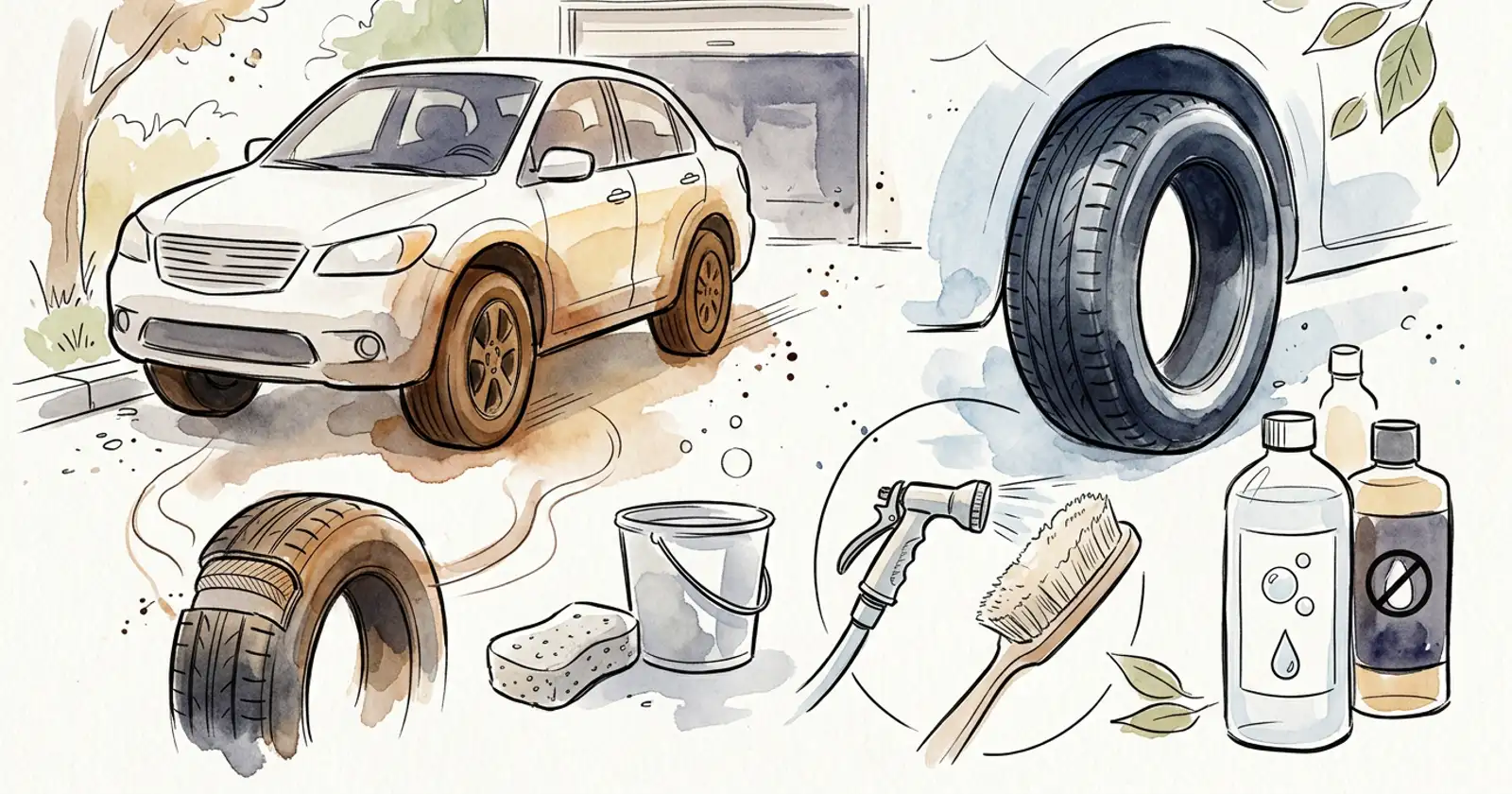
The brown film is called blooming. In a 2021 letter to Washington’s Department of Ecology, the U.S. Tire Manufacturers Association explained the mechanism: the antiozonant migrates through the rubber to the surface during use, where it forms a film. The film reacts with ozone, and as it is used up, more moves to the surface. Only part of it dissolves into the rubber when the tire is made; the rest sits undissolved as a reservoir, which is why it can last until an 80,000-mile tire is worn out.
The association called the compound, 6PPD, the most effective antioxidant and antiozonant available and said all its members use it. Washington’s legislature had set aside $195,000 for the state to assess it and possible alternatives, which is why the letter exists.
Three things follow from that chemistry:
- It isn’t dirt. A car-care maker’s explainer puts it bluntly: blooming looks like grime or brake dust, but it’s a chemical residue, and water alone won’t remove it.
- It isn’t harmful. The same explainer says it doesn’t weaken the rubber or change how the tire handles. It does signal that some of the protective chemical is being used up, which the same source calls normal wear.
- It never fully stops. Owners in a community discussion reported tires still releasing brown at 16,000 and 20,000 miles, and one said it tapers off at different rates on different tires.
Why it looks worse on some cars
Three things can make the bloom look worse:
- Brake dust and road film. The bloom looks like grime, so it’s easy to miss that real grime is on top of it. A wash that only hits the paint leaves both.
- Old dressing. Layers of shine product trap dust and the brown film under a glossy skin. One reply in a community discussion about brown tires said the brown was old dressing and recommended cleaning several times before applying anything new.
- Heat, sun and ozone. A car-care maker lists heat cycles from driving, UV and ozone, and petroleum-based dressings among the triggers that speed the reaction up.
What tire makers say to use
A consumer magazine asked three tire makers in 2016 for feedback on aftermarket tire products. The makers’ answers were about cleaning, not products. One said tires should be cleaned with soap and water. Another did not recommend lubricants or chemicals on the tire at all. The third said its tires already contain antioxidants and waxes, and that a dull look over time is those waxes migrating to the surface, which helps protect the tire.
So the baseline is a tire cleaner or car soap, a stiff brush, and a rinse. Owners in community threads repeat the cleaner until the foam stops running brown, and expect it to come back anyway. Our first-wash guide covers the order of a full wash, and if you’ve had the wheels coated, coated-wheel care explains what to keep off the wheel next to the tire.
Dressings: what the labels say
| Product (maker’s page) | Type | Price | What the maker’s page says |
|---|---|---|---|
| Adam’s High Gloss Tire Shine, 16 oz | Non-solvent dressing | $9.99 | Non-solvent formula, fast drying, without excessive sling or greasy residue |
| Stoner More Shine Tire Finish, 22 oz spray | Spray dressing | $9.99 | UV protection; bonds to tires to keep them black for weeks; one coat for a lighter finish, two for higher gloss |
| 303 Automotive Protectant | Matte protectant | Not listed on maker page | No harmful silicone oils; UV protection for rubber, vinyl and plastic, including tires; dries to a clean matte finish |
| Stoner Tarminator, 10 oz | Solvent tar and sap remover | $9.99 | Do not use on rubber trim or other solvent-sensitive materials |
The last row is there because a tar remover comes up in community threads as what pulls stubborn brown off. Its own page says not to use it on rubber trim, so using it on a tire sidewall is at your own risk.
A dressing is cosmetic. It sits on top of the tire and doesn’t change the chemistry the tire industry describes. For a matte look inside the car, see matte protectants over greasy dressings.
A routine that works
- Clean the tires every wash with a tire cleaner and brush, rinse well.
- Dress with a non-solvent product; one thin coat.
- Skip petroleum-based dressings, which a car-care maker lists as a bloom trigger.
- Blooming is normal, so a maintenance wash that includes tires is a better buy than a one-off “fix”.
How we research our articles: methodology.
Sources
Based on 7 sources · How we price
- U.S. Tire Manufacturers Association, letter to the Washington State Department of Ecology on 6PPD and alternatives, Oct 8, 2021 (PDF): ustires.org/sites/default/files/2024-03/USTMA%20feedback%20on%20the%20Dept%20of%20Ecology%20antioxidants%20and%20antiozonants%20assessment.pdf
- Consumer Reports, How to Keep Your Tires Looking Good (Aug 23, 2016): consumerreports.org/tires/how-to-keep-your-tires-looking-good
- Stoner Car Care, Is Tire Blooming Bad? What Causes Brown Tires: stonercarcare.com/blogs/wheel-tire-care/is-tire-blooming-bad-what-causes-brown-tires-and-how-to-clean-them
- Adam’s Polishes, High Gloss Tire Shine: adamspolishes.com/products/adams-high-gloss-tire-shine
- Stoner Car Care, More Shine Tire Finish (Spray): stonercarcare.com/products/more-shine-tire-finish-spray
- Gold Eagle, 303 Automotive Protectant: goldeagle.com/?p=9933
- Stoner Car Care, Tarminator: stonercarcare.com/products/tarminator