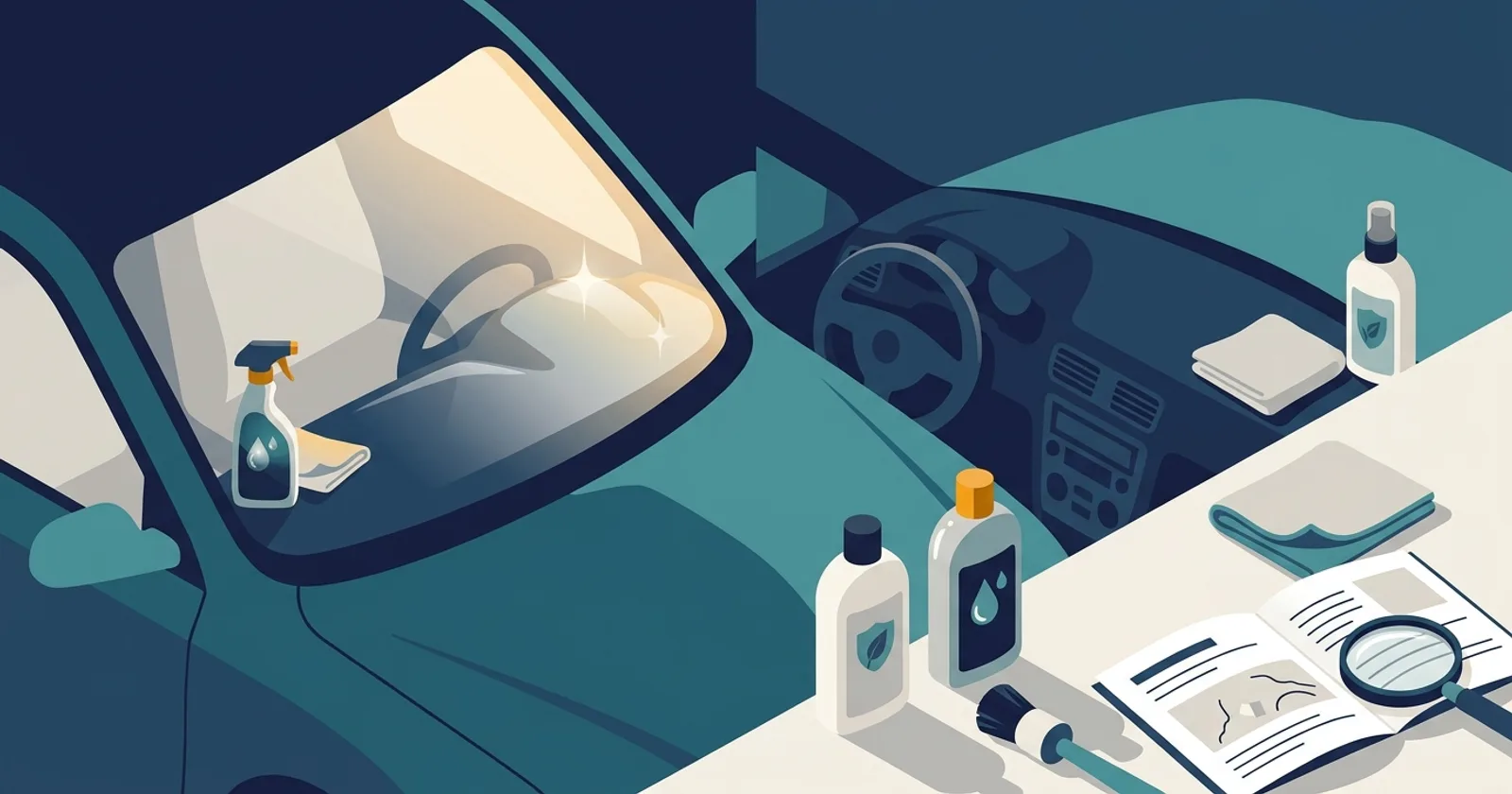
Carmakers warn about this directly. One automaker’s service bulletin says extra interior gloss “may cause annoying reflections in the windshield.”
Here’s what the people who regulate and build cars say, and how to act on it.
What carmakers and NHTSA say
Glare from shiny parts in front of the driver is an old safety topic. NHTSA’s Standard No. 107 once capped the gloss of metal parts in the driver’s forward view at 40 gloss units. Those included wiper arms and the inside windshield moldings. Its stated purpose was to keep their glare from distracting drivers or blocking their vision.
NHTSA dropped the standard in 1996. The reason matters for your dash. The agency found carmakers already used non-glossy materials and matte finishes in front of the driver, even on parts the rule didn’t cover. The rule never covered the dash. In 1989, NHTSA ended a plan to extend the limits to non-metal surfaces.
The carmakers’ own care instructions are what you should follow now:
- One automaker’s service bulletin says not to use silicone or wax-based products on the interior, or cleaners with solvents such as alcohol. It says they can raise the gloss unevenly. Extra gloss may “make it difficult to see through the windshield under certain conditions.”
- Another automaker’s owner’s handbook says not to polish the instrument panel. Polished surfaces are reflective “and may interfere with the driver’s view.”
- A third automaker’s manual says to wipe the top of the dash with a soft cloth and a mild detergent diluted in water. Then wipe off any leftover detergent with a damp, well-wrung cloth.
Your own owner’s manual is the authority for your car. This isn’t safety advice. Read the care section before anything goes on the dash.
Low sun makes glare worse. In Minneapolis, the noon sun peaks only about 21.6 degrees above the horizon on the winter solstice, per the U.S. Naval Observatory’s calculator. Somewhere like that, check your dash on a sunny winter day after any detail.
Matte protectant vs greasy dressing
| Option | What the source says | Effect on gloss | Watch out for |
|---|---|---|---|
| Mild cleaner and water | Automaker manuals: diluted mild detergent, or warm water and a mild non-detergent cleaner | Removes residue; adds nothing | Test on a hidden spot first |
| Silicone or wax-based dressing | Automaker bulletin: raises gloss unevenly, causes windshield reflections | Adds shine | Bulletin says not to use on interior |
| Matte, water-based protectant (e.g. 303 Aerospace Protectant) | Maker: clear matte finish, silicone-free, no greasy film | Maker says matte | Maker’s claim, not a safety claim; check your manual |
| Dash cover | Automaker manual: no crash pad cover over or near airbag modules | Covers the surface | Must leave airbag areas clear |
Getting the matte back
- Read the manual’s care section. One carmaker’s manual says not to use cleaning agents on the instrument panel at all.
- Clean, don’t dress. Put a mild cleaner on a clean towel, not straight onto the dash. One automaker’s bulletin directs this. Wipe the residue off with a damp cloth, then dry it.
- Check it in daylight. If the reflection is gone, you can stop there. Or add a protectant whose maker says it dries matte.
- If it’s still shiny, cleaning isn’t the fix. Ask a dealer what your manual allows. If you use a cover, pick one that fits your manual’s airbag rules.
Check what your dash is made of, and clean it the way your manual says for that material. If the glare is on your steering wheel instead, see why a leather steering wheel turns shiny.
This guide is about glare. For heat, UV and cracking, see cracked dashboards in hot states. Dressing film on the inside of the glass is covered in hazy windshield in winter.
What to tell your detailer
A detailer may finish the dash with a dressing, so say what you want before the job starts. Try: “No shine on the dash. Clean it, wipe it dry, and use a matte product or nothing.” Our guide to interior detail price tiers shows what each level usually includes.
The same goes for seats. A slick finish isn’t the goal there either; see our guide to cleaning new leather seats without making them slick. Interior coatings are covered in is interior ceramic coating worth it.
If a detail leaves your dash glaring, ask for a re-clean. Our guide to getting a bad detail fixed covers how to ask. Saying what you want up front is one of the steps to the best result when booking a detail.
Sources
Based on 9 sources · How we price
Checked 2026-10-09. How we check facts: methodology.
- NHTSA, Final rule rescinding FMVSS No. 107, Reflecting Surfaces (61 FR 11587, March 21, 1996): govinfo.gov/content/pkg/FR-1996-03-21/html/96-6745.htm
- General Motors service bulletin 06-00-89-029V, Interior Cleaning (April 2024, NHTSA file copy): static.nhtsa.gov/odi/tsbs/2024/MC-11000158-0001.pdf
- Land Rover owner’s handbook, Vehicle cleaning: topix.landrover.jlrext.com/topix/service/procedure/217421/PDF/4d958a13-1aa2-4000-8f2b-491b9f5407a1/en_GB?page=1
- Mazda CX-90 owner’s manual (2024), Instrument Panel Top (Soft pad) Maintenance: mazdausa.com/static/manuals/2024/cx-90/contents/69090200.html
- Kia owner’s manual, Interior care: ownersmanual.kia.com/full_webhelp/MV1A/2026/en_US/topics/chapter9_15_2.html
- Kia Sorento owner’s manual, Air bag warnings: ownersmanual.kia.com/docview/webhelp/doc/2f77a3f4-e47f-43da-9096-a2cdaa8ecd3a/topics/chapter4_5_6.html
- Polestar 2 owner’s manual (2024), Cleaning the instrument panel: polestar.com/us/manual/polestar-2/2024/article/a52415040db8ccbcc0a8015103b0a099
- U.S. Naval Observatory, Celestial Navigation Data (Sun altitude, Minneapolis, Dec. 21, 2025, local noon): aa.usno.navy.mil/api/celnav?date=2025-12-21&time=18:08&coords=44.98,-93.27
- Gold Eagle, 303 Aerospace Protectant: goldeagle.com/product/303-aerospace-protectant