Dust is the detailing problem that never ends. In one community discussion, an owner who had just washed and waxed found light dust on the hood a week later and asked whether to hose it or wash again. In another, an owner asked whether the wax dusters sold for exactly this job are worth it. Replies split hard both times. Here’s what the makers’ own instructions say, and where the risk really is.
Why dry dust scratches
Dust isn’t soft. Pollen grains, grit and brake dust have hard edges, and anything that drags them across paint under pressure leaves fine marring. That’s why every waterless-wash label has the same warning. One maker says that if the surface feels soiled, sandy or gritty, don’t use the product, and to remove caked-on dirt, mud, sand or grit with water first. A detailing-supply company’s waterless kit page says it’s for dust and light film, not mud, caked road grime, salt, or a car that has sat outside for weeks, because waterless washing a genuinely dirty vehicle drags grit across the paint.
Static makes it worse. Replies in the dust threads blamed static electricity for dust that clings to paint, and said some toppers attract more of it than others. One protectant maker markets its matte interior and trim product partly on repelling dust.
The three options, side by side
| Option | What it is | Published price | Safe when | Not for |
|---|---|---|---|---|
| Wax duster (The Original California Car Duster, via Eckler’s) | Cotton mop head treated with baked-on paraffin wax; no spray needed | $36.99 | Light, dry dust on a waxed or coated car kept indoors | Grit, pollen clumps, a damp car, a car parked outside |
| Waterless wash (Shine Supply Waterless Wash Kit) | Spray on, wipe off with plush towels; two-step kit with a gloss follow-up | $60.00 kit | Dust and light film, anywhere the car is parked | Mud, caked grime, salt, a car that sat out for weeks |
| Rinseless wash (Optimum No Rinse, 32 oz, via Detailed Image) | Concentrate diluted in a bucket, 1 oz to 1 to 2 gallons; wipe with a soaked towel, no rinse | $19.99 (about $0.62 an ounce) | Light to moderate dirt, no hose, apartment or garage | Heavy mud and sand, which still want a pre-rinse |
Prices are from the sellers’ pages, checked October 2026. How we research: methodology.
When the duster is fine
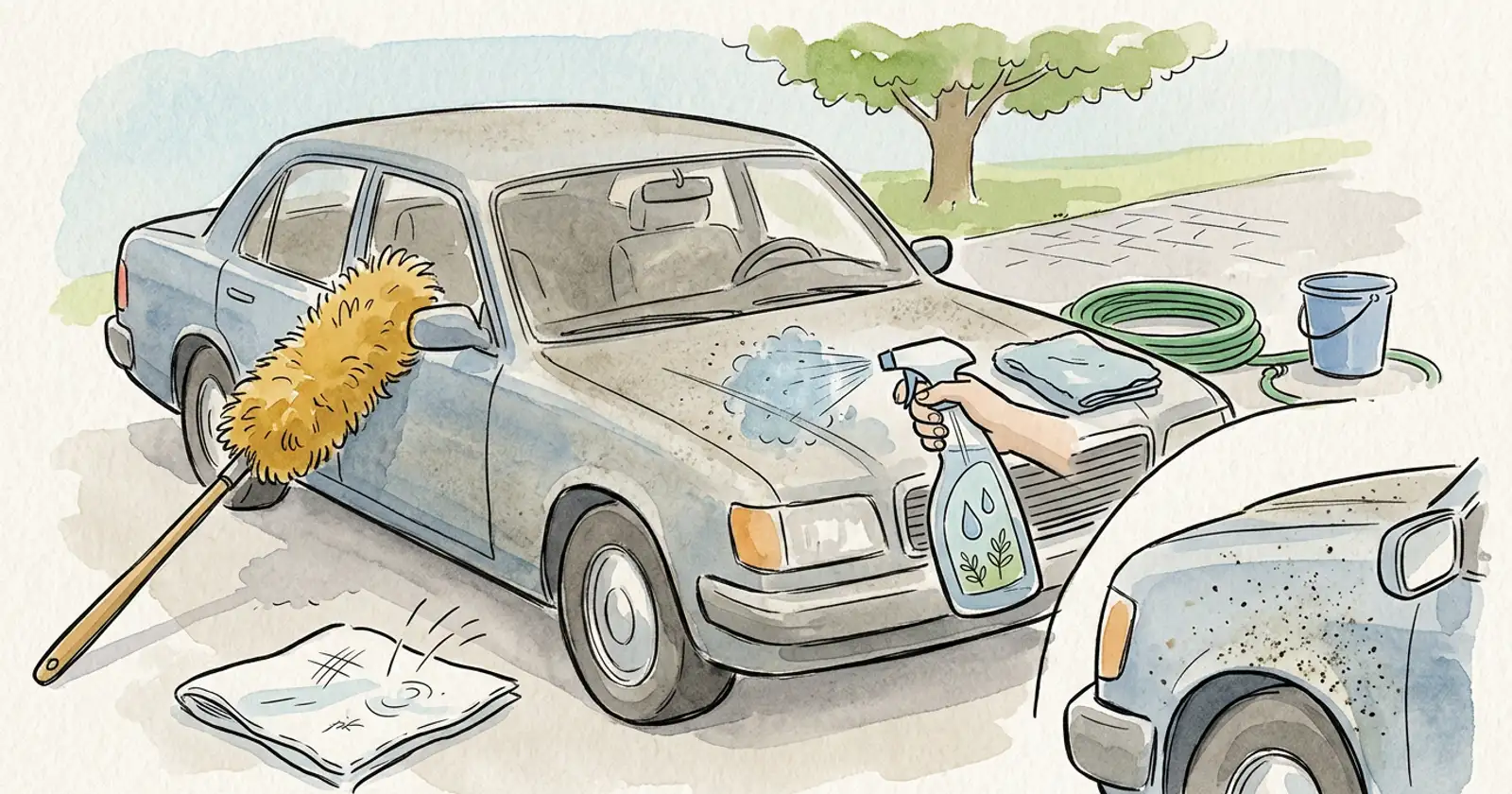
The duster maker’s pitch is that its baked-in wax lifts dust in one pass with no water or spray. Owners who like them stress dusting rather than wiping, and one said to use it only for light dust and pollen. One long-time user in the discussion said the same duster, owned since 2007 for a black car, still does the job. That matches the one realistic use case: a garage-kept car with a protected finish and a thin layer of dry household dust.
The owners who hate them aren’t wrong either. Replies called them a scratch risk, especially on black paint, because the strands trap the grit they pick up and drag it across the finish. If the dust is thick enough to write your name in, or it’s been rained on, or the car lives outside, skip the duster.
When to use waterless or rinseless
Waterless is the between-washes tool for a lightly dusty car with no hose. Spray a panel, wipe one direction with a plush towel, flip to a dry side, move on. The limit is in the name of every kit: light dust and film only.
Rinseless does more. Because the towel is soaked in a bucket of solution, the dirt is lubricated and carried away instead of pushed around. One maker’s directions are 1 oz of concentrate to 1 or 2 gallons of water, which from a $19.99 bottle is about 62 cents of product per wash. It’s the method we recommend for washing in winter without a spigot and for a dark car in desert heat, and it works just as well for the Tuesday dust layer.
A plain hose rinse with no touching is safer still, if your water doesn’t spot. Our guide to spot-free rinsing at home covers filters and deionizers.
When to leave it alone
Pollen season is the time to stop fighting. In Portland, Maine, the local TV meteorologist’s explainer says pine pollen typically peaks in early to mid-June, starts showing up in late May, and is mostly gone by July; a colder-than-normal May holds the trees back a little longer. One owner in the dust discussion found a garage-kept car coated in pollen after a weekend, with the garage door opened only a few times. Dusting that daily means dragging abrasive pollen across the paint daily. Wash it properly when the season breaks, and until then rinse it when you can and ignore it when you can’t. If the car has sat through the whole season, use our first-wash order.
Inside the car, dust is mostly static and what you carry in. Replies to an owner wiping the dash every few days pointed to alcohol wipes making static worse, a damp microfiber instead of a dry one, and an anti-static interior detailer. Our matte protectant guide covers which finishes hold less dust.
Sources
Based on 6 sources · How we price
- Eckler’s, The Original California Car Duster: ecklers.com/the-original-california-car-duster-25-253898-1.html
- Shine Supply, The Waterless Wash Kit: shinesupply.com/collections/shine-kits/products/waterless-wash-kit
- Element Armor, Waterless Wash + Wax 16 oz (Woot listing with maker’s instructions): tools.woot.com/offers/element-armor-waterless-wash-wax-16oz-2
- Detailed Image, Optimum No Rinse Wash & Shine 32 oz: detailedimage.com/Optimum-OPT-M36/No-Rinse-Wash-Shine-2010-Formula-P444/32oz-S1
- Gold Eagle, 303 Automotive Protectant: goldeagle.com/?p=9933
- WGME (Portland, ME), Climate Chronicles: Why is pollen everywhere right now? (June 11, 2026): wgme.com/news/local/climate-chronicles-when-will-pine-pollen-stop-covering-our-cars