That’s the pattern in car-care forums. One owner said a sedan bought three weeks earlier still smelled of the salesman’s cologne, seats and trunk alike. Another left meat in the car for two weeks. An enzyme treatment “helped for a minute,” then the smell returned.
Rule one: find the source, then remove it
EPA ranks the ways to control indoor air pollution. Source control comes first, ventilation second. Air cleaning is a backup when the first two fall short. The same order works in a car. A car that has spent weeks in a container is another source of odor; see what to clean on an imported car first.
Get close to the seats, carpet, trunk and spare-tire well and sniff. For urine, an animal welfare group’s guide says a black light will usually show even old stains.
Odor by odor
| Odor | What it is | What breaks it down | When to extract or replace |
|---|---|---|---|
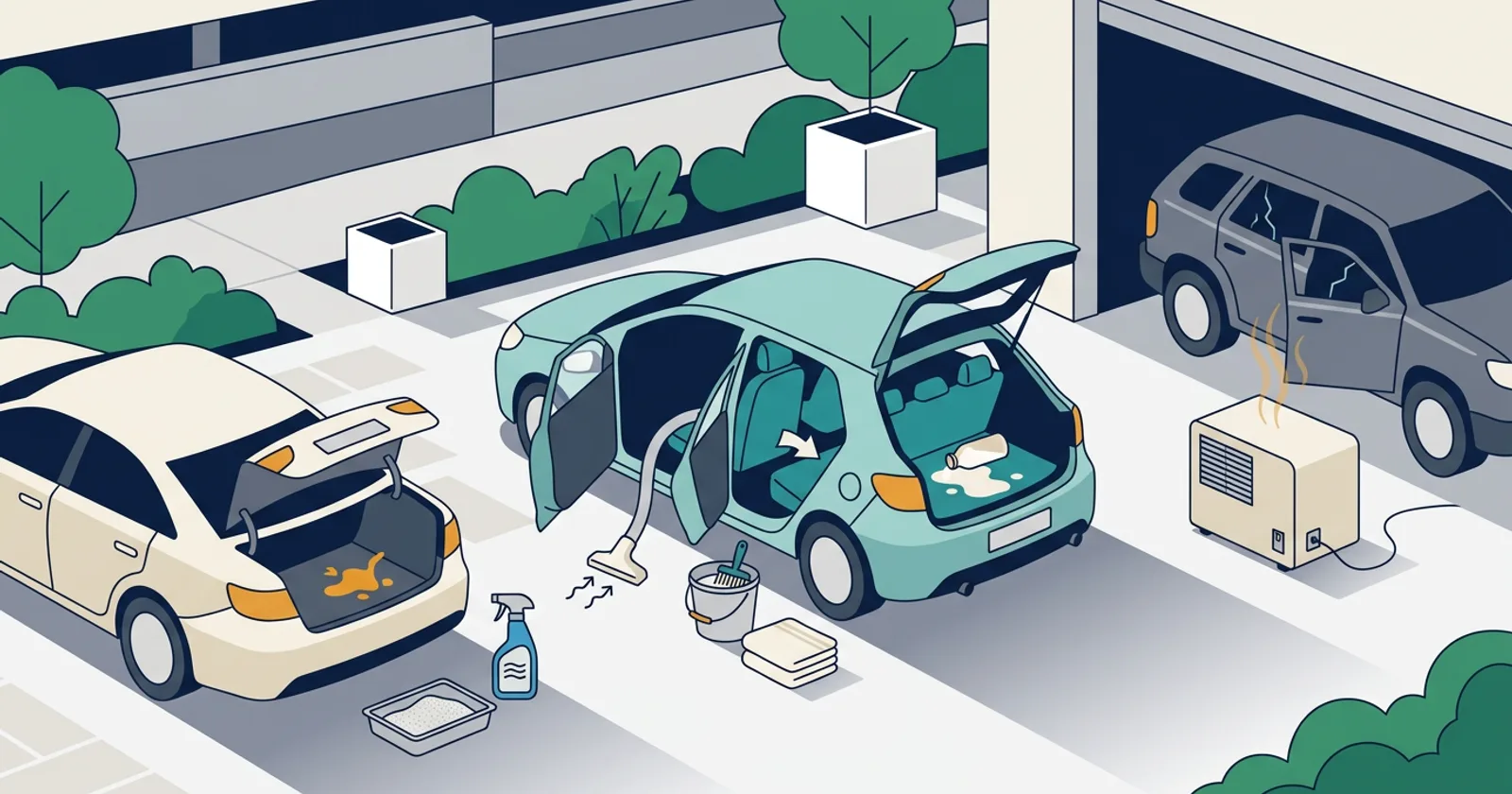
| Cat urine | Uric acid crystals that bind to fabric and don’t dissolve in water | Enzyme cleaner, applied deep enough to reach the cushion or pad | When it soaked the carpet pad or seat foam and repeat treatments fail |
| Spilled milk | A protein stain | Cold water first, then an enzyme product | When it ran under the carpet or into the seat foam |
| Cologne or perfume | Fragrance soaked into cloth | Lukewarm water with dish soap and vinegar, alcohol on stubborn spots, then fresh air | When one panel still smells after cleaning; have a detailer extract it |
Cat urine: go as deep as it went
Cat urine takes the most care of the three. An Ask Extension expert, answering a Marion County, Oregon, resident in April 2026, explained why. Cat urine contains uric acid crystals that bind tightly to fabric and aren’t water-soluble. The smell can come back when humidity rises, long after the spot looked clean.
- Blot fast. The animal welfare guide says the more fresh urine you remove before it dries, the easier the odor is to remove.
- Skip steam and strong cleaners. The same guide warns that steam can set the odor for good, and that ammonia and vinegar don’t remove it.
- Rinse and extract. Flush with cool water, then pull it back out with a wet-vac or extractor.
- Soak with enzymes. One pet enzyme cleaner’s label says to use enough to reach the upholstery and the cushion underneath, and to let it stand at least 1 hour. Older odors may need more than one round.
If you already tried other sprays, rinse first. The guide says leftover cleaners can weaken an enzyme cleaner. If urine reached the padding, it says you may need to replace that section. Pet hair is a separate job; see how detailers price pet hair.
Spilled milk: cold water, then enzymes
Milk is a protein stain. Iowa State University Extension says to use cold water on protein stains and never hot water first, since heat can set the stain. So no steam on a fresh milk spill.
Blot, flush with cold water and extract. Then use an enzyme product. A Michigan state stain guide for laundry suggests soaking stubborn protein stains in an enzyme product for at least 30 minutes. You can’t soak a car seat, so keep the spot damp with the cleaner instead, then extract.
The smell lives where the milk ran: under the seat rails, into the foam and into the carpet pad. Pull the floor mats and look underneath. Clean only the surface and the sour smell will be back.
Cologne: wash the fabric, then air it out
Fragrance is the easiest of the three, because nothing is spoiling. The Michigan guide groups perfume with stains you soak at least 15 minutes in lukewarm water with a little dish soap and white vinegar. For stubborn spots, it says to sponge with alcohol from the edge toward the center. On a car seat, apply these with a damp cloth instead of soaking. Test anything on a hidden spot first.
Then let air do the rest. EPA lists outdoor air ventilation as the second most effective approach. Park somewhere safe with the windows cracked on dry days. EPA notes that gas-adsorbing material is sometimes used when source control and ventilation fall short, so an odor-absorbing product is a fair backup.
What about ozone?
Many detailers sell ozone treatments, so know what EPA says first. At levels that don’t exceed public health standards, EPA says ozone isn’t effective at removing many odor-causing chemicals. It cites research suggesting ozone may mask body odor rather than remove it. Higher levels are sometimes used in unoccupied spaces, but EPA says little is known about the by-products left behind. EPA also warns that inhaled ozone can damage the lungs.
Ozone should come after the source is cleaned, not instead of it. Ask the detailer how long the car sits and airs out before you get it back.
What a detailer charges
One mobile detailer lists a $50 ozone add-on. Another charges $100 for an odor elimination treatment. A dedicated odor-removal service starts at $289, and its most severe level starts at $1,289.
Ask what the price includes: extraction, enzyme treatment, ozone, and whether they’ll pull seats or carpet. Compare it with what each interior detail tier covers, and get the scope in writing. If the smell is back a week later, here’s how to ask for a fix.
Sources
Checked 2026-10-09. How we check facts: methodology.
- U.S. EPA, Ozone Generators that are Sold as Air Cleaners: epa.gov/indoor-air-quality-iaq/ozone-generators-are-sold-air-cleaners
- Ask Extension (Oregon State University Extension response), How to eliminate cat odor that has permeated items: ask.extension.org/kb/faq.php?id=927814
- Iowa State University Extension and Outreach, AnswerLine, Holiday Stains: blogs.extension.iastate.edu/answerline/2022/12/13/holiday-stains
- State of Michigan, Tips for getting stains out of your laundry: michigan.gov/fyit/housing/tips-for-getting-stains-out-of-your-laundry
- Animal Welfare Association, Removing Pet Odors and Stains (PDF): awanj.org/wp-content/uploads/Removing-Pet-Odors-and-Stains-2019.pdf
- Rocco & Roxie, Stain & Odor Eliminator (product label and directions): roccoandroxie.com/products/carpet-cleaner
- AZ Mobile Detail, Add-ons: azmobiledetailing.com/add-ons
- Wash My Mobile, Pricing: washmymobile.com/pricing
- 713 Steam, Car Odor Removal: 713steam.com/car-odor-removal-austin
- Community discussion (cologne smell in a used car): reddit.com/r/AutoDetailing/comments/1ktt4xg
- Community discussion (meat odor in a trunk): reddit.com/r/AutoDetailing/comments/1kq8v7e