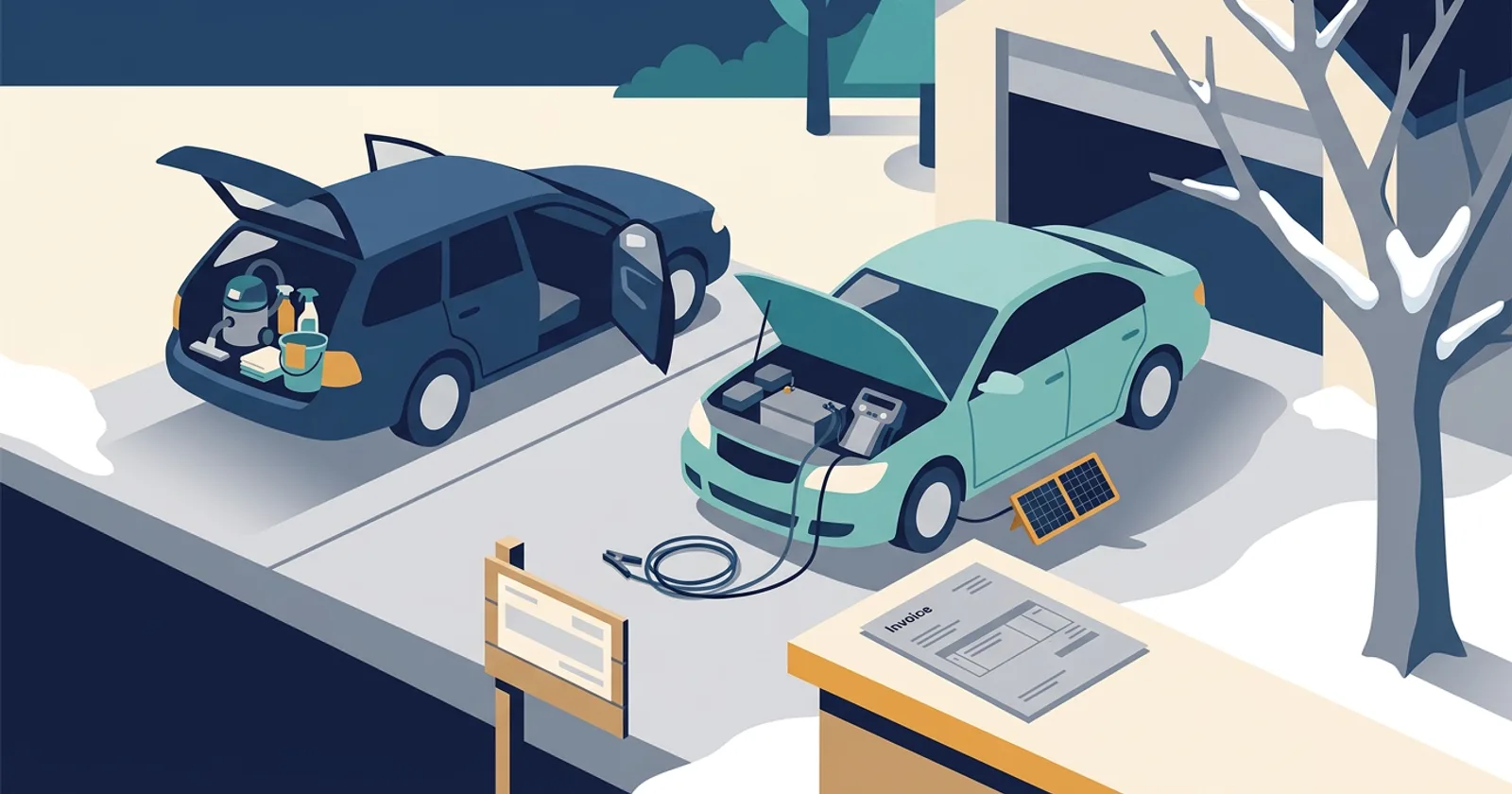
An interior job keeps doors open for a long stretch. The dome light, door lights and map lights stay on. A tired battery in a cold driveway may not hold up.
Why it happens
Automakers warn about this in plain words. One automaker’s owner’s manual tells drivers not to use the interior lights for long periods when the car isn’t on, because it may cause battery discharge. The same manual explains that, on cars with the feature, the interior lights turn themselves off about 20 minutes after the car is switched off. But if a door is opened with the car switched on, the lights stay on continuously. On a car like that, a detailer who leaves the key on for the radio or the windows defeats the very feature meant to save the battery.
Age is the other half of the story. A national motor club says the average car battery lasts three to five years, and that all the electronics in newer cars may push that closer to three. A battery near the end of that range has less in reserve, and a long interior job is often what tips it over. Owners of electric cars can also read about washing an electric car.
Then there’s cold. The same motor club’s research center reports that at 32°F a car battery loses about 35 percent of its strength. At 0°F it loses about 60 percent. Starting may also need up to twice the normal current when temperatures drop. In the Twin Cities, the normal January temperature is about 16°F, according to Minnesota DNR climate data. That’s well below freezing on average, so a weak battery has less margin on a January detail. Detailers who work through the cold season can read how mobile detailers get through winter.
Detailers see it too. On one detailing forum, a detailer said it had happened three times in about 10 years, and asked whether the open doors made them partly to blame.
How to prevent it
If you’re the car owner
- Check your owner’s manual for the interior light controls. It shows what switches your car has and how the lights time out.
- Tell the detailer the battery’s age. “It’s the original battery” is useful to hear before the doors open.
- Watch for warning signs. The motor club lists dim or yellow headlights and dome lights that look dim or flicker. If you see these, consider having the battery checked before you book.
Booking blind is one of the mistakes to avoid when hiring a mobile detailer. Give the detailer what they need to know up front.
If you’re the detailer
- Ask about battery age when you book. One question saves an awkward pickup.
- Turn the interior lights off first thing, using the car’s own switch, and glance at them again before you leave.
- Keep the ignition off when you can. A phone and a speaker can play your music.
- Close doors between sections. Less open-door time means less light time.
- Consider carrying a jump pack, following its maker’s instructions. It could belong on any mobile detailing startup gear list.
- Put a battery note on your booking form. Something simple: “Doors will be open during interior work. Older batteries may drain. Please tell us if yours is over three years old.”
If it happened to you: who pays?
The car won’t start, and the detailer is packing up. Start with a question, not an accusation. “My car won’t start. Any idea what happened?” goes further than “You killed my battery.”
If a jump gets the car running and it starts normally afterward, the problem is solved. If the battery won’t hold a charge and has to be replaced, sort out the cause first.
| What happened | One common way to settle it |
|---|---|
| Battery was old or already weak | Owner pays for a new battery; detailer offers a free jump |
| Detailer left lights or ignition on after the job | Detailer covers the fix |
| Unclear, normal open-door job | Split: detailer offers a discount, owner buys the battery |
This isn’t legal advice or a rule, just one way people settle it. If the conversation gets stuck, our guide to finding a reliable mobile detailer explains why to ask about insurance before you book, and how to check it.
Keep it calm and give the detailer a fair chance to make it right. It is the same approach as when you are unhappy with the finished work.
Sources
Checked 2026-10-08. How we check facts: methodology.
- AAA Minneapolis, 5 Signs Your Car Battery Won’t Make it Through Winter: minneapolis.aaa.com/magazine/fall-2024/5-signs-your-car-battery-wont-make-it-through-winter
- AAA Hudson Valley, Cold Weather Is Hard on Your Car Battery: hudsonvalley.aaa.com/?p=10824
- Kia owner’s manual, Interior lights: ownersmanual.kia.com/full_webhelp/DEEV/2022/en_RG/topics/chapter5_20.html
- Kia owner’s manual, Interior lights, automatic turn off function: ownersmanual.kia.com/full_webhelp/DEEV/2022/en_RG/topics/chapter5_20_1.html
- Kia owner’s manual, Interior lights, lamp operation: ownersmanual.kia.com/full_webhelp/DEEV/2022/en_RG/topics/chapter5_20_2.html
- Minnesota DNR State Climatology Office, Twin Cities normals 1991-2020: dnr.state.mn.us/climate/journal/twin-cities-normals-1991-2020-compared-1981-2010.html
- Community discussion (detailing forum): autogeekonline.net/threads/customers-battery-dead-after-detail.96473