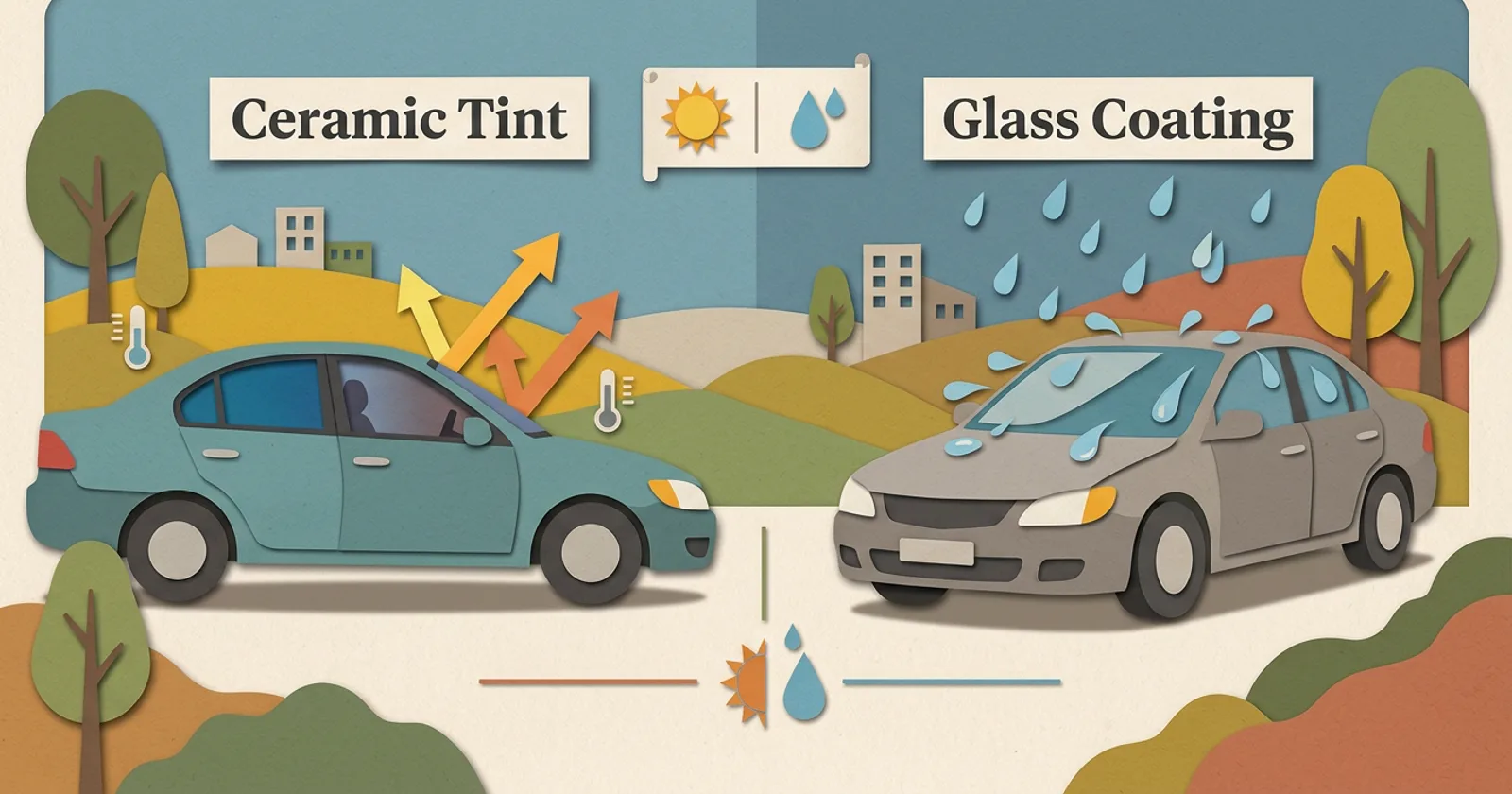
If your goal is a cooler car in summer, the film is what you’re shopping for. A coating can be a nice add-on, not a substitute.
That matters in hot markets. Jacksonville averages about 80 days a year at 90°F or hotter, and about 60 of them fall in June, July and August, according to NOAA’s 1991–2020 normals.
What each one costs and does
| Product | Published price | What it changes |
|---|---|---|
| Ceramic window film, full vehicle | $480 ceramic; $580 high-performance IR; $850 premium (Blackout, Gilroy, CA); windshield priced separately | Rejects part of the sun’s heat and UV; darkens the glass |
| Windshield film | $150–$350 (CDC Detailing guide) | Heat through the largest window; darkness limits apply |
| Glass coating, all exterior windows | $140, or $100 with a paint coating (Reyes Revive, Omaha) | Water beading and easier cleaning |
| Glass coating add-on | $200 (Smith Bros Mobile Detailing) | Same |
| DIY glass sealant | $14.99 (Adam’s) | Water rolls off; maker says it lasts 4 to 6 months |
A New Jersey shop’s guide says film type drives 60% to 70% of a tint price. Two quotes for the same car can be selling different films, so ask for the film series by name.
What film does for heat
Film makers publish heat numbers, and the key one is total solar energy rejected. One maker’s data sheet says its premium film rejects up to 64% of the total solar energy coming through vehicle windows. It also lists infrared rejection of up to 68% and blocks up to 99.9% of UV light.
Compare films on the same measure and the same darkness. Makers use different infrared measures, so an infrared number from one brand doesn’t line up with another’s.
Windshield film is usually a separate line item. Ask whether your quote includes it and what your state allows on the windshield.
What a glass coating does
A glass coating is about water. One installer says its coating bonds to the windows to repel water, dirt and bugs for better visibility. One maker’s consumer glass sealant says water rolls away above 30 mph and that it lasts 4 to 6 months.
None of the coating products or services we checked claims to cut cabin heat. On a windshield, a coating can also change how wipers behave. See wiper chatter on a coated windshield.
Darkness limits
Every state sets its own tint rules. Florida’s statutes are one example. Front side windows must let at least 28% of visible light through. Windows behind the driver must let at least 15% through on many vehicles. Rules differ elsewhere, so check your state’s published limit and ask the shop how it meets it. This isn’t legal advice.
Questions to ask a tint shop
- Which film series is this, and what total solar energy rejection does its data sheet list at the darkness I’m getting?
- Is the windshield included, and is a clear or light windshield film an option?
- Does the price include removing old film?
- What does the warranty cover, and who backs it, the shop or the film maker?
- Will the darkness I’m choosing meet my state’s published limit?
Get the film name and darkness written on the invoice. It makes a warranty claim, or a question at inspection, much easier.
Other ways to beat the heat
A windshield sunshade is the cheap option for a parked car. Our guide to cracked dashboards in hot states compares sunshades, film and dash covers. If you’re coating the paint anyway, the ceramic coating cost guide covers what that adds.
How we research our articles: methodology.
Sources
Based on 9 sources · How we price
- NOAA NCEI, 1991–2020 annual and seasonal normals, Jacksonville International Airport (USW00013889): ncei.noaa.gov/access/services/data/v1?dataset=normals-annualseasonal-1991-2020&stations=USW00013889&dataTypes=ANN-TMAX-AVGNDS-GRTH090,JJA-TMAX-AVGNDS-GRTH090&format=json
- Blackout, pricing (Gilroy, CA): gilroyblackout.com/pricing
- CDC Detailing, car window tinting cost (Pitman, NJ): cdcautodetailing.com/what-is-the-cost-of-tinting-windows-on-a-car
- Reyes Revive, ceramic coating (Omaha, NE): sites.google.com/view/reyes-revive/ceramic-coating
- Smith Bros Mobile Detailing, ceramic coating: sbmobiledetailing.com/services/ceramic-coating
- Adam’s Polishes, Glass Sealant: adamspolishes.com/products/adam-s-glass-sealant
- 3M, Automotive Window Film Crystalline Series technical data sheet (PDF): multimedia.3m.com/mws/media/2672231O/3m-automotive-window-film-crystalline-series-technical-data-sheet.pdf
- Florida Statutes 316.2953, side windows: leg.state.fl.us/statutes/index.cfm?App_mode=Display_Statute&URL=0300-0399/0316/Sections/0316.2953.html
- Florida Statutes 316.2954, windows behind the driver: leg.state.fl.us/statutes/index.cfm?App_mode=Display_Statute&URL=0300-0399/0316/Sections/0316.2954.html