Why a coated windshield makes wipers chatter
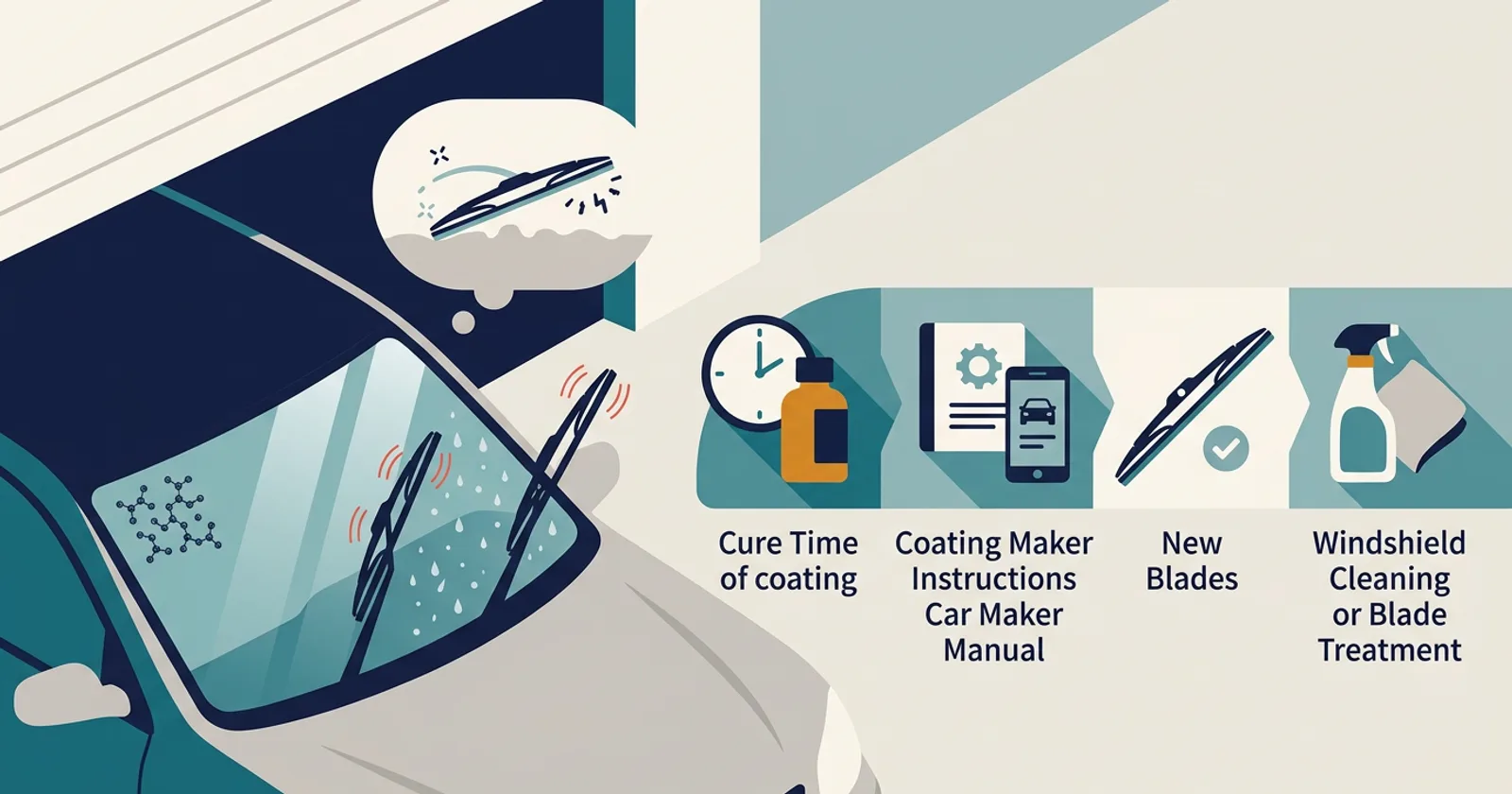
A wiper blade is built to drag across wet glass. It flips its rubber edge at the end of each stroke and drags back the other way. When the friction changes from one spot to the next, the blade can skip instead of glide.
One car maker’s service bulletin spells this out. It says residue you can spot by water beading causes “differences in the friction values” that can make the blades vibrate. It names wax residue as the usual cause, but also water-repellent nano-particle paint coatings and silicone-based washer fluid.
That is the catch with a glass coating. Its whole job is to make water bead. If the coating went on thick in one spot and thin in another, or wasn’t buffed off evenly, the glass has slick and less-slick zones. The blade feels every one of them.
Why you only notice it when the first rain comes
In one community discussion, a Southern California driver used a ceramic spray coating on the glass, then heard the wipers grabbing on the first rainy day, a couple of weeks later. That timing makes sense.
Downtown Los Angeles averages only 0.24 inch of rain from June through September combined, out of 14.25 inches a year, based on NOAA’s 1991-2020 normals. A coating you apply in summer may not meet a real rainstorm for months. By then, the blades have sat unused too, and one car maker notes that long periods of disuse can deform them.
Is it dangerous?
Treat it as something to fix, not ignore. One car maker’s owner’s manual warns that worn blades can damage the windshield and impair driver vision. A wiper maker’s checklist says chatter marks mean a new blade is “urgently needed.” If the wipers aren’t clearing your view, fix them before you rely on them.
The fixes, in order
| Step | What to do | Who says so |
|---|---|---|
| 1. Respect the cure | Keep the glass dry 12 to 24 hours after coating, per your product | Gtechniq; Adam’s Polishes |
| 2. Give it time | Some judder can fade within two weeks | Gtechniq |
| 3. Clean the blades | Washer fluid or mild detergent on a cloth, then rinse; no fuel or petroleum products | Nissan; Toyota |
| 4. Check for patchy beading | If some areas bead and some don’t, the friction is uneven; remove residue evenly | Mercedes-Benz |
| 5. Coat the blades (optional) | Only with a glass coating that lists this step | Gtechniq |
| 6. Replace worn blades | After cleaning, not before | GM; Mercedes-Benz; Bosch |
| 7. Check the arm | Wrong blade angle or arm pressure can cause chatter | GM; Bosch |
A few notes on the steps:
- Cure time. One glass coating maker says to keep the car out of the elements for at least 12 hours. Another says to keep its coating away from water for 12 to 24 hours.
- Give it two weeks. The first maker says that in 90% of cases, judder after its coating disappears within two weeks.
- Clean before you buy. One car maker’s tech bulletin tells dealers to clean the glass and the blades first, and to replace blades only if the problem comes back after cleaning. Another warns against using fuel, kerosene or petroleum products on the rubber.
- Blades last test. One car maker’s bulletin says to swap blades only once the windshield has no water-repellent areas left. New rubber on patchy glass can chatter just like the old rubber.
- The arm. A wiper maker’s checklist says that after a windshield replacement, a shop should check the wiper pressure and angle. One car maker’s bulletin lists high arm force and a blade that doesn’t sit at the right angle as chatter causes.
When the coating itself is the problem
Car makers and coating makers want opposite things. A car maker’s owner’s manual says your windshield is clean “if beads do not form” when you rinse it with clear water. A glass coating is designed to make water bead. So following a car maker’s cleaning steps all the way may strip the coating.
That can be the right call. If chatter lasts well past two weeks, the blades are fresh and the arm checks out, the coating may be uneven or the wrong product for glass. Ask your installer how to remove it and start over. Before recoating, one coating maker highly recommends claying or polishing the glass first, then buffing until the glass is streak-free and clear.
If a detailer coated the glass, raise chatter with them first. Our list of booking mistakes covers what to ask about aftercare before you pay. Thinking about doing it yourself? Our guide to DIY coating vs a pro job covers prep and cure. For spots that won’t wipe off, see water spots on a coated car. For what pro coatings cost, see our ceramic coating cost guide.
How to avoid chatter next time
- Prep the glass first, per the coating maker. One recommends clay or a glass polish.
- Buff off all the residue so the glass is evenly clear.
- Keep the glass dry through the full cure time on the label.
- Start with blades in good shape. One wiper maker says to replace them at least once a year.
- Pick a coating whose directions cover windshields, and follow its prep and cure steps.
See how we research our articles.
Sources
- Gtechniq, G1 ClearVision Smart Glass: gtechniq.co.uk/shop/auto/glass-metal/g1-clearvision-smart-glass
- Adam’s Polishes, Graphene Ceramic Glass Coating Advanced: adamspolishes.com/products/graphene-ceramic-glass-coating-advanced
- Mercedes-Benz, Complaints About Noises or Poor Windshield Wiper Wiping Performance (LI82.30-P-059239, 2026), via NHTSA: static.nhtsa.gov/odi/tsbs/2026/MC-11032875-0001.pdf
- GM TechLink, Wiper Blade Performance Diagnosis: gm-techlink.com/?p=18874
- Toyota, T-SB-0185-13 Wiper Blade Maintenance and Cleaning, via NHTSA: static.nhtsa.gov/odi/tsbs/2013/SB-10061645-2280.pdf
- Nissan X-Trail 2024 Owner’s Manual, Cleaning (wiper blades): nissan.ie/ownership/car-owner-manual/manuals/iom/xtrail/0t33/e1/2024/cleaning-1.shtml
- Bosch, Tips and tricks for keeping Bosch wiper blades in good shape: boschaftermarket.com/xrm/media/images/parts/wiper_baldes/pdf_45/en_1/factsheet_bosch_windshield_cleaning_tips_tricks.pdf
- Bosch, Clear view: maintenance of Bosch wiper blades: boschaftermarket.com/xrm/media/images/country_specific/za/parts_9/wba_tipps_tricks_wischblattpflege_2pager_en_87039.pdf
- NOAA NCEI, 1991-2020 monthly precipitation normals, Los Angeles Downtown USC Campus: ncei.noaa.gov/access/services/data/v1?dataset=normals-monthly-1991-2020&stations=USW00093134&format=csv&dataTypes=MLY-PRCP-NORMAL&includeStationName=true
- NOAA NCEI, 1991-2020 annual precipitation normals, same station: ncei.noaa.gov/access/services/data/v1?dataset=normals-annualseasonal-1991-2020&stations=USW00093134&format=csv&dataTypes=ANN-PRCP-NORMAL&includeStationName=true