Below are the platforms’ own rules on minimum spend and billing. You’ll also find the math to judge your numbers and the reasons they swing.
One owner’s numbers
In an April 2026 thread on a small-business forum, a detailing owner shared ad results from the biggest social network. They posted roughly $4 per lead, $40 per booked job and a 3.5x return on ad spend. They couldn’t find figures for detailers online. They wanted numbers from real businesses, not agency gurus.
The first two numbers imply a booking rate: $40 per booking ÷ $4 per lead = 10 leads per booking. So about 1 in 10 leads booked.
The replies came from strangers and can’t be checked. One said their leads ran $7 to $8 before they switched to better before-and-after photos. Another claimed in-app form leads should cost $1 to $2, with one in five booking. Another said form leads come cheaper but are lower quality. Treat all of it as anecdote. Most replies shared one point that holds up on its own. $40 per booking is only “good” next to what the job is worth.
Your break-even lead price
You need three numbers from your own records:
- Average ticket for jobs that came from ads.
- Job cost: supplies, fuel and your time on that job at the wage you’d pay yourself.
- Booking rate: booked jobs ÷ leads.
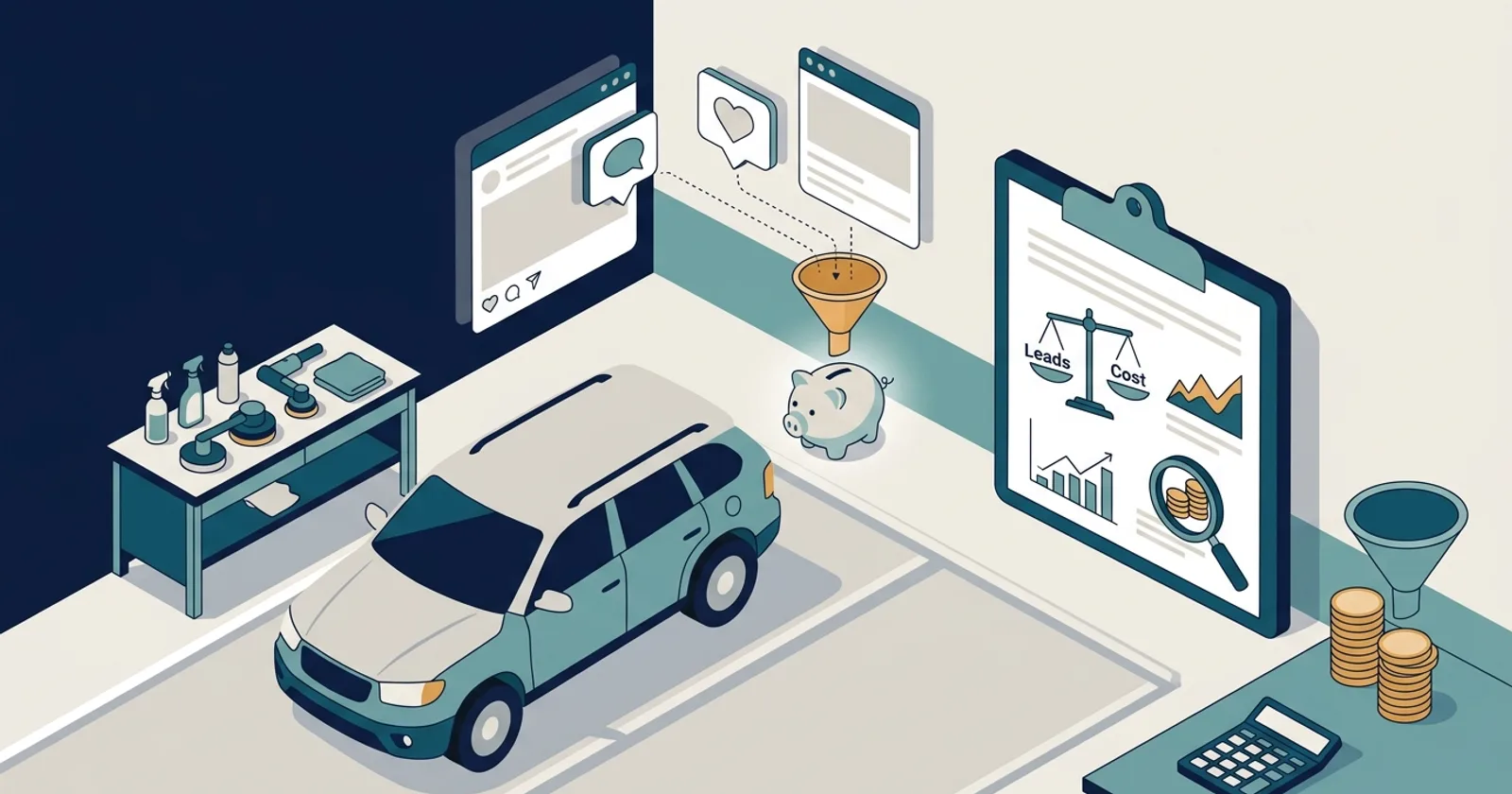
Ticket minus job cost is the most you can pay for one booking. Multiply that by your booking rate to get the most you can pay per lead.
Here’s a worked example with made-up round numbers. A $200 job that costs $120 to do leaves $80, so $80 is your ceiling per booking. At 1 booking in 10 leads, $80 × 0.10 = $8 per lead. At 1 in 5, $80 × 0.20 = $16 per lead.
Doubling your booking rate doubles what you can afford per lead. That’s why fast follow-up matters as much as the ad. A simple booking setup with reminder texts and deposits helps here.
Be careful with return on ad spend. It’s revenue ÷ ad spend and ignores job costs. In the example, a $200 job bought with $80 of ads is $200 ÷ $80 = a 2.5x return. Yet it only breaks even. A customer who comes back raises your ceiling, so price the second visit with that in mind. If your ticket is too thin for any ad to work, revisit how much to charge first.
What platforms require upfront
| Platform | Minimum spend (its own help pages) | How billing works | What it means in dollars |
|---|---|---|---|
| Meta (Facebook, Instagram) | No fixed figure; depends on vertical, bid strategy, optimization and currency. Ads Manager alerts you if a budget is too low | Usually per impression. Cards charged at a payment threshold and on the monthly bill date. New accounts spend $10 on impression billing before other charge types | Can spend up to 75% over the daily budget on a given day, but no more than 7× the daily budget in a week |
| TikTok | Daily budget: campaign over $50, ad group over $20 | Lifetime ad group minimum = days × daily minimum | Its own example: $20 × 31 = $620 for a 31-day ad group |
| Nextdoor | You choose a daily budget | Charged 30 days upfront (daily budget × 30), then every 30 days; a cancelled ad runs to the end of the period | $10 a day = $10 × 30 = $300 upfront |
Rules as written on each platform’s help or product pages, checked October 9, 2026.
Two things catch new advertisers. First, the biggest network’s daily budget is an average, not a cap. A $20 daily budget can spend up to $20 × 1.75 = $35 on one day. It can’t spend more than $20 × 7 = $140 that week. Second, say you set a cost-per-result goal there. The help page says your daily budget should be at least 5 times that goal. An $8 lead goal means at least $8 × 5 = $40 a day.
Why your numbers won’t match
- What you optimize for. The biggest network’s help page says some optimization events need more budget than others, depending on how hard they are to achieve.
- How big your area is. Boise, Idaho, had about 238,429 residents in the Census Bureau’s July 2025 estimate. A detailer covering one city that size shows ads to the same finite pool every week. Results from a big metro won’t transfer.
- Form or landing page, and the photos. Both came up in the thread as reasons one owner’s leads cost more or less than another’s.
- The season. Demand drops when exterior work stops. See how mobile detailers get through winter.
Before you spend a dollar
- Log every lead and every booking from day one, or you can’t calculate any of this.
- Write down your ceiling per lead before you launch.
- Pick a test budget you can afford to lose entirely. Ads can lose money, and nothing here predicts what yours will return.
- Set up the free option first: a business profile listed as a service-area business.
How we checked these numbers: see our methodology.
Sources
Based on 8 sources · How we price
- Meta Business Help Center, Best practices for minimum budgets: facebook.com/business/help/203183363050448
- Meta Business Help Center, About daily budgets: facebook.com/business/help/190490051321426
- Meta Business Help Center, About getting charged: facebook.com/business/help/146070805942156
- Meta Business Help Center, How Meta charges for ads: facebook.com/business/help/716180208457684
- TikTok Business Help Center, About budgets for ads in TikTok Ads Manager: ads.tiktok.com/help/article/budget
- Nextdoor for Business, Reach more local customers on Nextdoor: business.nextdoor.com/en-us/local/advertise-with-nextdoor-broad
- U.S. Census Bureau, QuickFacts, Boise City city, Idaho: census.gov/quickfacts/fact/table/boisecitycityidaho/PST045224
- Community discussion, r/sweatystartup, “Car detailing business owners running meta ads” (April 2026; anecdotes only): reddit.com/r/sweatystartup/comments/1smsoc9