Two threads this year framed the question from both sides. In one, a detailer posted a 3.5-hour interior for $170 and asked whether to adjust prices; replies ranged from fair for a generally clean car to one detailer who would have charged $300. In the other, a parent asked whether $750 for a 4.5-hour full detail of a kid-wrecked minivan was normal; once it emerged two people worked it, some replies recalculated it as 9 labor-hours and about $80 an hour and called that more reasonable, while others still thought it high. Both arguments are the same arithmetic. Here’s how to run it on your own book.
The ten-job table
Log these columns for your last ten invoices: price, hours (door to door), labor-hours if you had help, miles driven, how you were paid. Then compute per hour and per hour after costs. Here are the two thread examples and three published menus that list price and time together.
| Job | Price | Hours | Per hour | After costs (card, 20 mi, insurance share, $5 product) |
|---|---|---|---|---|
| Interior, 3.5 h (r/Detailing poster) | $170 | 3.5 | $49 | $41 |
| Minivan full detail, two workers (r/Detailing poster) | $750 | 4.5 (9 labor-hours) | $167 ($83 per labor hour) | $79 per labor hour |
| Interior, SUV/truck/van (The Final Piece, St. Louis, MO) | $220 | 3 | $73 | $64 |
| Interior, two-door (The Final Piece) | $160 | 3 | $53 | $44 |
| Express wash, sedan (Most Excellent Auto Detail, Tampa and Orlando, FL) | $60 | 1.5 | $40 | $24 |
| Full detail, sedan (Most Excellent Auto Detail) | $259 | 3 | $86 | $76 |
| Ceramic maintenance wash (Blake’s Detailing and Upholstery Services) | $150 | 1.5 | $100 | $82 |
Costs used: a widely used processor’s in-person card fee of 2.6% plus 15 cents; the IRS business mileage rate of 76 cents a mile (July to December 2026) on a 20-mile round trip, $15.20; a $54-a-month general liability premium, the average an insurance marketplace reports for detailers, spread across 20 jobs, $2.70; and a flat $5 product allowance, our assumption. Published menus list service time, not drive time, so their real figures are a little lower. How we research: methodology.
What the deductions actually are
Card fees. In-person tap or dip runs 2.6% plus 15 cents on one widely used processor; an online or invoiced card payment is 3.3% plus 30 cents. On a $170 job that’s $4.57 or $5.91.
Miles. The IRS rate exists because driving costs more than gas. At 76 cents a mile, a 20-mile round trip is $15.20; a 50-mile one is $38. If your service area is wide, our travel-fee guide covers charging for it rather than eating it.
Insurance. An insurance marketplace reports detailers and car washes paying an average of $54 a month, or $646 a year, for general liability with $1 million per occurrence and $2 million aggregate limits. Divide your actual premium by your monthly job count and put that line on every job.
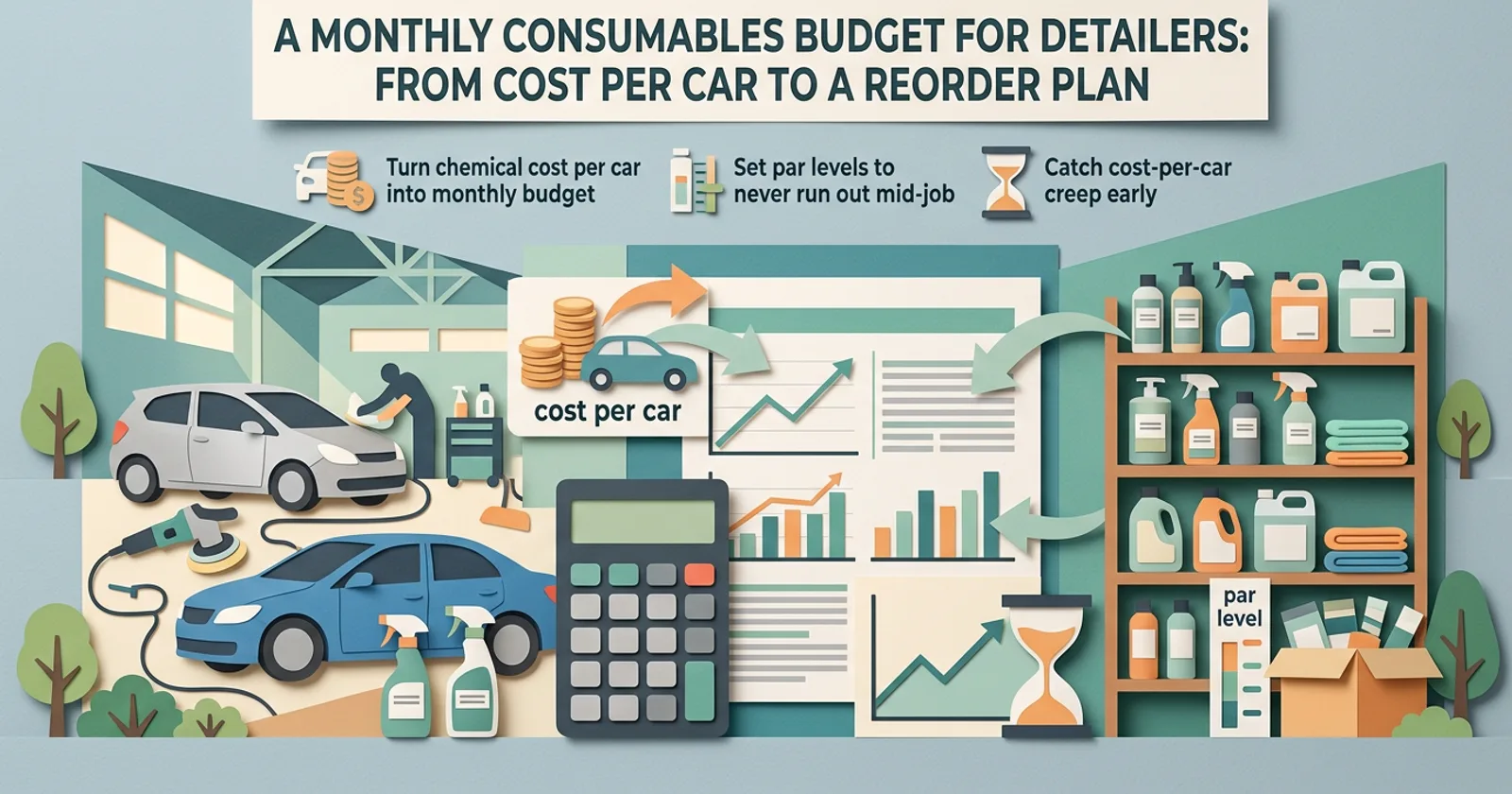
Product. A rinseless wash is about 62 cents of concentrate per bucket from a $19.99 bottle; interiors, dressings and towels add more. Our product cost per car guide works it out line by line; $5 is a round placeholder until you’ve done your own.
Not on the list: the van payment and the hours you spend quoting. This check is a floor, not a full P&L.
Reading your own numbers
Three patterns show up in almost every list.
The cheap quick job is the worst hour. A $60 express wash at 1.5 hours is $40 an hour before costs and about $24 after, because the fixed deductions don’t shrink with the ticket. Either the wash is a loss leader that feeds detail bookings, or the price is too low. Our maintenance wash pricing guide covers pricing the repeat visit so it isn’t a loss.
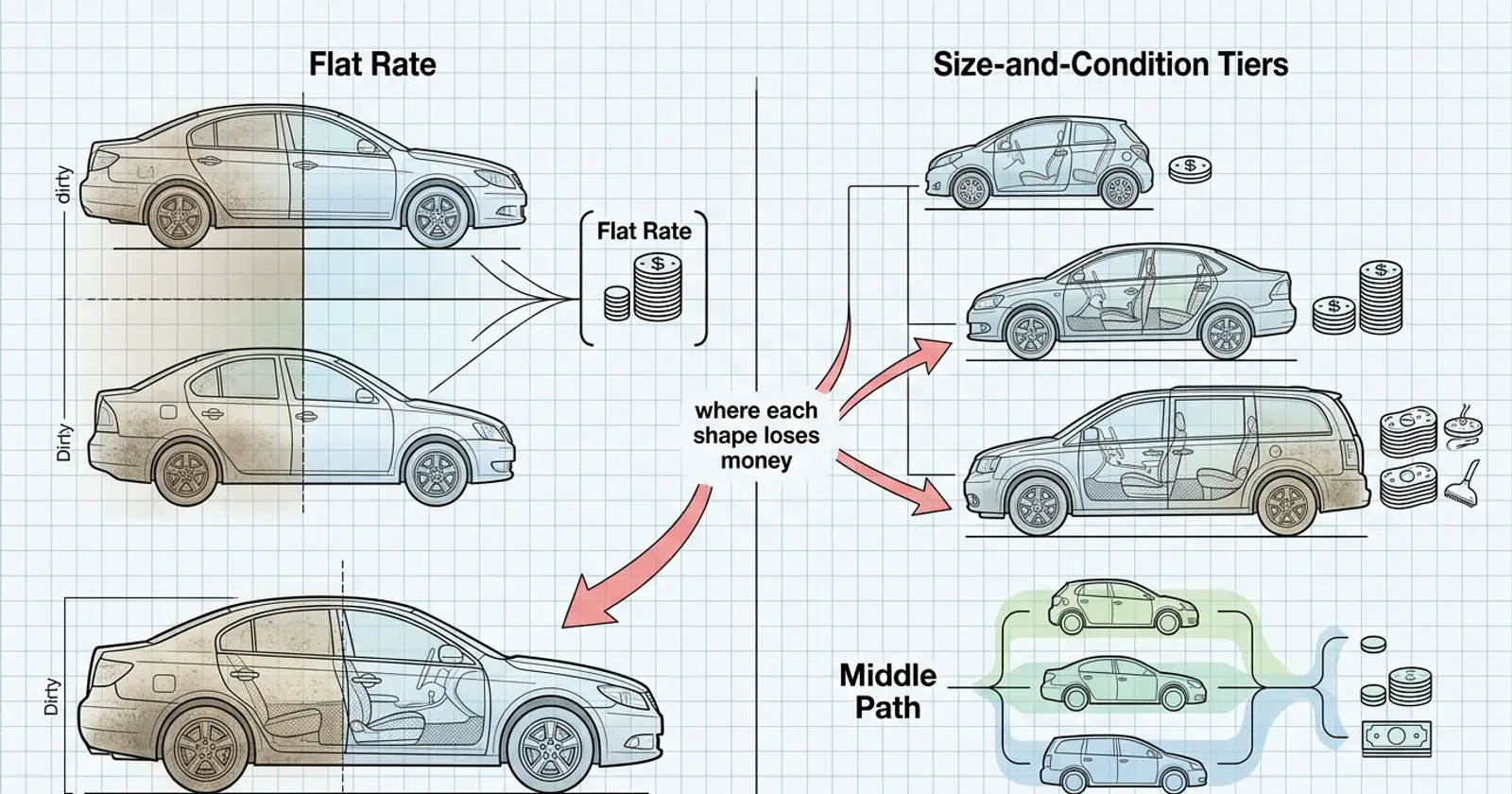
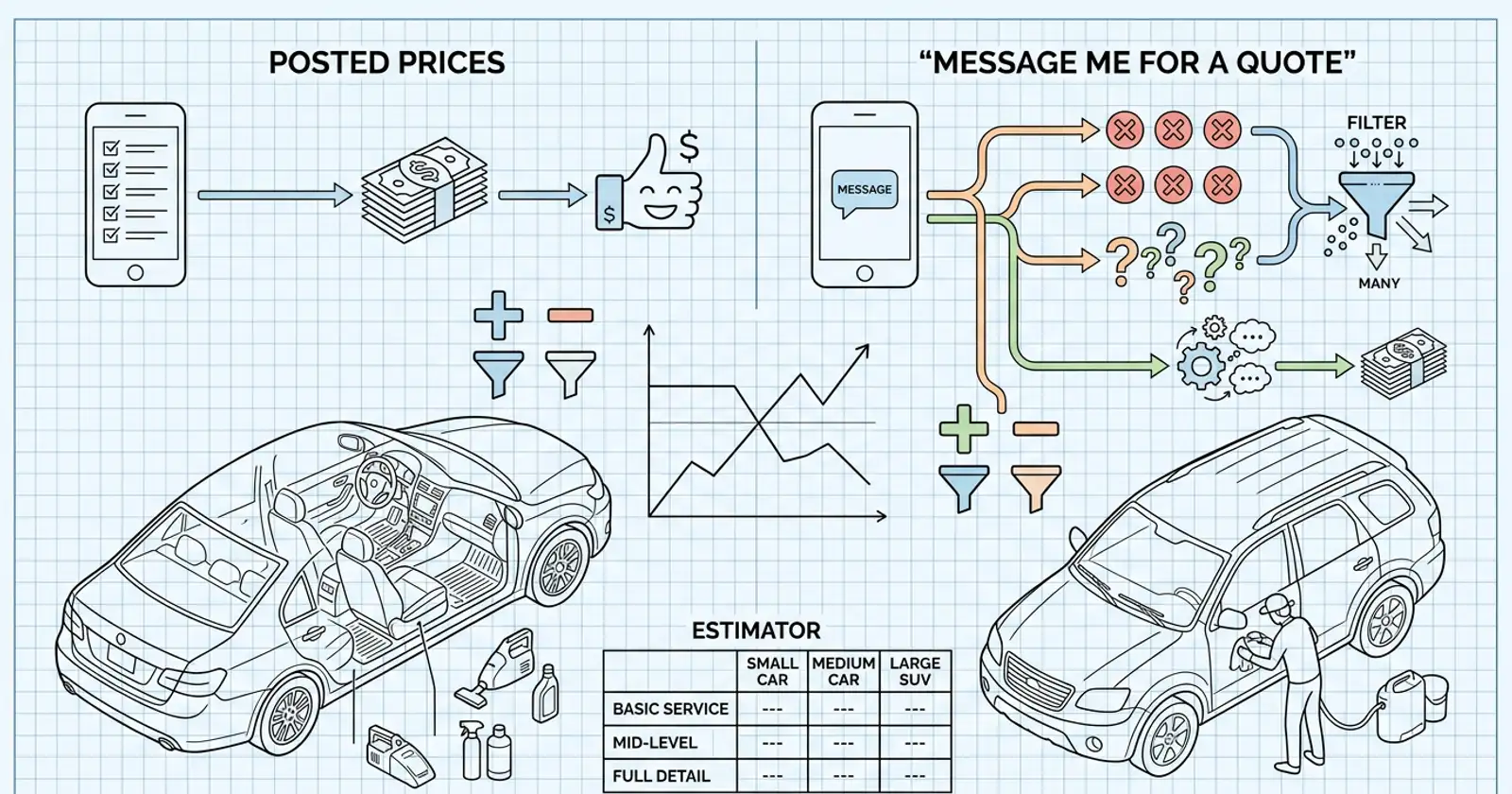
Condition is the hidden variable. The $170 interior would have been fine at two hours. Replies in that thread said the car “looked like it survived children,” and the fix they offered was a rate, $100 to $150 an hour depending on what you see, quoted up front. That means asking before you arrive; see quoting from photos.
Two people doesn’t double the price. The $750 minivan looks like $167 an hour until you count both workers; then it’s $83 per labor hour, and after costs about $79. If you’re paying a helper, their wage comes out of that too.
The comparison floor
The Bureau of Labor Statistics reported a median annual wage of $35,830 for employed cleaners of vehicles and equipment in May 2025, about $17 an hour over a 2,080-hour year. That’s what someone earns washing cars for a wage, with no van, no insurance and no unpaid quoting. Your after-cost hourly on a job should clear it by a wide margin, or you’re running a business to earn less than an employee. The $80 floor suggested in the first thread reflects that.
If several of your ten jobs land under your line, don’t cut corners on the work. Reprice the service, add a condition step, or raise the base; our guides to building prices from a cost floor and raising prices without losing regulars cover both.
Sources
Based on 8 sources · How we price
- U.S. Bureau of Labor Statistics, Occupational Outlook Handbook, Hand Laborers and Material Movers (Pay): bls.gov/ooh/transportation-and-material-moving/hand-laborers-and-material-movers.htm
- IRS, Standard mileage rates: irs.gov/tax-professionals/standard-mileage-rates
- Square, Processing fees and pricing: squareup.com/us/en/pricing
- Insureon, Auto Detailing and Car Wash Insurance Cost: insureon.com/auto-services-business-insurance/car-detailing-wash/cost
- Detailed Image, Optimum No Rinse Wash & Shine 32 oz: detailedimage.com/Optimum-OPT-M36/No-Rinse-Wash-Shine-2010-Formula-P444/32oz-S1
- The Final Piece (St. Louis, MO), booking page: book.heygoldie.com/The-Final-Piece
- Most Excellent Auto Detail (Tampa and Orlando, FL), workplace booking menu: form.jotform.com/261077143077052
- Blake’s Detailing And Upholstery Services, booking menu: book.heygoldie.com/Blake-s-Detailing-And-Upholstery-Services/checkout