The question behind this guide
A mobile detailer posted to a large detailing community that a nearby city wanted a quote for 12 to 15 utility vehicles, cleaned every two weeks and maybe weekly. Their retail full detail ran $175 to $235, and they’d heard fleets expect a discount. How much?
Most replies said the draft prices looked too low. One commenter who bills a city said public buyers want a fixed menu, not shopping or surprise invoice amounts, and that payment can arrive by check weeks later. Another warned that the first fleet discount becomes the price the next fleet asks for. Those are anecdotes, but the warnings are worth taking seriously.
Fleet work is a different deal from dealer recon. A dealer turns cars for sale; a city or contractor wants the same work trucks kept presentable on a schedule.
Start with what public fleets publish
Some public buyers post their rates. They show what a fleet manager is used to paying, and how far apart a fleet wash and a retail detail are.
| Public buyer | Vendor or provider | Service | Published price |
|---|---|---|---|
| Connecticut DAS fleet car wash program | Simply Clean Car Wash, mobile on-site | Exterior wash / full service / detail | $25 / $50 per vehicle; detail from $200 |
| Connecticut DAS fleet car wash program | Detail4Days, mobile on-site | Regular wash / full service, by size | $45 to $75 / $100 to $150; detail $80 an hour |
| University of Alabama Fleet Services | In-house | Full-size or box van: full detail / interior / exterior | $75 / $55 / $55 (sedans and minivans: $60 full detail) |
Two things stand out. Fleet visits are mostly wash or “full service” level, not your retail full detail. And bigger vans cost more: the university charges $75 for a full-size van’s full detail against $60 for a sedan. Price your van list by size, the way you would any vehicle.
Per vehicle or per visit?
Per vehicle, per visit is what buyers can check against an invoice: 14 vans washed, 14 line items. It handles a fleet that grows or shrinks.
Per visit (a flat route price) suits a yard where every van is always there. It’s simpler to bill but breaks the day three vans are out on a job.
Many operators combine them: a per-van price with a minimum per visit. Either way, write the scope down. The maintenance plan approach works here too: a deeper first clean to reset each van, then a lighter recurring visit. List what a biweekly visit includes, what’s extra (heavy mud, tool beds, pet hair from a crew dog), and who moves the vans.
What a volume discount should buy
Every two weeks is 26 visits a year. Fifteen vans makes 390 van-washes. That volume is worth something, but only where it actually saves you work:
- One location. Fifteen vans in one yard cut out 14 drives and setups.
- A fixed day. A standing slot fills a weekday you’d otherwise market for.
- A lighter scope. A wash-and-wipe-down is not your retail full detail.
- A term. A signed year beats a “let’s try it” month.
Then run your hours. If a van takes 45 minutes, divide the per-van price by 0.75 to get your hourly rate, and compare it with your retail hours. If the fleet pays less per hour, it should fill time you’d otherwise lose, like a slow winter week. Washing in a city yard still falls under wash water rules, so ask where your rinse water goes.
Paperwork a public buyer wants
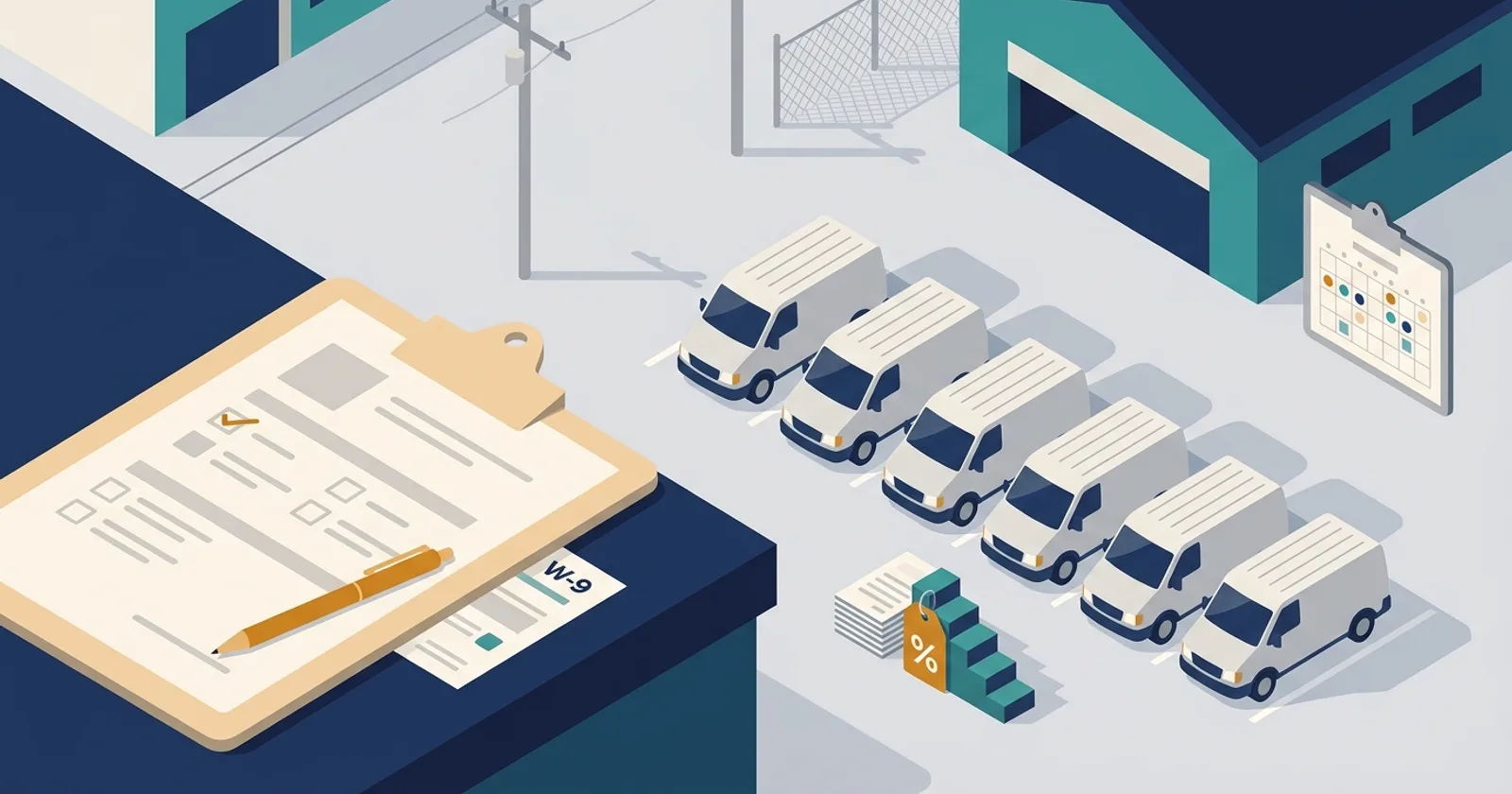
Vendor registration and a W-9. Toledo, Ohio, says it has many purchases under $10,000. Even for those, vendors must be registered with the city and have a W-9 on file. Toledo also says it pays vendors by check, so plan for the wait. Our dealer guide covers what the IRS says about W-9s and 1099s.
A certificate of insurance. The SBA lists general liability insurance as coverage for any business. Ask your agent for a certificate. If the city wants to be an “additional insured,” know that the certificate alone doesn’t do that. Connecticut’s insurance regulator says it takes an endorsement or being named in the policy, and it may cost more.
Bid rules. In Ohio, a city’s director of public service may sign a contract up to the amount in Revised Code section 9.17. The Ohio Department of Commerce set that at $79,568 for 2026. Above it, council must authorize the spending by ordinance, and the city advertises for bids for two to four weeks. The statute also forbids splitting a purchase into parts to avoid those steps. Simple math: 390 van-washes would have to average more than $204 each to pass $79,568. A biweekly van contract may well stay under it. Your city’s own rules can add steps, so ask the purchasing office.
Our retail pricing guide covers building a cost floor before you quote anyone.
How we check every number: methodology.
Sources
Checked 2026-10-09. The community thread is paraphrased only and isn’t linked here because of brand-safety rules for comment content.
- Connecticut Department of Administrative Services, Fleet Operations Car Wash Program list: portal.ct.gov/-/media/DAS/Fleet-Operations/CT-DAS-Car-Wash-List.pdf
- University of Alabama Fleet Services, Auto Washing and Detailing: fleet.ua.edu/auto-detailing
- Ohio Revised Code section 735.05, Director of public service may make contracts: codes.ohio.gov/ohio-revised-code/section-735.05
- Ohio Revised Code section 9.17, Amount for purposes of competitive bidding: codes.ohio.gov/ohio-revised-code/section-9.17
- Ohio Department of Commerce, Competitive Bidding Threshold: com.ohio.gov/divisions-and-programs/industrial-compliance/competitive-bidding-threshold
- City of Toledo, How to do business with the city: toledo.oh.gov/business/how-to-do-business-with-the-city
- U.S. Small Business Administration, Get business insurance: sba.gov/business-guide/launch-your-business/get-business-insurance
- Connecticut Insurance Department, Bulletin S-14 (certificates of insurance): portal.ct.gov/cid/department-resources/bulletins/sales-bulletins/bulletin-s-14