In one detailing community discussion this October, operators were split. Some said public prices filter out tire-kickers and save hours of messages. Others said a call lets them explain the value of correction or coating before the number lands. Several commenters said that when prices are hidden, they assume the job is out of budget and move on.
Four ways detailers present prices
Prices are from each detailer’s own page on October 9, 2026.
| Approach | Real example | What it filters | What it costs you |
|---|---|---|---|
| Fixed price by vehicle class | Twins Detailing (Orlando): standard detail $135 sedan, $150 SUV, $170 truck; add-ons “always quoted before work begins” | Price shoppers, before they message | You need a written rule for the dirty car |
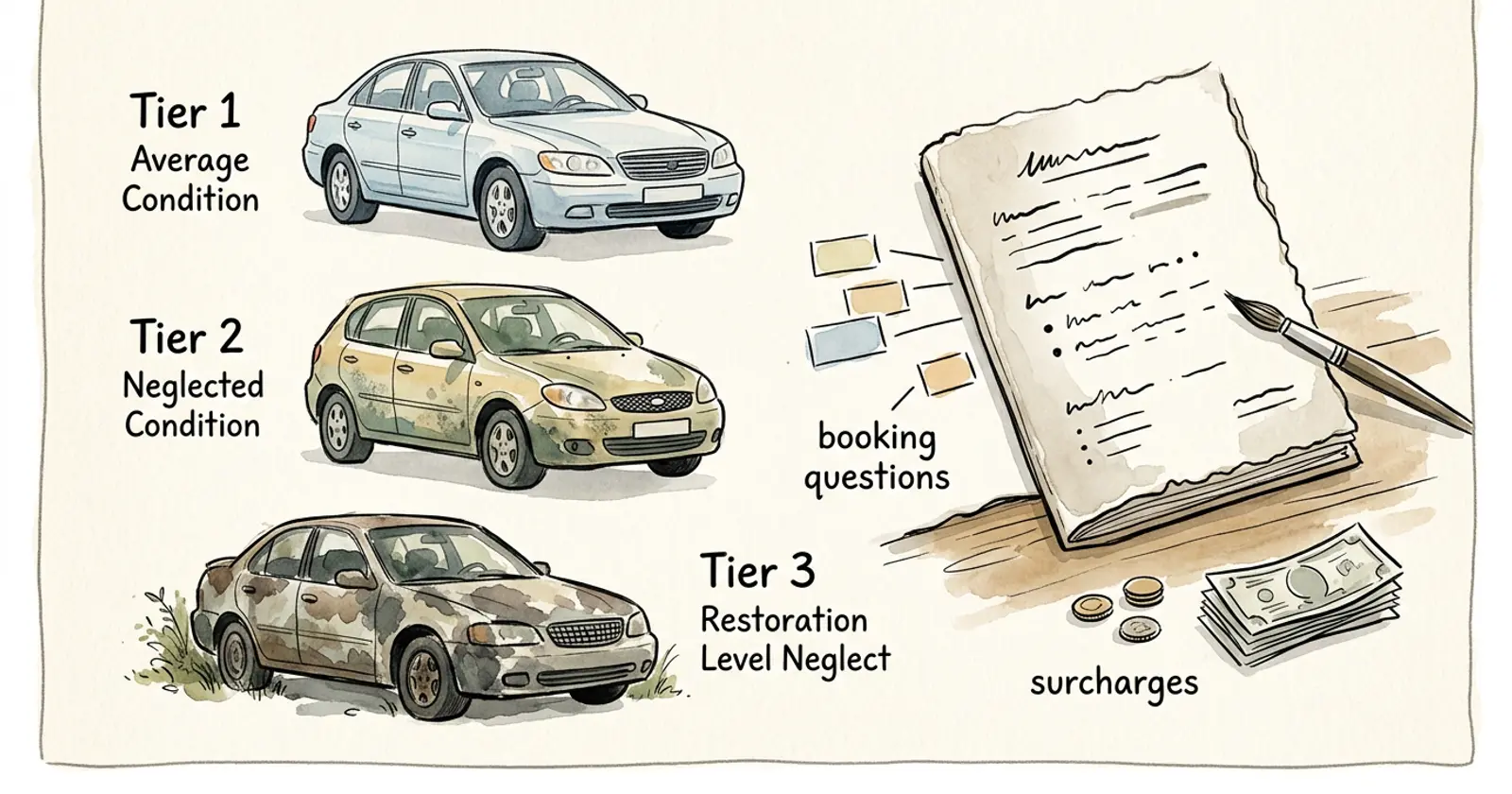
| “Starting at” with a defined baseline | Better Auto Detailing (Atlanta): interior for an “average condition” car from $199.99; pet hair or kid mess +$60; extra time $25 per 15 minutes | Price shoppers, plus surprise at the end | More text on the page |
| Price range | Car Detailing HTX (Houston): full interior $139 to $169; Go Gleam (Dallas): interior starting at $200 to $250, “depends on vehicle size and condition” | Most price shoppers | Customers anchor on the low end |
| Hourly rate plus free estimate | A-1 Mobile Auto Detailing (Washington): $50 an hour for interiors, $55 for exteriors; a sedan interior averages 4 hours, about $200 | Some price shoppers, if they do the math | Customers can’t see a total without asking |
What posting prices does for you
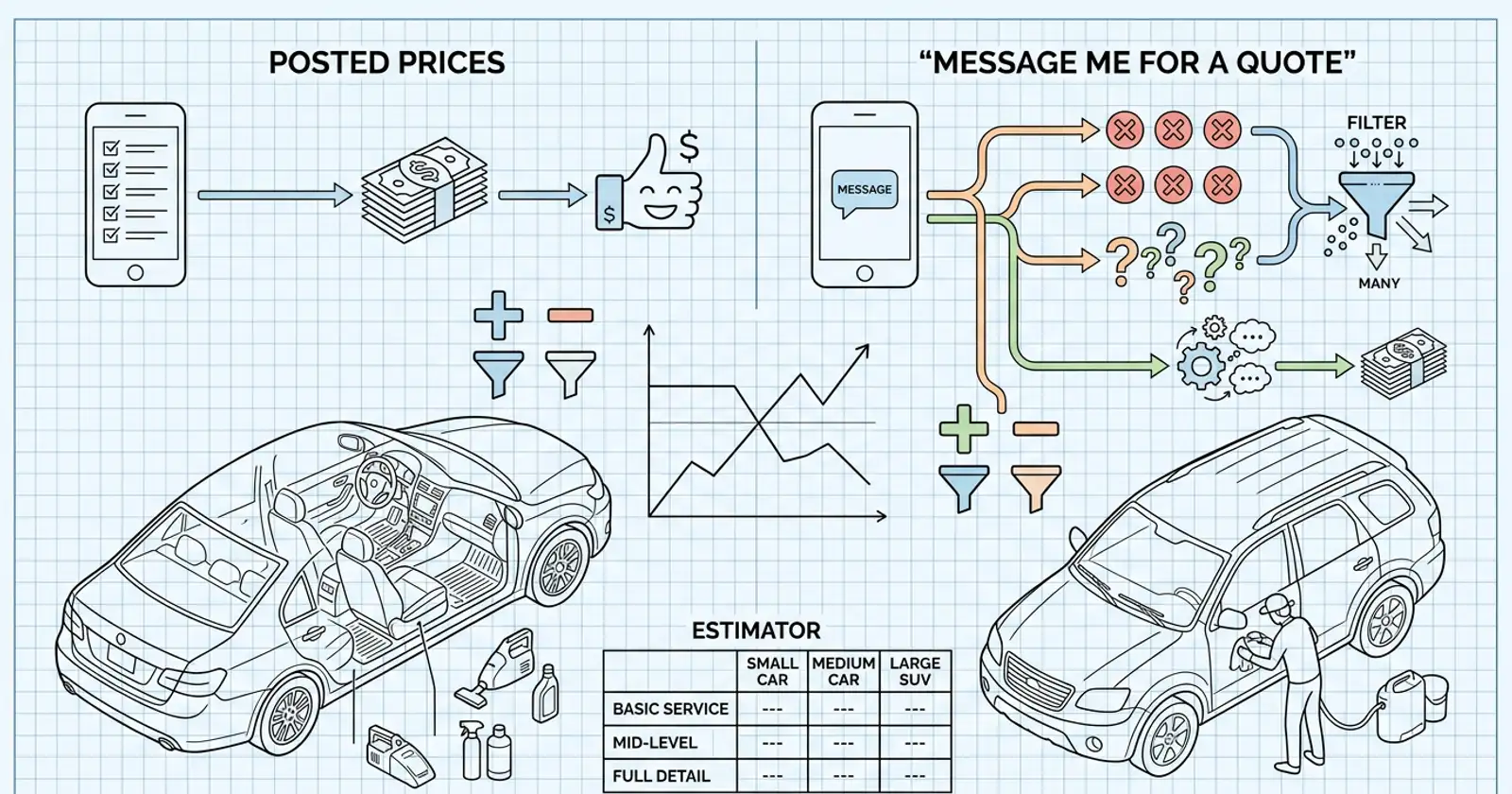
A posted price answers the first question every lead asks. Leads who can’t pay it leave without messaging you. The ones who book have already agreed to the number.
A quote-only page skips that filter. Every lead becomes a conversation, including the ones who’d have left after seeing a number. That’s the real cost of “message me for a quote”: your time, spent on replies that don’t book.
That only holds if the posted price is real. The FTC’s Guides Against Bait Advertising call bait “an alluring but insincere offer.” They say no ad should run unless it’s a bona fide effort to sell what’s advertised. So your starting price should be one you actually sell, on a car you’d actually call average. If almost no car qualifies, the number will cost you trust at the driveway. This isn’t legal advice, just a reason to keep the floor honest.
How to word “starting at”
The Atlanta page is a good model. It does three things:
- Defines the baseline. The interior price is labeled for an “average condition” car. A pricing notice says rates assume average condition.
- Names what raises it, with numbers. Pet hair or kid mess is plus $60. Extra time is billed at $25 per 15 minutes, which works out to $100 an hour. It says added charges apply only if needed and will be clearly communicated.
- Gives a way to quote the odd job. For mold, it asks the customer to text photos after booking so it can quote accurately.
The Orlando page adds a promise worth copying: add-ons are always quoted before work begins. That’s the line that keeps a starting price from feeling invented. Our guide to pet hair surcharges shows how detailers price the most common step-up.
Starting price vs confirmed quote
A starting price is the menu number before anyone sees the car. A confirmed quote is the number both sides agree on after the car is checked.
A Columbus, Ohio mobile menu keeps that gap visible. Each full-detail tier lists its tasks and its time:
- Essential, $249.99, about 2.5 hours: foam hand wash, wheels, vacuum, and dash, console and door cleaning.
- Signature, $349.99, about 3.5 hours: adds carpet and seat shampoo, steam cleaning and spray wax.
- Restoration, $499.99, about 5 hours: adds clay bar, iron decontamination, stain removal and an ozone odor treatment.
A customer can match the car to a tier before booking. The page also charges a non-refundable platform fee at booking. Name any fee like that next to the price.
Then confirm in three steps:
- Post the starting price and the car it assumes.
- Check the car, on arrival or from photos, against your listed condition steps.
- State the final number before work starts. If nothing applies, the starting price is the quote.
The middle path: a simple estimator
You don’t need custom software. A three-line estimator on your page, or in your booking form, covers most jobs:
- Vehicle class: your base price for a sedan, SUV and truck.
- Condition step: one named surcharge for pet hair, kid mess or heavy soil.
- Add-ons: each with its own price.
Using the published numbers above, an SUV at $150 with a $60 condition step is $210. The customer can work that out before messaging you. If your booking software can show the total, even better. See our guide to booking software for a one-van detailer.
Which fits your business
- Mostly washes and standard details: post fixed or starting prices, with a condition rule in writing.
- Mostly correction and coatings: post a starting price or range, then quote from photos or an inspection.
- Raising prices soon: posted prices make the change visible. Our guide to raising prices covers how to tell regulars.
Before you post anything, set your floor. Our pricing guide covers labor, product and drive time, and flat rate vs size-and-condition tiers covers the shape of the menu itself. How we gather prices: methodology.
Sources
Based on 8 sources · How we price
- Twins Detailing, Mobile Detailing Orlando: twinsdetailingorlando.com/services/mobile-detailing-orlando
- Better Auto Detailing, Detailing Packages: betterautodetailing.com/detailing-packages
- Car Detailing HTX, Car Detailing Pricing: cardetailinghtx.com/car-detailing-pricing
- Go Gleam Mobile Detailing, Pricing: gogleamdetailing.com/pricing
- A-1 Mobile Auto Detailing, Pricing and Services: a1mobileautodetailing.com/PRICINGANDSERVICES
- Tuff Detail Service (Columbus, OH), booking menu: book.heygoldie.com/Tuff-Detail-Service
- FTC Guides Against Bait Advertising, 16 CFR 238.0 (via Cornell LII): law.cornell.edu/cfr/text/16/238.0
- FTC Guides Against Bait Advertising, 16 CFR 238.1 (via Cornell LII): law.cornell.edu/cfr/text/16/238.1