You’re not building a show car. You’re building something that has to start every morning from your driveway or apartment lot. This guide covers the vehicle choice only; for gear lists and startup prices, see how to start a mobile detailing business. It doesn’t promise any income. If fleet work is the goal, quoting a first fleet contract shows how vans fit into it.
Start with the number on your door
Water is the heaviest thing you’ll haul. A gallon weighs about 8.34 pounds, so:
- 15 gallons is about 125 pounds
- 45 gallons is about 375 pounds
- 80 gallons is about 667 pounds
- 100 gallons is about 834 pounds
That’s before the tank, pump, pressure washer, generator and you. Every car, pickup and van up to 10,000 pounds GVWR has a tire and loading placard on the driver’s door pillar. It tells you the most that occupants and cargo combined should weigh. Federal labeling rules for motor homes spell out two things worth copying: a full load of water counts as cargo, and so does a towed trailer’s tongue weight.
So do the math before you buy a tank, not after.
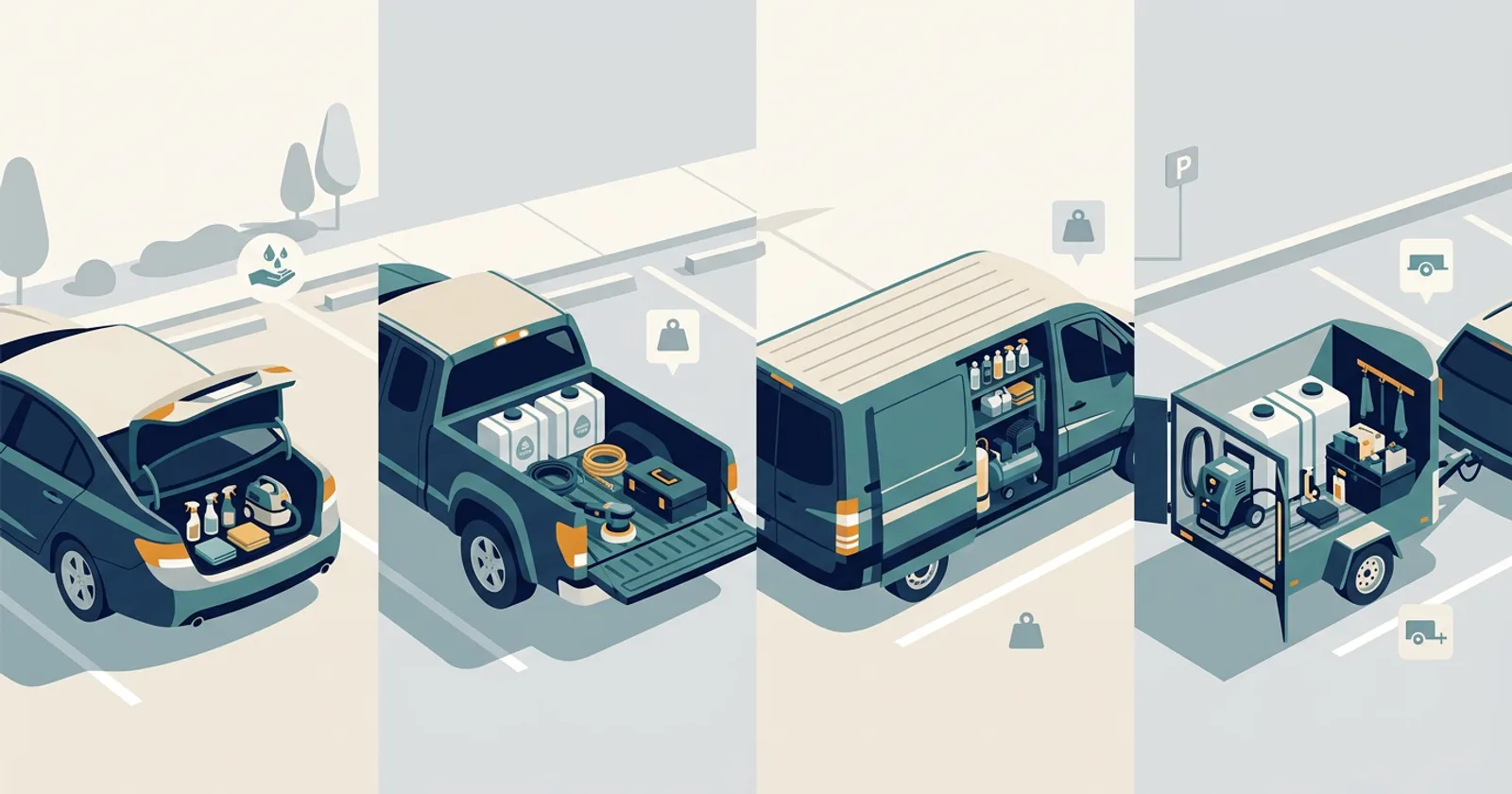
The four setups at a glance
| Setup | Example water load | Security | Parking at home | Main limit |
|---|---|---|---|---|
| Trunk or hatch | 15 gal (about 125 lb) | Good if gear fits out of sight | Same as your daily car | Space and payload |
| Pickup | 45 gal (about 375 lb) | Weak without a cap or lockbox | May hit truck-size street rules | Gear exposed to weather and theft |
| Cargo van | 80 gal (about 667 lb) | Strong; everything locks inside | Check HOA rules on work vans | One breakdown parks the business |
| Enclosed trailer | 80 gal (about 667 lb) | Strong when locked | Often restricted on streets | Storage, towing skill, tongue weight |
Water weights use 8.34 pounds per gallon. Tank sizes are examples from operator setups and retail listings, not limits for any one vehicle.
Trunk rig
Everything rides in the trunk and back seat of the car you already own. One operator in a detailing forum fit a 15-gallon tank, a pump and a shop vac into the trunk of a small sports car. They said they use about 5 gallons per car on careful washes.
It works for maintenance washes and light interiors. You’ll pack like it’s Tetris, damp towels will make the car smell by midweek, and a lifted truck with a dirty bed will make you wish for more water. If you go tankless, rinseless washing stretches what a small rig can do.
Pickup
The bed becomes your bay. One operator running a 45-gallon tank on a truck setup said a wash takes them 12 to 16 gallons, so about three jobs per fill.
The catch is exposure. An open bed means gear gets rained on and is easy to grab, so most people add a cap or lockable boxes. Climbing in and out of the bed all day is hard on knees, too.
Cargo van
This is the lock-it-and-forget-it option. The tank sits against the bulkhead, reels mount to the walls, and nothing needs tarping when it rains mid-job. One 80-gallon detailing tank listed at $550 measures 44.5 by 22 by 20.5 inches, which gives you a sense of the floor space you’ll give up.
The downside: if the van breaks, the whole business is on a tow truck. Have a backup plan, even if it’s a trunk kit in the garage. Thinking of adding boats to the route? Read about per-foot boat detailing first.
Enclosed trailer
You keep your daily driver and tow a rolling shop. Water and gear capacity can match a van. When you’re off the clock, you unhitch.
Two things trip people up. First, the trailer’s tongue weight comes out of your tow vehicle’s payload. Second, parking. Phoenix, for example, bars trailers on residential streets, along with trucks over a three-quarter-ton rated chassis, except while loading or unloading. Check your HOA covenants too. If you rent an apartment, budget for paid storage.
How to pick by the jobs you do
- Maintenance washes and quick interiors on cars and small SUVs: trunk rig.
- Large SUVs, trucks, families with dog hair: pickup or van. You need a real vacuum and more water.
- Fleet accounts, steam and full interiors: van or trailer. Running out of something mid-job costs more than the space.
- You have a solid SUV or truck and nowhere to park a second vehicle: trailer, if you can store it legally.
Before you carry your own water, check how your city handles wash water and storm drains. Long country drives also change the rig math, as the guide to rural travel fees shows. If your work leans toward coatings and correction, read mobile or shop first.
The upgrade path
- Start with what you own. Learn which products you use on every job.
- Move up when you keep turning down work because you can’t carry enough water or the right tool. A partly built rig from a detailer leaving the trade can save build time.
- Buy a trailer only once you have a legal, safe place to park it.
- Keep the old kit for a while after you move up. New rigs need fixes at the worst time.
Every rig is a compromise between money, space and the jobs you hate to turn away. See our methodology for how we check sources.
Sources
- USGS, Estimated Use of Water in the United States in 2000, conversion factors: pubs.usgs.gov/circ/2004/circ1268/htdocs/text-conversion.html
- eCFR, 49 CFR 571.110, Tire selection and rims and motor home/recreation vehicle trailer load carrying capacity information: ecfr.gov/current/title-49/subtitle-B/chapter-V/part-571/subpart-B/section-571.110
- City of Phoenix City Code Sec. 36-140, Parking trucks and trailers on residential streets: phoenix.municipal.codes/CC/36-140 (archived copy: web.archive.org/web/20240917005515/https://phoenix.municipal.codes/CC/36-140)
- Car Supplies Warehouse, RALDA’S 80-Gallon Mobile Detailing Water Tank: carsupplieswarehouse.com/products/raldas-water-tank-80-gallon
- Community discussion, r/AutoDetailing, “350z mobile detail setup”: reddit.com/r/AutoDetailing/comments/1sh4nfe
- Community discussion, r/AutoDetailing, “My Mobile Detail Setup”: reddit.com/r/AutoDetailing/comments/1iq98gj