Where the worry comes from
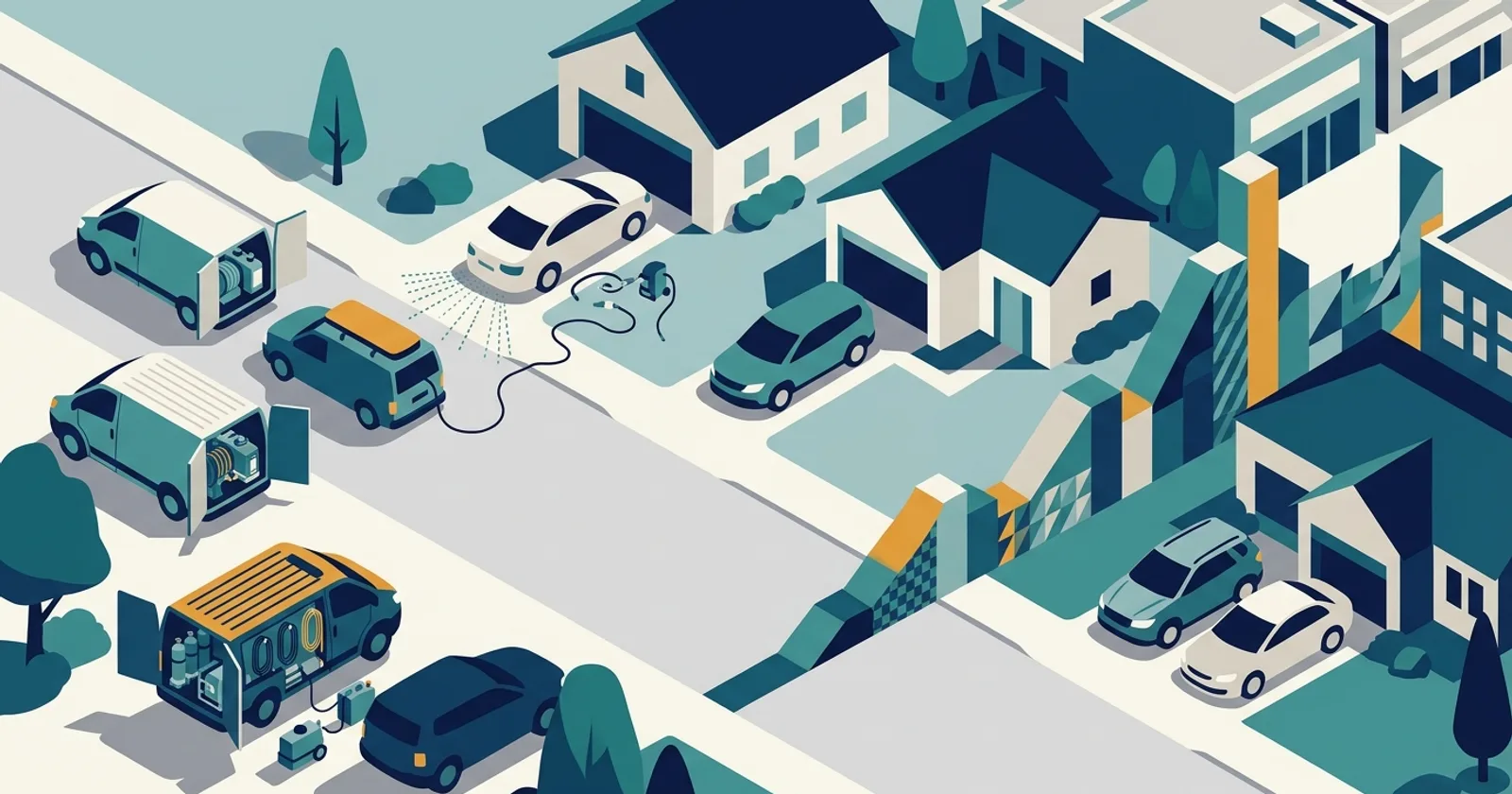
A common worry is that newcomers with a pressure washer and a social media page will undercut everyone. The worry is understandable, since our breakdown of startup costs shows how little gear it takes to begin. But “it feels crowded” and “the data says it’s crowded” are different claims.
What each count actually measures
County Business Patterns (CBP) counts establishments, meaning single business locations, that have paid employees. Employment is measured in the week of March 12. Detailing falls under industry code 811192, “Car Washes”, whose official examples include automotive detail shops, mobile car and truck washes, and self-service car washes. One number covers a tunnel wash with a big crew and a two-person detail shop. A solo detailer with no payroll isn’t in it.
Nonemployer Statistics (NES) counts businesses with no paid employees that are subject to federal income tax and have at least $1,000 in receipts. Most are sole proprietorships, and the Census Bureau notes the business may or may not be the owner’s main income. That is where most solo mobile detailers would land. The catch is that NES doesn’t publish car washes on their own. Its finest cut is code 81119, “Other Automotive Repair and Maintenance”, which also includes oil change shops and businesses like rustproofing and tire repair. Read it as a broader bucket, not a headcount of detailers.
Business Formation Statistics (BFS) counts applications for an Employer Identification Number (EIN), the federal tax ID. Nationally it splits them only by broad sector, and detailing sits in “Other services” (NAICS sector 81) with every other repair and personal-service business. An application is paperwork, not an open business.
The numbers since 2019
| Count (what it measures) | Area | 2019 | Latest | Change | All industries, same count |
|---|---|---|---|---|---|
| CBP 811192: locations with employees | U.S. | 16,976 | 19,807 (2023) | +17% | +5% |
| NES 81119: businesses with no employees | U.S. | 77,177 | 105,290 (2024) | +36% | +18% |
| CBP 811192: locations with employees | Raleigh-Cary metro | 80 | 90 (2023) | +12.5% | +12.5% |
| NES 81119: businesses with no employees | Raleigh-Cary metro | 333 | 402 (2024) | +21% | +25% |
Three things stand out.
The national growth is real. Payroll locations grew about three times as fast as all business locations, and the no-employee automotive bucket about twice as fast as all nonemployers.
Most of it is small. In 2023, 10,352 of the 19,807 payroll locations, about 52%, had fewer than five employees. In 2024, 94,251 of the 105,290 no-employee businesses in the broader bucket, about 90%, were sole proprietorships.
Local markets can look different. In the Raleigh-Cary metro (Wake, Johnston and Franklin counties), payroll car wash and detailing locations grew at the same pace as all local business locations. The no-employee automotive bucket grew more slowly than the area’s nonemployers overall. That looks like a market keeping pace with a growing region, not one being swamped.
The application data tells a similar story. Nationally, EIN applications in “Other services” rose from 327,295 in 2019 to 483,258 in 2025, up 48%. Applications across all industries rose 62% over the same years, so this sector trailed the wider startup boom. And only a small share of applications turn into businesses with employees, as our look at Florida’s business data shows.
What the counts can’t tell you
- Who’s missing. Side gigs under $1,000 a year are left out of NES, and so is anyone who never reports the income.
- Demand. The counts measure businesses, not how many cars need work or how often owners pay for it.
- The last two years. The newest CBP year is 2023 and the newest NES year is 2024, so the most recent wave of social-media startups isn’t in them yet.
Where competition actually bites: price
What matters more than a metro’s business count is how many operators chase the same job at the same price. The Census counts can’t show which services are crowded, so treat this as a hunch to test locally: basic washes need the least gear and skill, so they may be where price pressure shows first, while paint correction, coatings and fleet accounts may be less crowded.
If you’re weighing the market, a few practical steps:
- Survey local prices before you decide the market is full. Collect published menus from nearby operators, then build yours from a cost floor, as in our guide on how much to charge.
- Don’t race the cheapest ad. Our piece on raising prices without losing regulars covers holding your rate.
- Look for less crowded work. Dealer accounts and rural routes may face less direct competition than suburban driveway washes, though the counts above can’t confirm it.
- Pull your own county. The CBP and NES files above are free downloads by county and metro. Compare your area’s change with its all-industry total, as in the table.
None of this predicts what you’d earn. Income depends on your prices, costs, skill and local demand.
How we got these numbers
Every count comes from Census Bureau files downloaded October 9, 2026. Percentages and totals summed from state or monthly figures are our own math. See our methodology.
Sources
- U.S. Census Bureau, County Business Patterns, 2019 and 2023 U.S. and metro files: www2.census.gov/programs-surveys/cbp/datasets/2023/cbp23us.zip, www2.census.gov/programs-surveys/cbp/datasets/2019/cbp19us.zip, www2.census.gov/programs-surveys/cbp/datasets/2023/cbp23msa.zip and www2.census.gov/programs-surveys/cbp/datasets/2019/cbp19msa.zip
- U.S. Census Bureau, About County Business Patterns: census.gov/programs-surveys/cbp/about.html
- U.S. Census Bureau, CBP metro area county reference (2017 and 2022 delineations): www2.census.gov/programs-surveys/cbp/technical-documentation/reference/metro-area-geography-reference/msa_county_reference17.txt and www2.census.gov/programs-surveys/cbp/technical-documentation/reference/metro-area-geography-reference/msa_county_reference22.txt
- U.S. Census Bureau, Nonemployer Statistics, 2024 U.S. and metro files and 2019 state and metro files: www2.census.gov/programs-surveys/nonemployer-statistics/datasets/2024/historical-datasets/nonemp24us.zip, www2.census.gov/programs-surveys/nonemployer-statistics/datasets/2024/historical-datasets/nonemp24msa.zip, www2.census.gov/programs-surveys/nonemployer-statistics/datasets/2019/historical-datasets/nonemp19st.zip and www2.census.gov/programs-surveys/nonemployer-statistics/datasets/2019/historical-datasets/nonemp19msa.zip
- U.S. Census Bureau, About Nonemployer Statistics: census.gov/programs-surveys/nonemployer-statistics/about.html
- U.S. Census Bureau, Business Formation Statistics, monthly data: census.gov/econ/bfs/csv/bfs_monthly.csv
- U.S. Census Bureau, Business Formation Statistics definitions: census.gov/econ/bfs/definitions.html
- U.S. Census Bureau, 2022 NAICS descriptions: census.gov/naics/2022NAICS/2022_NAICS_Descriptions.xlsx