Two operator threads this year asked the same thing from different ends. A newer detailer wanted to know whether pros use condition tiers and written disclaimers at all, since the detailers who had worked on their own car never mentioned stains that might not lift. A busier one described “standard interior” bookings that turned out to be sand in every crevice and years-old coffee, and asked how to get honest condition answers without being the bad guy asking for more money on arrival. The replies and the published menus below point the same way.
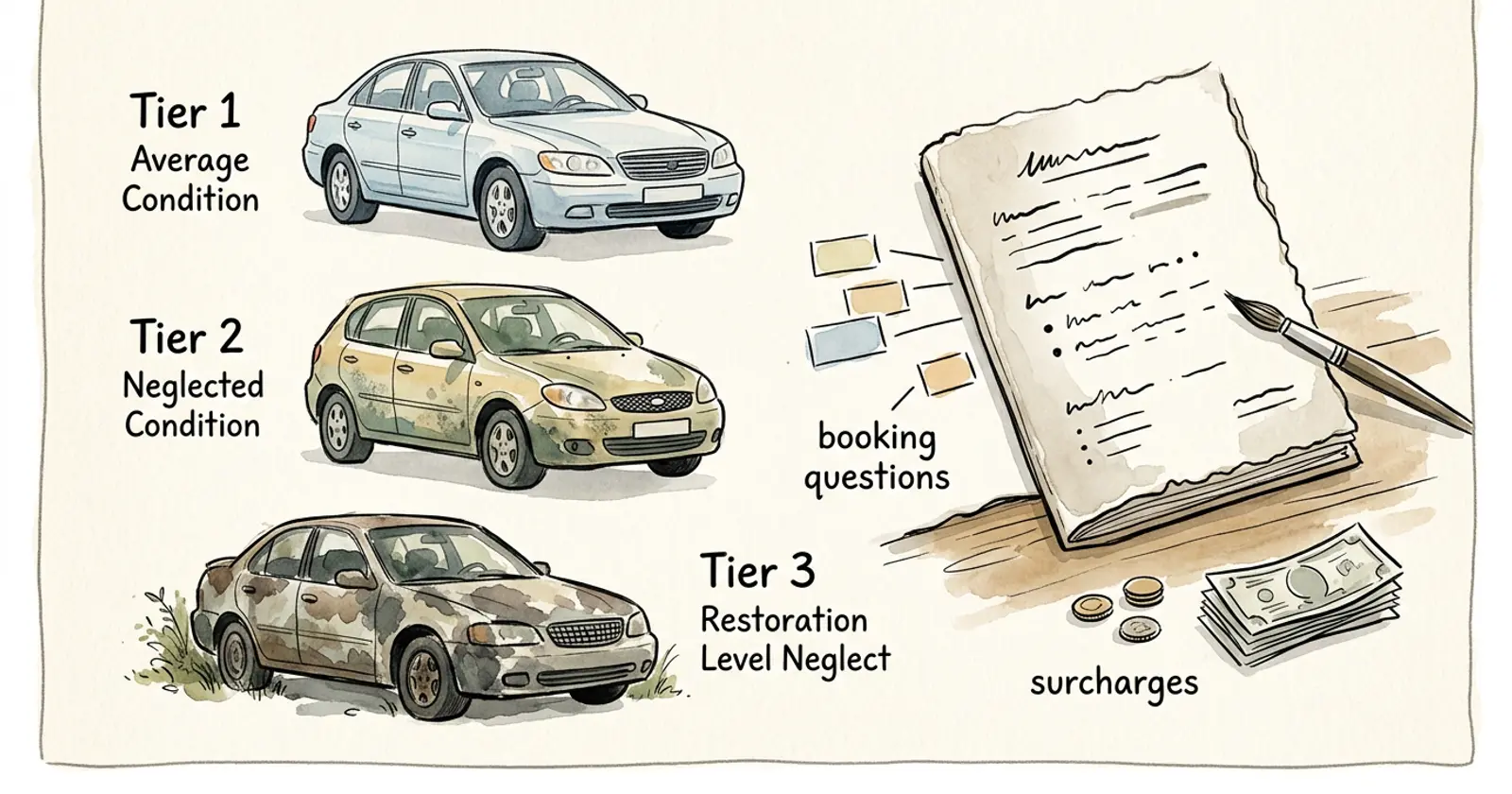
A three-step scale that customers can self-grade
| Step | What it looks like | What it adds | Published example |
|---|---|---|---|
| Standard | Light dust, crumbs, routine use; belongings removed | Base price | Base packages described as for “lightly soiled vehicles only” (D&C Labs Mobile Detailing) |
| Heavy | Visible stains, pet hair, sand, trash to remove | A fixed add-on | “Fairly Dirty $30, Very Dirty $60” add-on for excessive dirt, pet hair, debris or sap (World Class Auto Detail) |
| Neglected | Everything above plus odor, mold risk, biohazard, years of buildup | Hourly, or the full package minimum | “$90 per hour in extreme cases” (World Class Auto Detail); heavy cars “will require at least a full detail package” (D&C Labs) |
Prices are from the operators’ own booking pages, checked October 2026; locations aren’t listed on those two pages. How we research: methodology.
The point of a scale isn’t the exact dollar steps. It’s that the customer picks a step before you arrive, which turns “it’s not that bad” into a choice they made. One reply in the busier thread described a detailer whose booking page has a photo-illustrated condition list, A through D, with a line that misrepresenting the vehicle moves the price. Another reply suggested putting sample photos of what counts as “really bad” on the website so the grade is self-evident.
Our pet hair surcharge guide covers how detailers price the most common single trigger; the first-reply template covers which five photos set the grade.
The booking questions that set the step
One mobile detailer’s intake form shows the pattern in full. After the package grid (sedan, SUV, large SUV or truck), it states that prices may vary with vehicle size, condition and level of contamination, then asks: general condition (light dirt, moderate dirt, heavy dirt, very dirty); excessive pet hair, yes or no; seat, carpet or floor-mat stains, yes or no; strong odors (smoke, pet, food, mold); damaged, loose, broken or sensitive areas. It ends with customer-preparation lines (belongings removed; the business isn’t responsible for items left inside) and a signature.
That form does three jobs: it sets the tier, documents what the customer said, and collects the disclaimer acknowledgment. Replies added the photo step: ask for pictures of the front seats, back seats, floors, trunk and worst area, quote a range, and have the line ready that heavy pet hair, stains or trash moves it out of standard interior.
The disclaimer, in plain words
Published detailer policies already contain every clause you need. Borrow the structure, not the text, and have a lawyer read yours.
- What can’t be restored. One policy lists it outright: permanent stains, dye transfer, paint overspray, etched water spots, deep scratches, rock chips, paint oxidation, faded plastics, torn upholstery, burns, permanent odors, mold damage, rust, other pre-existing damage; detailing improves appearance but can’t return damaged materials to factory condition.
- What the customer must tell you. The same policy makes customers responsible for informing the detailer of known issues before work begins. Another operator’s terms require disclosure of pre-existing damage and say the business isn’t responsible for existing scratches, dings or mechanical issues.
- What the price assumes. A Jacksonville operator writes that starting prices are listed and the final price may vary with vehicle size and condition. A Maine detailer names the triggers: pet hair, excessive dirt, sand or trash, deep staining, oily leather, biohazards, excessive salt or mud will require additional charges, discussed in person.
- How changes get agreed. If additional work is required beyond the selected package, it’s discussed first; no additional charges without the customer’s approval.
Add belongings and trash: one St. Louis detailer charges $25 if personal items aren’t removed before arrival, and the intake form above says areas with belongings may be skipped or cleaned around. Write what you’ll throw away and what you won’t touch.
Raising the price on site
Replies in the newer detailer’s thread offered two models: charge hourly for disaster-level cars and anything hard to estimate, or set the flat rate high and refund part as goodwill if the car turns out easier. Both beat the third option the busier thread described: doing the extra work and hoping for a tip.
Whichever you pick, the on-site script is the same. Show the gap against what was booked or pictured, name the step it moves to and its price, and get a yes before continuing. Consumer rules expect that in spirit: Washington’s attorney general tells car owners that when they deal face-to-face they’re entitled to a written estimate for repairs expected to top $100, and that a shop can’t exceed it by more than 10% without approval. Detailing isn’t auto repair, but customers expect the same courtesy. Document the agreement in a text; it’s the paperwork that wins a chargeback and the habit that keeps a fleet account honest.
Biohazard and mold are a separate decision; several published policies list them as surcharge triggers, and some detailers decline them outright. For what a neglected car priced as standard does to your margin, see our hourly-rate check.
Sources
Based on 8 sources · How we price
- World Class Auto Detail, booking menu (PocketSuite): pocketsuite.io/book/world-class-auto-detail/items/coupe-compact-cars
- D&C Labs Mobile Detailing, services and pricing: dncdetail.carrd.co
- Capo Auto Lab, customer intake form (Jotform): form.jotform.com/261744109386058
- Bellweather Mobile Auto Care, Policies: bellweatherdetailing.odoo.com/policies
- Next Level Detail Pros (Jacksonville, FL), booking page and policies: book.heygoldie.com/NextLevelDetailPros
- Driveway Dazzle Auto Detailing (Maine), booking page: cal.com/rowan-barger-d04hj0
- The Final Piece (St. Louis, MO), booking page and policies: book.heygoldie.com/The-Final-Piece
- Washington State Office of the Attorney General, Auto Repair: atg.wa.gov/auto-repair