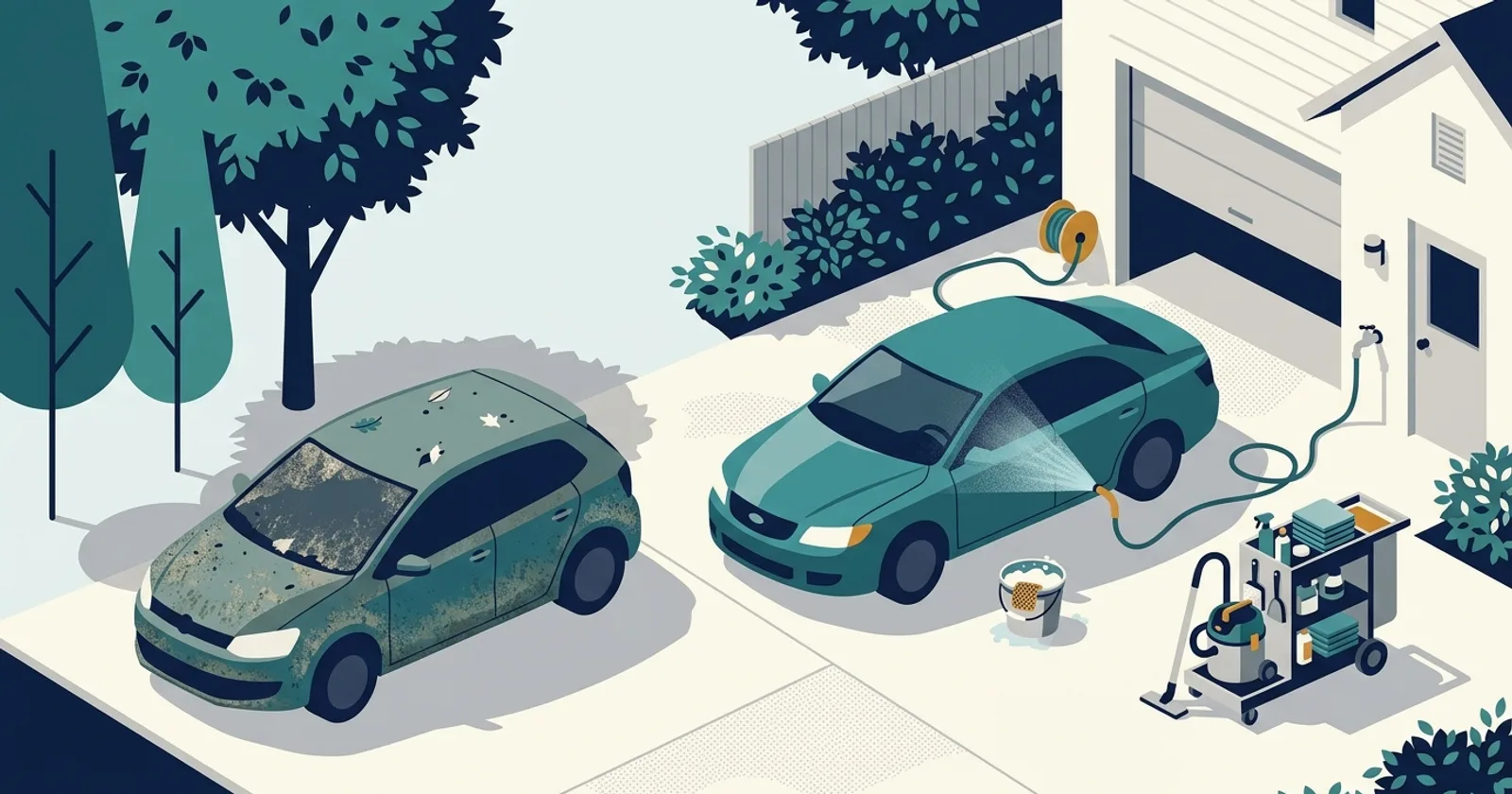
On a detailing forum, one owner whose car sat outside for six months said a first pass took off about 90% of the pollen. The hood and roof were still crusted. The replies agreed on one thing: start with the least aggressive step and move up only if you must.
Why the crust is harder than normal dirt
A car parked outside collects layers. Pollen and dust land, rain or dew wets them, and the sun bakes them on. Repeat that for a season and the film bonds to the paint.
The bigger worry is what’s mixed in. One carmaker’s owner’s manual says bird droppings contain acids that can eat away the clear and color base coat if not removed. It says hardened tree sap sticks to the finish, and if you scratch it off while hard, paint can come off with it. Another carmaker’s manual warns that bird droppings can damage paint in just a few hours.
After months, some damage may already be done. The first wash should get the loose layer off without adding scratches.
The first wash, in order
- Park in the shade on a cool panel. One foam pre-wash label says not to use it in direct sunlight and not to let it dry.
- Rinse the whole car with plenty of water. One carmaker’s manual lists washing without first rinsing off dirt as a cause of scratches. If you use a pressure washer, the same manual says to keep the nozzle at least 12 inches from the paint and not to linger on one spot.
- Pre-soak with foam or a pump sprayer. That foam label says to wait about 4 to 5 minutes, then rinse. An Australian brand gives the same 4 to 5 minutes for its foam. Work low to high, rinse high to low. On a crusted hood, you can soak and rinse twice.
- Hand wash gently with lots of water. Use car shampoo and a soft mitt, and rinse the mitt often. The manual says to use lukewarm or cold water, rub gently, and never let soap dry on the finish.
- Dry with a clean towel, then look. Check every panel in daylight. Anything still there goes to the table below.
If your area has hard water, drying right away matters. Our guide to water spots on a coated car explains why spots form and how to tell them from etching.
What’s left after the wash, and what to do next
| Still on the paint | Next gentle step | Stop and call a pro if |
|---|---|---|
| Thin pollen haze | Second foam soak and wash | It won’t come off after two washes |
| Hard tree sap | Damp cover 1 to 2 hours, then rinse | Sap leaves a raised or dull spot |
| Bird dropping marks | Soft sponge and water, then wax | An outline stays after drying |
| Tar specks | Tar remover per label, then rewax | Specks smear or won’t lift |
| Rough feel all over | Clay with plenty of lube | You don’t plan to polish after |
The damp cover idea comes from the carmaker’s manual. It says to lay dampened newspaper over sap or bugs for one to two hours, then rinse the loosened debris away. A wet microfiber towel does the same job.
Clay deserves a warning. A detailing retailer’s guide says clay will almost always leave at least some marring of its own unless the paint is fairly hard and well lubricated. Clay is a step you take when you plan to polish next, not a quick fix.
When the first wash is done, and when it isn’t
A spot that stays after a careful wash and dry is no longer dirt. It’s usually etching in the clear coat. Washing harder won’t fix it.
That’s the point to stop. Removing etching means polishing, and polishing removes a thin layer of clear coat. A good detailer measures paint depth first. Our guide to paint-depth readings before polishing explains what those numbers mean. When you book, ask in writing whether the quote covers decontamination and a polish, or only a wash. See how to find a reliable mobile detailer for what to check.
Finish with protection. Any tar or spot remover, and many strong soaps, take wax off with the grime. The carmaker’s manual says to rewax those areas even if the rest of the car doesn’t need it.
The spring version of this problem
In cold climates, the car that sat all season often sat through winter too. Milwaukee averages 48.7 inches of snow a year, and its median last spring freeze is around April 19, according to NOAA’s 1991 to 2020 normals. That leaves cars that live outside wearing salt, grime and winter film for months before the first warm wash day.
If you can’t wait for spring, our guide to washing in winter with the spigot off covers the indoor and self-serve options. Once spring arrives, use the same gentle order above, and start with the underside. The manual says to pay special attention to salt and mud under the fenders and to keep the drain holes along the doors and rockers clear.
If a detailer’s work on a neglected car disappoints, see how to judge a detail and get it fixed. For how we check our sources, see our methodology.
Sources
- Mazda, 2025 CX-5 owner’s manual, Exterior Care: mazdausa.com/static/manuals/2025/cx-5/contents/07040100.html
- Mazda, 2025 CX-5 owner’s manual, Maintaining the Finish (Washing): mazdausa.com/static/manuals/2025/cx-5/contents/07040101.html
- Kia owner’s manual, Exterior care: ownersmanual.kia.com/full_webhelp/AB/2023/en_GB/topics/chapter8_19_4.html
- Gyeon Q2M Foam product page, Car Supplies Warehouse: carsupplieswarehouse.com/products/gyeon-q2m-foam-2021-formula
- Bowden’s Own, Pre wash with Summer Snow: bowdensown.com.au/guides/how-to-use-our-car-care-products/exterior-how-to-guides/how-to-use-your-2024-chill-out-pack/pre-wash-with-summer-snow
- Detailed Image, What Causes Swirl Marks?: detailedimage.com/Ask-a-Pro/what-causes-swirl-marks
- NOAA NCEI, 1991–2020 annual/seasonal normals, Milwaukee Mitchell Airport (CSV): ncei.noaa.gov/data/normals-annualseasonal/1991-2020/access/USW00014839.csv
- Community discussion (detailing forum): reddit.com/r/AutoDetailing/comments/1ulquu4